
RADICAL BLACK ACTIVISTS AND JOHN BROWN
HENRY HIGHLAND GARNET (1815-1882)
Black Convention Activist, Abolitionist, Minister
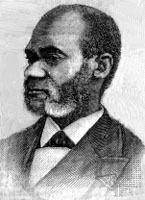
Henry Highland Garnet Engraving
Engraving of Henry Highland Garnet after a photograph by J.U. Stead. Image courtesy of Culver Pictures.
Henry Highland Garnet was born in New Market, Kent County, Maryland. He and his family were enslaved by the enslaver and plantation owner Colonel Spencer [1].
When Garnet was nine, he and his family (11 members, including his mother, father, and sister), escaped slavery and fled to Bucks County, Pennsylvania [2].
Garnet studied at Noyes Academy in Canaan, New Hampshire in 1835 [3].
Garnet then continued his studies at Oneida Theological Institute and graduated in 1840. Despite Garnet’s earlier experiences with white supremacist violence and the belief that violence must be met with physical resistance, throughout the early 1840s (1841-1842), Garnet “had not yet taken a firm position on the question of slave revolts” [4], [5].
However, by 1843, Garnet became increasingly radical: he “slowly came to believe that not only did slaves have the right to rebel, but that abolitionists had the right to support them” [6].
In the collectively authored “An Address To The Slaves Of The United States,” delivered by Garnet at the 1843 National Convention in Buffalo, NY, asserted that enslaved peoples had a “religious duty” to resist slavery [7], [8].
The oration ended with direct calls for resistance and reminders that “no oppressed people have ever secured their liberty without resistance,” and to “remember that you are THREE MILLIONS” [9].
Garnet’s calls for resistance were met with a mix of approval and fear, and delegates at the 1843 Convention failed to pass Garnet’s appeal by one vote [10].
However, by 1848, when the “Address” was published in a pamphlet along with Walker’s “Appeal,” the majority of abolitionists embraced Garnet’s position [11].
Garnet’s influence continued to spread, greatly shaping Black nationalist politics. Throughout the 1850s, tensions continued to mount, and it is during the Bleeding Kansas period (1854-1859) that Garnet most likely first heard of John Brown [12], [13].
Although Garnet began to focus more on advocating for Black emigration from the United States, he was well aware of the increasing violence and “the deepening sectional crisis” [14].
Brown was familiar with Garnet and had been since the 1843 “Address” [15].
Timeline
A brief timeline of events in the life of Henry Highland Garnet, focused on his interactions with and influence on John Brown and other Black Convention activists.
1815
Garnet was born in New Market, Kent County, Maryland. He and his family were enslaved by Colonel Spencer [16].
1824
Garnet, aged 9, and 11 members of his family, escaped slavery and fled to Bucks County, Pennsylvania [17].
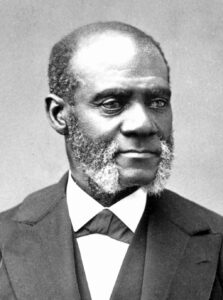
Henry Highland Garnet via Blackpast.org.
1835
Garnet studied at Noyes Academy in Canaan, New Hampshire. The school is attacked by a white mob; “they dragged the school down with oxen and terrorized the students” [18].
Black students were then forced to leave New Hampshire. This experience greatly shaped Garnet: “he realized that in any struggle it is necessary to be able to back up agitation with physical threats” [19].
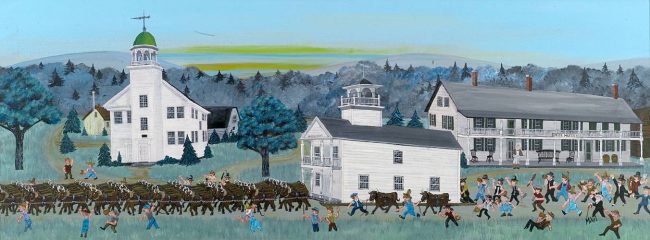
Image: Painting by Mikel Wells portraying a white mob removing the school by its foundations. Courtesy of Canaan Historical Society.
1840
Garnet graduates from Oneida Theological Institute [20].
Image: Special Collections and Archives, Knox College Library, Galesburg, Illinois.
1843
Garnet delivered “An Address To The Slaves Of The United States at the 1843 National Colored Convention in Buffalo, New York [21].
In this collectively authored speech, Garnet asserted that enslaved peoples had a “religious duty” to resist slavery [22].
The oration ended with direct calls for resistance and reminders that “no oppressed people have ever secured their liberty without resistance,” and to “remember that you are THREE MILLIONS [later changed to four millions when published in the 1860s]” [23].
Garnet’s calls for resistance were met with a mix of approval and fear, and delegates at the 1843 Convention failed to pass Garnet’s appeal by 1 vote [24].
1848
The “Address” is published in pamphlet form alongside Walker’s “Appeal…”
1854-1859
Garnet likely first heard about Brown during the Bleeding Kansas period. In the newspapers, Garnet read of the bloodshed in Kansas: “his ears filled with stories about places like Pottawatomie Creek, where in the dead of night, a free soiler named John Brown and six companions had dragged five pro-slavery settlers from their cabins and murdered them” [25].
February 1858
Brown (pictured) wrote to Garnet, asking him “to organize societies for the recruitment of blacks to his group” [26]. Impressed with Brown’s plans, Garnet organized a meeting in Philadelphia the following month in order to “enlist the financial assistance of local Blacks” [27]. Brown had been aware of Garnet since the 1843 “Address” and greatly admired him [28].
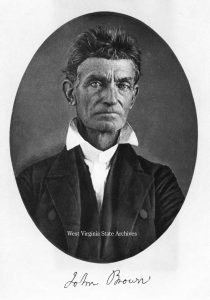
John Brown c. 1856. Image courtesy of West Virginia State Archives.
John Brown c. 1856. Image courtesy of West Virginia State Archives.
March 16, 1858
Brown met with Garnet, Douglass, and William Still in Black attorney Stephen Smith’s home, “to discuss a plan to incite a slave insurrection at Harpers Ferry, Virginia” [29][30].
1858
In a different meeting with Gerrit Smith, Brown asked Garnet for his opinion on the plan to raid Harpers Ferry, and Garnet replied that “the time has not yet come for the success of such a movement” [31].
May 1858
Garnet did not attend the Chatham Convention in May of 1858, and “became somewhat disillusioned with Brown when he was forced to cancel his plan of attack, which had been scheduled originally for the summer of 1858” [32].
December 2, 1859
Garnet continued to admire Brown and delivered a eulogy for him in Shiloh Presbyterian Church and “declared December 2nd [1859] to be Martyr’s Day” [33]. Even though Garnet did not participate in the Chatham Convention or the Harpers Ferry Raid, his influence on and support of Brown greatly impacted both men and their allies.
Credits
Created by Jessica Thelen, PhD student in English, for P. Gabrielle Foreman’s ENGL/HIST 677 class, Spring, 2019. Edited by P. Gabrielle Foreman.
References
[1] Ofari, Earl. “Let Your Motto Be Resistance”: The Life and Thought of Henry Highland Garnet. Beacon Press, 1972, p. 2.
[2] Ofari 2.
[3] Ofari 5.
[4] Ofari 7-8.
[5] Ofari 33-34.
[6] Ofari 34.
[7] For more on the 1843 “Address” and its connections to the Colored Conventions Movement, see Graves, Harrison; Asplaugh, Jake; Spires, Derrick. “Henry Highland Garnet’s ‘Address to the Slaves And Its Colored Conventions Origins.” Omeka RSS.2016. https://oldsite.coloredconventions.org/address/ .
[8] Bennett, Lerone Jr. Pioneers in Protest. University of Michigan Press, 1969, p. 153.
[9] Garnet, Henry Highland. “An Address To The Slaves Of The United States,” blackpast.org. Emphasis in original text.
[10] Bennett 155.
[11] Bennett 155.
[12] Stuckey, Sterling. The Ideological Origins of Black Nationalism. Beacon Press, 1972, p. 17.
[13] Pasternak, Martin B. Rise Now And Fly To Arms: The Life Of Henry Highland Garnet. University of Massachusetts Press, 1981, p. 83.
[14] Pasternak 94.
[15] Ofari 2.
[16] Ofari 2.
[17] Ofari 5-6.
[18] Ofari 5-6.
[19] Ofari 6.
[20] Ofari 7-8.
[21] For more on the 1843 “Address” and its connections to the Colored Conventions Movement, see Graves, Harrison; Asplaugh, Jake; Spires, Derrick. “Henry Highland Garnet’s ‘Address to the Slaves And Its Colored Conventions Origins.” https://oldsite.coloredconventions.org/garnet-address-1843/.
[22] Bennett, Lerone Jr. Pioneers in Protest, p. 153. Print.
[23] Garnet, Henry Highland. “An Address To The Slaves Of The United States,” blackpast.org.
[24] Bennett, Lerone Jr. Pioneers in Protest, p. 155. Print.
[25] Pasternak 83.
[26] Ofari 106.
[27] Ofari 106.
[28] Pasternak 94.
[29] Quarles 40.
[30] Pasternak 94.
[31] Pasternak 94.
[32] Ofari 106.
[33] Gregory Toledo, The Hanging Of Old Brown: A Story Of Slaves, Statesmen, And Redemption, p. 228..