
MARY ANN SHADD CARY’S HERSTORY IN THE COLORED CONVENTIONS
INTRODUCTION
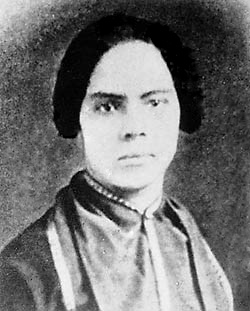
Mary Ann Shadd. Image courtesy of National Archives of Canada via Wikimedia Commons.
Mary Ann Shadd Cary is remembered for her contributions to nineteenth-century Black activism, journalism, and editorship through the Canada-based newspaper, The Provincial Freeman. This exhibit examines her life’s work in political organizing by closely studying her participation in the Colored Conventions movement, as well as the ways she influenced the movement from its margins as an agent in other movements. Over the course of her life she wrote for several Black newspapers, delivered public addresses and lectures, and fundraised for various initiatives. In so doing, she advanced the causes of racial uplift, Black nationalism, emigration to Canada, and Black women’s political and economic empowerment. Her savvy outspokenness ensured she could leverage the Colored Conventions wide support and influence, without sacrificing her commitment to issues that were unpopular with convention leaders. This exhibit is made possible by the extensive archival research and analysis of Shadd Cary’s biographer Jane Rhodes [1], the collection of conventions records and research by the Colored Conventions Project [2], and growing scholarship on Black women’s work in the conventions from our project’s partners and contributors to our edited volume [3].
By using Mary Ann Shadd Cary’s activism as a lens, this exhibit redefines the Colored Conventions movement in order to center those whom Shadd Cary represented: Black Canadian emigrationists, Black women, and marginalized voices in the press. Black Canadian scholars Rinaldo Walcott [4] and Kristin Moriah [5] remind us that these identities and communities were flexible and mobile, calling into question the borders and social division that tried to define Shadd Cary and her allies. This exhibit moves beyond the convention minutes and proceedings to examine her impact on the movement through broader terms.
Shadd Cary used the Black press and networks to engage and influence the agendas and outcomes of the conventions on behalf of her community. Writing herself into public debates and working in organizations and fields crucial to Black political organizing, she shaped how various Black communities were represented, where they moved, what financial support they received, and how they defined and pursued freedom and racial uplift. By tracing the ways the Colored Conventions weave in and out of most of Shadd Cary’s life (and vice versa) we can rectify the histories and places where she has been forgotten. This exhibit also strives to unite the pieces of her legacy, separated by national borders, generational divides, professional silos, and disparate communities of her familial and cultural descendants, to connect to one another as we embrace our shared inheritance of the legacy Mary Ann Shadd Cary’s Black freedom struggles.
How to Explore this Exhibit
REFERENCES
[1] Rhodes, Jane. Mary Ann Shadd Cary: the Black Press and Protest in the Nineteenth Century. Bloomington, IN: Indiana University Press, 1998.
[2] Casey, Jim, “Mary Ann Shadd Cary.” The Fight for Black Mobility: Traveling to Mid-Century Conventions, Colored Conventions Project.. https://oldsite.coloredconventions.org/black-mobility/delegates/mary-ann-shadd-cary/. Accessed 10 Dec. 2020.
[3] Foreman, P. Gabrielle, et al., editors. The Colored Conventions Movement: Black Organizing in the Nineteenth Century. University of North Carolina Press, 2021.
[4] Walcott, Rinaldo. “‘Who Is She and What Is She to You?” Mary Ann Shadd Cary and the (Im)Possibility of Black/Canadian Studies.” Atlantis, vol. 24, no. 2, 2000, pp. 137–46.
[5] Moriah, Kristin. “‘a Greater Compass of Voice’: Elizabeth Taylor Greenfield and Mary Ann Shadd Cary Navigate Black Performance.” Theatre Research in Canada, vol. 41, no. 1, 2020, pp. 20–38.