
BLACK WOMEN’S ECONOMIC POWER: VISUALIZING DOMESTIC SPACES IN THE 1830s
Teaching Questions: College/AP Classes
This exhibit features an interactive map of Philadelphia’s Black community, which includes nineteenth-century photographs of the streets and buildings. It also locates where Black Philadelphians lived, attended church, ran their businesses, printed their literary productions, held meetings, and buried their loved ones.
Why is it important to visualize the spaces where African Americans built their lives and community? How can this map be used?
What do you make of the geography of churches, boarding houses, and etc. What does mapping the proximity of Black businesses, boarding houses, and meeting houses—the neighborhoods where these multi-day Black conventions were held—tell us about the larger spatial scope of the meetings themselves? Consider the visualization below.
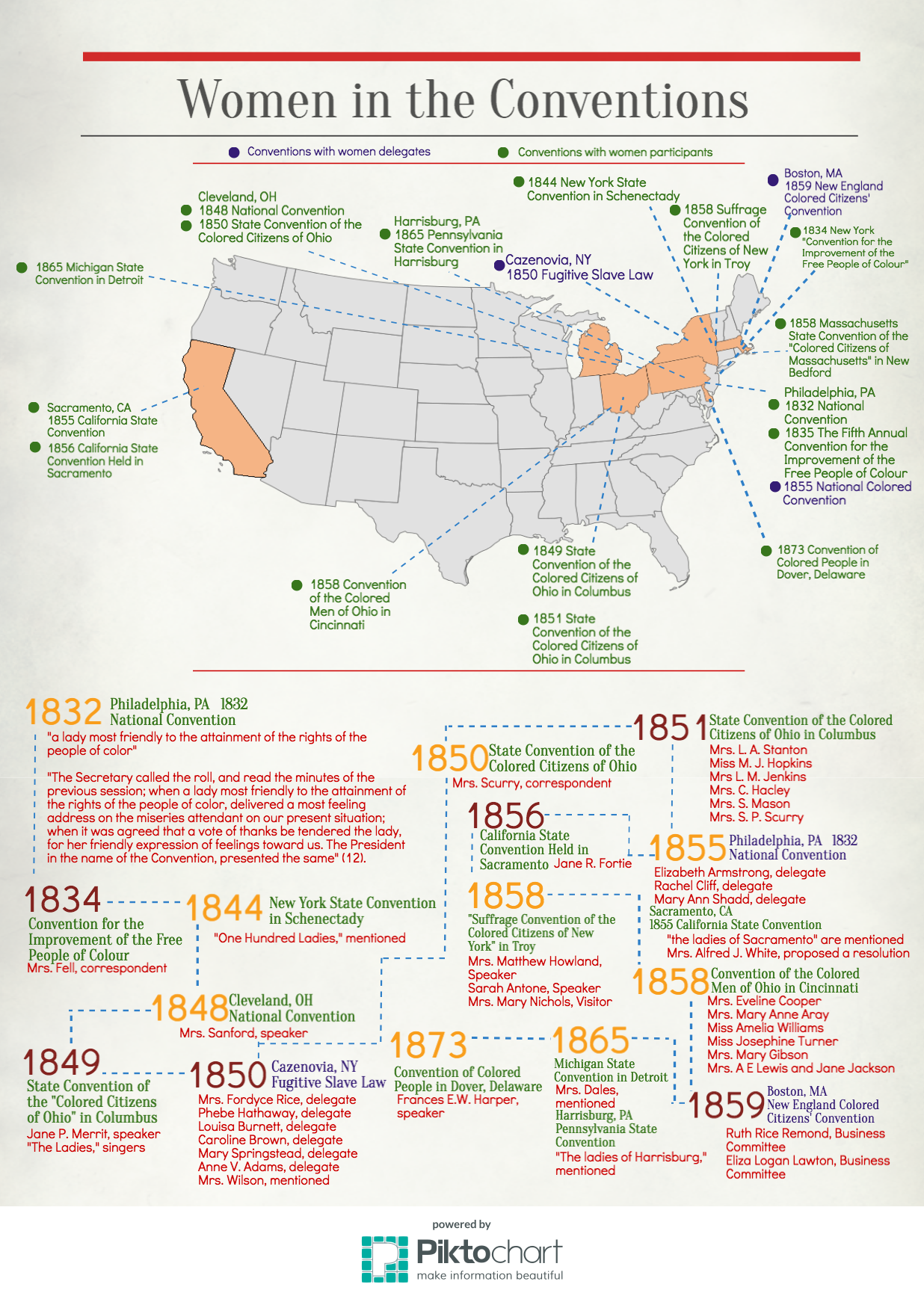
Created by Samantha de Vera using PiktoChart. Information gathered from the Maps section of Colored Conventions website (compiled by Jim Casey). Map rendered by Andrés Martínez Paz of San Diego State University. Click image to view a bigger version.
The curator of this exhibit, Samantha De Vera, and the author Psyche Williams-Forson posit that Black women’s boarding houses are “sites of intellectual production.” As this page shows, Black delegates and activists published a thank you card to hostess Serena Gardiner.
How does acknowledging Black women’s work of facilitating and providing spaces for political discussions help us understand early nineteenth-century organizing and the practices that undergirded it? How does it complicate the notion of gendered separate spheres? As P. Gabrielle Foreman compels readers to ask, how do we center “Black women’s intellectual and infrastructure-building labor in convention organizing, even as the written proceedings and records too often marginalize and anonymize them[?]” 1
—
1 P. Gabrielle Foreman, “Black Organizing, Print Advocacy, and Collective Authorship: The Long History of the Colored Conventions Movement,” The Colored Conventions Movement: Black Organizing in the Nineteenth Century, eds P. Gabrielle Foreman, Jim Casey, and Sarah Lynn Paterson (Chapel Hill: University of North Carolina Press, 2021), 22.
Besides running boarding houses, Black women in Philadelphia also worked as dressmakers and milliners, their crafts displayed upon the bodies of their patrons who conveyed their respectability, status, and economic wealth through them. As Jasmine Nichole Cobb writes, “Free Blacks used clothing to transgress norms relating to civil status as well as socioeconomic privilege. Dress portrayed entitlement to respect, and it offered a pleasure that was no longer accessible to Whites only.”2 Compare the carte de visite of a well-dressed Black lady and a Philadelphian caricaturist’s racist attempts to denigrate Elizabeth Wilson Hinton, a well-to-do member of Philadelphia’s free Black community.
What insights can you draw from looking at Black women’s articulation of freedom and contestation of slavery’s visual culture through dress? How do we fit this form of resistance alongside the performances within the Colored Conventions?
—
2 Cobb, Jasmine Nichole. Picture Freedom: Remaking Black Visuality in the Early Nineteenth Century (NYU Press, 2015), 120.
This exhibit offers brief biographies of Black business owners who joined a cadre of Black activists through their financial support and business activities. For example, bakers Jacob and Elizabeth Gilmore sold tickets to William Whipper’s and John C. Bowers’s talks. While scholars have focused on Grace Bustill Douglass’s father and husband, as this exhibit page shows, she earned money through her trade as a milliner and was active in several antislavery circles and advocated for Black education.
How do we unpack the connections between economic power and community leadership within the Black community?
The five Colored Conventions held in Philadelphia during the 1830s attracted delegates from all over the Northeast. This exhibit maps out where delegates from each convention traveled from, helping viewers to comprehend the effort and commitment that attendees devoted to the Colored Conventions movement as well as the connectedness of Black communities in the North.
How do maps such as this help us understand early nineteenth-century Black mobility? How can we use digital tools to explore the challenges and dangers involved in travelling as a Black person during the nineteenth century?
If your class were to create/hold a convention today, what issues would be its focus? Write a convention call that outlines the convention’s objectives, urgent issues at hand, and the active measures delegates and attendees would need to consider, discuss, and plan. Write a comprehensive call and brief version of it (see examples in separate tabs above, EXAMPLE: Full Convention Call and EXAMPLE: Brief Convention Call). Prepare to address the following questions:
1) How would your convention be organized?
2) What organizations and which leaders would be invited? Who are the non-famous people who would need to be there and from what communities/entities would they draw? Consider how an unprecedented number of Black women participated in the 1854 Emigration Convention and how their presence informed the issues that were discussed and the resolutions that were passed.
3) What objectives do you think most attendees would agree on?
From the Colored Conventions Project’s Digital Records – view
A CALL FOR A CONVENTION OF THE COLORED INHABITANTS OF THE STATE OF NEW YORK.
Fellow Citizens, – We issue this call, to invite you to attend a State Convention , to be held in the city of Albany on Tuesday, the 18th day of August next.
The primary object we have in inviting you to assemble is, to take in to consideration the political condition of our people in this State, and to adopt such measures as can be simultaneously carried out by our brethren, in every section of the State, to obtain a relief from those political disabilities under which we labor.
The principal legal disability which affects us is, our deprivation of the free exercise, in common with other men, of the elective franchise. A free suffrage is the basis of a free government, the safe-guard of a free people, the strength of the strong, the defence of the weak, a powerful auxiliary to respectability, wealth and usefulness; – and just in proportion as men are deprived of this, they are shorn of their strength, and are subject to poverty, disgrace, and abuse.
We are convinced, fellow citizens, that not only our political, but our depressed condition in all other respects in the State, owes itself, not in the least sense, to the fact that we are politically weak, not possessing the unrestricted use of the elective franchise. The body politic see in us, therefore, no favors to court, and nothing to fear. It is to them a matter of no concern, what may be the abuses we suffer, or how unhappy our condition.
You are aware, that while other citizens have a free and unrestricted use of the elective franchise, a property qualification is required on our part, in order for us to exercise this right, so important to a free people, and without which, a man cannot be considered, in a democratic sense, a freeman. This invidious requisition to the exercise of a birth-right privilege, weakens our standing as citizens of the State, and subjects us to all consequent inconveniences. It also degrades our population, because it virtually lowers us in the scale of humanity, and reflects disparagingly upon our character. To seek a removal of this radical evil, is the object of calling you together in convention .
There has been no time so favorable for us to meet for the above object, as the present season. There is evidently a redeeming spirit abroad in our State – an increasing disposition to stand by, and defend the weak against the strong, as the noble acts of the Legislature regarding our protection as citizens, clearly indicate. Ought we not, then, to avail ourselves of this favorable indication, and come together to take some decisive measures to lay before the next Legislature our grievances, with a view to produce further action on their part, for our political disenthralment?
To facilitate the business of the convention , it will be necessary that statements setting forth the legal and other disabilities of our people in different parts of the state, be presented at the Convention . To further this object, we invite all who expect to be present, to collect such statements, and also statistical accounts of the property, real and personal, public buildings, with their value, &c., owned by our people, and the condition of the people in morals, as compared with former times.
We therefore urge upon colored men in all sections of the State – men in all circumstances – if you possess self-respect – if you love liberty – if you appreciate your own rights – if you wish for political and moral elevation – if you have any interest in the prosperity of our people – if you have any regard for the welfare of your children – for the welfare of the State and of the Nation, to assemble at Albany on the 18th of August next.
We call upon the farmer to leave for a while his harvesting, and repair to the assemblage of his brethren. Let the mechanic leave his workshop, to share the toils of a general council. Let the laborer and the workingman be seen crowding the avenues that lead to the place of assemblage. Let every portion of our great and growing State, where lives a single object of oppression, be represented. We call upon the people in every city, town and village to represent themselves in that Convention . Let the aged and the youth – all – all – be found at the above place, on that day. Come up, fellow citizens, from Suffolk to Erie, from Clinton to Steuben, and let us engage together in a common interest.
(Signed)
NEW YORK CITY – Chas. B. Ray, Theo. S. Wright, John J. Zaille, Chas. L. Reason, Timothy Seaman, Wm. P. Johnson, Philip A. Bell, Henry Stoughtenburgh, D. Elston, Thomas Downing, Thos. S. Sidney, Frederick Olney, P.H. Reason, Z.S. Barbary, T. Van Rensalaer, Pres. of the Long Island Convention .
BROOKLYN – Augustus Washington.
JAMAICA – S.V. Berry, Wm. Ranty.
FLUSHING – Aaron Wood, Rev. Mr. Moore.
KINGSTON – Wm. Hansbrouck,
ALBANY – Rev. J.T. Raymond. R. Thompson, Jr.
TROY – W. Rich, Henry H. Garnett, A. Theuay, Jacob Brown, Wm. S. Baltimore, Geo. B. Morton, Marshall Jones.
GENEVA – Rev. John Niles, J.W. Duffin.
ROCHESTER – Rev. Thomas James, W.L. Brown.
BATH – Rev. John Tappan.
COMMITTEE OF CORRESPONDENCE.
The committee take the liberty to appoint the following persons, as a committee of correspondence, and to adopt such measures in their own city and town, as will further the object of the convention . If they are not willing to serve, they will please address a note to the chairman of the committee, (post paid none other will be taken from the office) to that effect. If no reply is made we shall regard it as accepting the appointment, and also as consenting to have their names attached to the call for the convention . We shall wait a few weeks for a reply,
NEWBURGH – C. Payne, I. Allen, J. Ray, T. Kendall.
POUGHKEEPSIE – J. Gray, M. Francis, U. Boston, H. Johnson.
KINGSTON – T. Harley, W. Hasbrouck.
CATTSKILL – M. Cross.
HUDSON – W. Van Alstine.
ALBANY – Rev. J.T. Raymond, R. Thompson, Mr. Pogue, Top & Van Vrankin, C. Morton.
TROY – Wm. Rich, A. Theuay, G. Baltimore.
WEST TROY – Wm. Stewart, Wm. King.
SCHENACTADY – R.P.G. Wright, Thomas Jackson, F. Thompson, John Wendall, Mr. Simpson, Mr. Dana.
UTICA – G.L. Brown, James Fountain, B.S. Anderson, Peter Freeman, R. Paul.
WHITSBOROUGH – J.W. Logan, E.P. Rogers, J.M. Brickers.
LITTLE FALLS – Wm. Jackson.
NEW HARTFORD – R. Wells, Mr. Brewster.
SYRACUSE – Rev. Mr. Chester, P. Jackson, Wm. Jenkins, A. Dunbar.
OSWEGO – T.E. Grant, D. Pease.
VOLNEY – Silas Slater, Mr. Slater.
GENEVA – J.W. Duffin, J. Bland, A. Freeman, S. Condall.
CANANDAIGUA – D.H. Ray, R. Valintine.
PALMYRA – P.B. Lee.
ITHACA – H. Jackson.
BATH – E.L. Platt, Rev. J. Tappan.
ELMYRA – Wm. Johnson.
ROCHESTER – A. Stewart, J. Brown, W.L. Brown, A. Williams, J.H. Bishop.
LEROY – O. Wood.
LOCKPORT – Wm. Brumley, Geo. Miller, W. Miles, J. Morgan, J. Robinson.,
BUFFALO – A.H. Francis, J.L. Lincheum, J. Garritt, J. Walker, P. Harris, H. Hawkins, B. Lincheum, Geo. Ware, Wm. Qualls.
SACKETTS HARBOR – Julias Ferrill.
FISHKILL – A. Adkins.
Citation
Convention of the Colored Inhabitants of the State of New York (1840 : Albany, NY), “A Call for a Convention of the Colored Inhabitants of the State of New York,” Colored Conventions Project Digital Records, https://omeka.coloredconventions.org/items/show/596.
From the Colored Conventions Project’s Digital Records – view
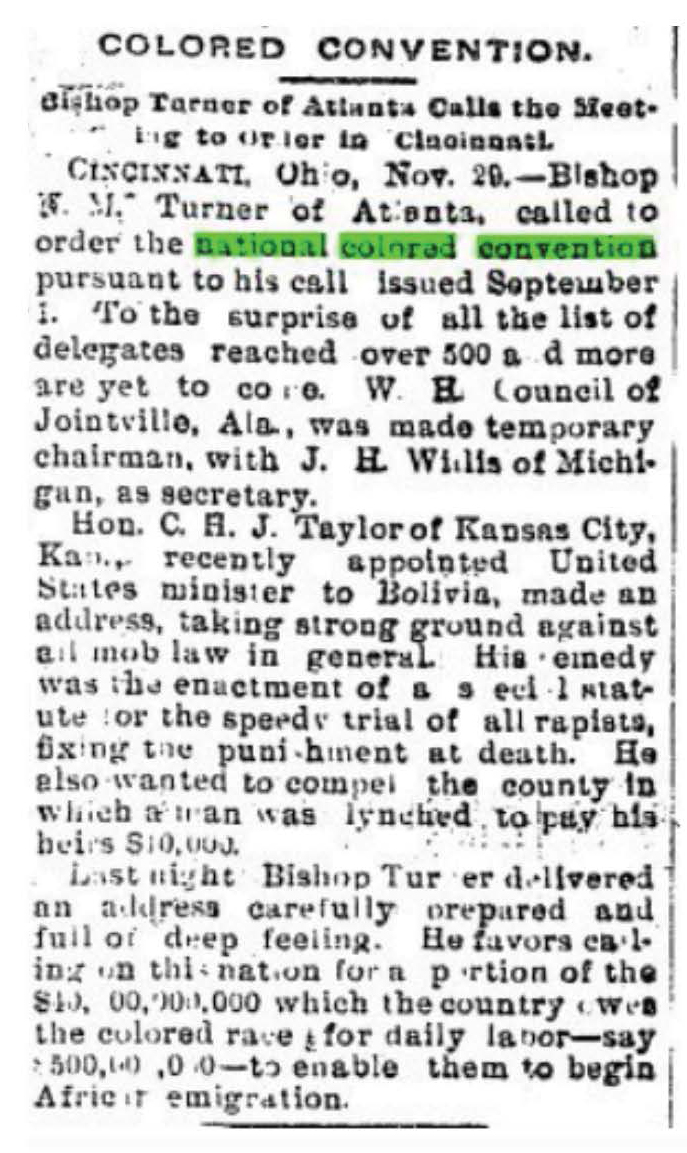
A report on the 1893 National Colored Convention held in Cincinnati, OH published in The Emporia Daily Gazette (November 29, 1893).
Citation
“Colored Convention. Bishop Turner of Atlanta Calls the Meeting to Order in Cincinnati.,” Colored Conventions Project Digital Records, https://omeka.coloredconventions.org/items/show/1656.
Credits
This teaching guide was created in spring 2021 by Samantha de Vera (History PhD candidate at UC San Diego) in collaboration with P. Gabrielle Foreman (CBDR Co-director, Penn State). Reviewed by Janel Moore Almond (Colored Conventions Project Teaching Advisory Board).
Suggested Readings
Cobb, Jasmine Nichole. Picture Freedom: Remaking Black Visuality in the Early Nineteenth Century. NYU Press, 2015.
——. “”Forget Me Not”: Free Black Women and Sentimentality.” MELUS 40, no. 3 (2015): 28-46.
Dunbar, Erica Armstrong. A Fragile Freedom: African American Women and Emancipation in the Antebellum City. New Haven; London: Yale University Press, 2008.
Millward, Jessice. “Charity Folks, Lost Royalty, and the Bishop Family of Maryland and New York.” The Journal of African American History 98, no. 1 (2013): 24-47.
Winch, Julie. “Sarah Forten’s Anti-Slavery Networks.” In Women’s Rights and Transatlantic Antislavery in the Era of Emancipation, edited by Skylar Kathryn Kish and Stewart James Brewer, 143-57. New Haven; London: Yale University Press, 2007.