
THE COLORED CONVENTIONS AND THE CARCERAL STATES
ASSAILING BLACK WOMANHOOD: THE ROLE OF THE PRESS
In seeking to understand the corrupt justice system that preyed on African American women and girls, it is important to take into account the role of the press in perpetuating demeaning images that swayed both public opinion and the courts. This section explores how multiple California newspapers covered African American women and girls charged with crimes in comparison to white women found guilty of crimes. This section also includes brief profiles of Black women, whom the courts convicted with insufficient and/or little evidence.
Between 1898 and 1900, several criminal charges gripped readers in California. These women—white and Black—received contrasting coverage in newspapers. While Black women like Laura Scott and Ethel Wilson received no sympathy from the press and instead had their images smeared and degraded, white women clearly enjoyed flattering descriptions and received a sympathetic voice. The slavery-era practice of vilifying Black women and upholding the virtues of white women is, indeed, very apparent in turn-of-the-century press. This section juxtaposes news articles to show how the press established the guilt of Black women even before trial and reinforced the innocence of white women even after conviction. The prominence of such articles created exclusionary notions of justice, which informed the decisions of jury members and judges.
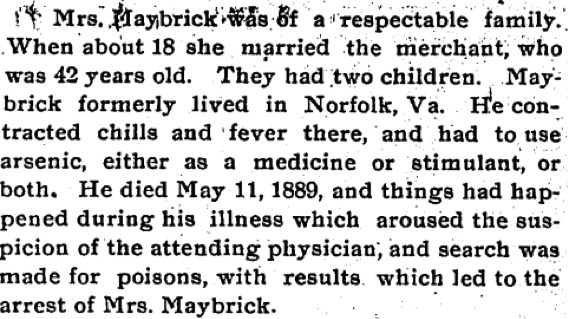
In 1899, petitions were mounting to have a white American woman, Florence Maybrick, released from prison in Britain. By that time, Maybrick had already spent ten years in prison for poisoning her English husband. In 1900, King Edward, under a lot of pressure from the American public, pardoned Maybrick. The widespread support and sympathy for Maybrick proved to be overwhelming, and she was eventually welcomed back to the U.S.
In the same year, Maud Pierce, a Black woman and a divorced mother with three children, was charged with acting as an accessory to commit murder. Pierce supported her family by working as a cook. Two men implicated her in the murder of James Bellew. Both Will Warner and Emanuel Brown claimed that Pierce was the instigator and painted her as the mastermind. Similar to Ethel Wilson’s case, the judges and jury relied on testimonies in convicting Maud. She was sentenced to 10 years in San Quentin State Prison for manslaughter, the maximum punishment for such crime.
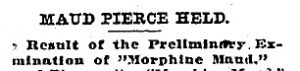
“MAUD PIERCE HELD.: RESULT OF THE PRELIMINARY EXAMINATION OF” Los Angeles Times (1886-1922); Mar 2, 1897; ProQuest Historical Newspapers: Los Angeles Times pg. 11.
When it came to covering Black women’s criminal trials, the same newspaper had a different approach, disparaging Black women’s name and character. Pierce’s name is not only insulted, but by giving her the nickname “Morphine Maud,” the newspaper implies that she is guilty—that she has a propensity for using drugs to victimize people.
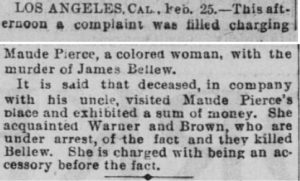
“LOS ANGELES TIMES, CAL., FEB. 25—This afternoon a complaint was filled.” San Francisco Call, 27 April 1897. California Digital Newspaper Collection.
Another case involving a white woman caught the sympathy of the press and the public in 1899. Mattie C. H. Rich was charged with killing her husband in Juarez, Mexico. She fled to the United States only to be extradited back to Mexico where she was later on convicted. She was called the Mexican Maybrick. [2] The outpouring support for Rich and Maybrick are evident in numerous articles before and after conviction.
In all three articles below, the Los Angeles Herald showed concern for Mattie Rich’s safety and health. More than once, the newspaper assures readers that Rich will be “cared for.”
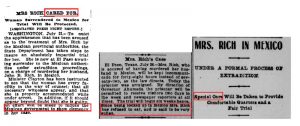
“Mrs Rich Cared For.” Los Angeles Herald. 22 Jul. 1899; ProQuest Historical Newspapers: Los Angeles Herald.
“Mrs. Rich’s Case.” Los Angeles Herald, 27 Jul 1899. California Digital Newspaper Collection.
“Mrs. Rich in Mexico.” Los Angeles Herald, 25 Jul 1899. California Digital Newspaper Collection.
Even after Rich’s conviction, the Los Angeles Herald was quick to imply Rich’s innocence by affirming her love for her murdered husband.
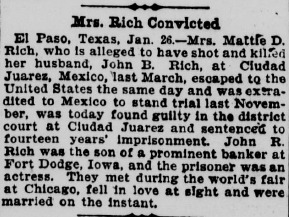
“Mrs. Rich’s Case.” Los Angeles Herald, 27 Jan. 1899. California Digital Newspaper Collection.
While Rich was described as a “sullen” prisoner deserving of protection and “special care,” Laura Scott, an African American woman charged with petty larceny, was described as a kleptomaniac with a drinking problem. Los Angeles Times establishes Scott’s guilt even before trial. The obvious implication is that she must be imprisoned and expelled from the public sphere.
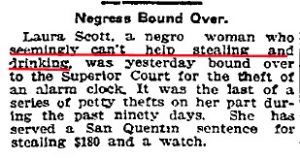
“Negress Bound Over.” Los Angeles Times (1886-1922); Feb 22, 1897; ProQuest Historical Newspapers: Los Angeles Times.
Upholding white womanhood necessitated the erosion of Black womanhood. As Hazel Carby argues, it was necessary to assert the virtues of white women and the immorality of Black women to “affirm the superiority of white sensibilities” and to disguise objective social relations during slavery. [3] Looking at newspaper coverage of women’s criminal trials, it is clear that this practice persisted—and continues to persist—after slavery. Despite being born after Emancipation, African American women suffered at the hands of a legal system that relied on the logic of slavery. The next section looks at the lives of two Black women who lived in Los Angeles—a place that Kelly Lytle Hernandéz aptly calls “City of Inmates.”
References
1. Judith Kelman. “From Yellow Journalism to Yellowed Clippings.” Seeking a Voice: Images of Race and Gender in the Nineteenth Century Press. (West Lafayette: Purdue University, 2009), 281.
2. “A MEXICAN MAYBRICK The First Case Against New Extradition Treaty.” Los Angeles Herald, Jun 22, 1899. California Digital Newspaper Collection.
3. Hazel Carby. Reconstructing Womanhood: The Emergence of the Afro-American Woman Novelist. (Oxford: Oxford University Press, 1987), 28.