
THE COLORED CONVENTIONS AND THE CARCERAL STATES
The Cases of Ethel Wilson and Laura Scott
Ethel Wilson
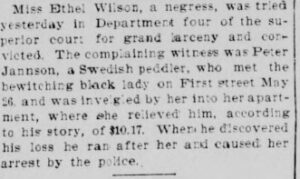
“Convicted of Larceny,” Los Angeles Herald, 27 July 1899. California Digital Newspaper Collection.
Ethel Wilson was a woman who dressed well. She was born in Dallas in 1881, where her parents, Charlotte and Wood Wilson, worked as washerwoman and railroad worker to provide for her and her brother. [1] Ethel Wilson might have moved to Los Angeles, California, independently. There she would have joined a small community of African Americans, about 2,000, who were lured by the promises of the West Coast.
An unfortunate encounter with a white man would lead to Ethel Wilson’s arrest. The man claimed that she took 17 dollars from him. Ethel was searched even after claiming she has nothing to hide. Even without actual evidence, the case went to court. The jury decided that the man’s accusations, as well as, another jailed woman’s claim of Wilson’s confession, were enough to sentence Ethel to three years in prison. The jury took 15 minutes.
In Los Angeles Times, Ethel was labeled a “demimonde.” [2] The Los Angeles Herald described her as “saucy” and “black as the ace of spades.” [3] These attacks on Ethel’s character implied—even before conviction—an innate propensity for criminal actions. Ethel’s denial and the lack of evidence were non-mitigating factors in her trial. Ethel was released in 1902; by then, she‘d had spent three years of her early adulthood in San Quentin Prison.
Laura Scott
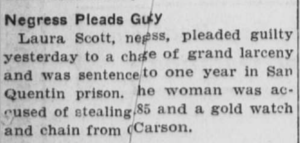
“Negress Pleads Guilty,” Los Angeles Herald, 5 August 1905. California Digital Newspaper Collection.
Laura Scott, like Ethel Wilson, took pride in the way she dressed. Both women wore elaborate hats—a privilege that was denied to enslaved Black women in the South before the war. Their quiet but visual efforts to assert their womanhood and reclaim control over the image of a free Black woman fell short in the face of behemoth legal system that sought to halt their social and economic mobility. Laura Scott was the daughter of two laborers in Alabama, who must have taken pride in the fact that their child acquired a profitable and respectable trade [5].
For women like Laura Scott, struggling for economic independence and surviving did not end at acquiring a trade. Surviving also meant trying one’s best to avoid the attention of police officers and persons with ill intent against African Americans. Moreover, as the previous section shows, Black women could not rely on the press to take their side.
References
[1] Year: 1880; Census Place: Dallas, Dallas, Texas; Roll: 1299; Family History Film: 1255299; Page: 98B; Enumeration District: 057.
[2] “ROBBED A SWEDE.” Los Angeles Times, Aug 22 1898, pp. 10, ProQuest Historical Newspapers: Los Angeles Times.
[3] “Walker’s Dark Secret.” Los Angeles Herald, May 27, 1899, California Digital Newspaper Collection.
[4] Mariame Kaba, “Laura Scott, Negress, Prisoner #23187,” https://prisoner23187.wordpress.com/. For more details about the life of Laura Scott, see Mariame Kaba, “Documenting One Woman’s Experiences in the Criminal Justice System: Laura Scott, Negress, Prisoner #23187,” Roots: Newsletter of the Afro-American Historical Society (Spring 2016).
[5] Year: 1880; Census Place: Scotts, Perry, Alabama; Roll: 28; Family History Film: 1254028; Page: 327B; Enumeration District: 082.