
THE COLORED CONVENTIONS AND THE CARCERAL STATES
INCARCERATION IN GEORGIA
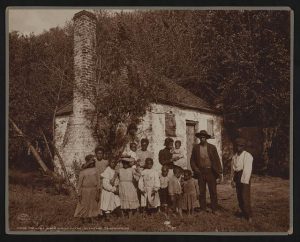
“The Whole black family at the Hermitage, Savannah, Ga.” Photograph courtesy of Library of Congress.
The vilification of African American women in newspapers is but a symptom of the systemic and institutionalized racism all over the country. Black women came face-to-face with a justice system that did not acknowledge their entitlement to the law’s protection. In many Southern states, Black womanhood was not only assailed but also criminalized. In postbellum Georgia, African American women were 40 times more likely to be imprisoned than white women. From 1873 to 1908, only 21 white women convicted of felonies were leased, compared to 846 of Black women. [1] The Black Codes in Georgia effectively plucked many African Americans from the free labor market and the public sphere to reinstate them in conditions that resembled slavery. But, as Talitha Leflouria expertly asserts, for African American women, “life in in a convict lease camp or on a chain gang was in many ways worse than slavery.” [2] To get a sense of the enormity of such a system, it is important to uncover the vulnerable demographics that were targeted by Georgia’s prisons. Below are charts and tables based on Georgia’s nineteenth-century prison statistics.
The timeline of many of these charts run from the beginning of the Colored Conventions movement to 1899. Scroll over each chart for more specific information.
SOURCE: Data gathered from Black Sheep Ancestors.
The chart above shows a steep rise in the number of African Americans executed per year after Emancipation. Georgia exploited the Thirteenth Amendment’s clause that allowed servitude as punishment. Prison populations multiplied, peopled by African Americans who were arrested for trivial actions and given unjustifiably long and cruel sentences. With limited legal resources, African Americans could not properly defend themselves in court.
As the next page shows, Black children suffered under Georgia’s justice system. The chart below shows the number of imprisoned children in four Georgia county prison camps.
SOURCE: United States Federal Census 1900.
The tyrannical prison system of Georgia attacked the African American family unit by targeting even its most vulnerable members—children. Moreover, the state continually ignored the sexual abuses Black women faced in prisons. On the other hand, the state did more than just extend a hand for white women convicts. White women were not only less likely to be imprisoned for the same infractions and crimes, they were also much more likely to be pardoned or given clemency. Often, instead of being sent to prison, they were sent to reformatory institutions meant to redeem them.
The state of Georgia exploited the bodies of Black women yet stringently protected that of white women. For this reason, convict leasing preyed disproportionately on African American women and girls. As Ida B. Wells wrote, “What is true of Georgia is true of the convict lease system everywhere. The details of vice, cruelty and death thus fostered by the states whose treasuries are enriched thereby, equals anything from Siberia. Men, women and children are herded together like cattle in the filthiest quarters and chained together while at work.” [3] Black women and children were extremely vulnerable to abuses in cramped spaces they shared with men. Wells and convention delegates also knew that the state used incarceration to disenfranchise Black men, but because women were yet to be granted the right to vote, their incarceration served as a tool to vilify Black womanhood and fortify the image of white women. Separating Black children from their mothers and female relatives also made it easier for white tradesmen and families to get apprentices under unfair contracts.
The chart below shows the number of Black women who were over-represented in prison populations each year.
SOURCE: The chart above is based on a table compiled by Talitha LeFlouria in her text Chained in Silence: Black Women and Convict Labor in the New South.
African American women reformers recognized the “gendered racial terror” [4] that African American women and girls experienced in camps. The next page delves into the persistent legacy of imprisoning children and, particularly, of the institutional practice of denying Black girls protection.
References
- Talitha LeFlouria. Chained in Silence: Black Women and Convict Labor in the New South. (Chapel Hill: University of North Carolina Press, 2015), 11.
- Ibid., 190.
- Ida B. Wells. The Reason Why the Colored American is Not in the World’s Columbian Exposition. Urbana Champagne: University of Illinois, 28.
- Sarah Haley. No Mercy Here: Gender, Punishment, and the Making of Jim Crow. (Durham: University of North Carolina Press, 2016), 253.