
FOR GENERATIONS TO COME: SOUTHERN HBCUS AND THEIR COLORED CONVENTIONS ROOTS
Southern States Convention of Colored Men, 1871
The Southern States Convention convened on October 18, 1871 in Columbia, South Carolina. Delegates traveled from Delaware to Florida and from Kentucky to Texas. Men who endorsed the call included: James T. Rapier (Alabama), Jonathan C. Gibbs (Florida), Josiah T. Walls (Florida), H. S. Harmon (Florida), P. B. S. Pinchback (Louisiana), and Frederick Douglass (District of Columbia). Josiah T. Walls was called to be temporary Chair and James Rapier, Josiah T. Walls, and P. B. S. Pinchback were among the official delegates.[1] The delegates created several committees including: the Committee on Education and Labor, the Committee on Address to the American People, the Committee on Printing, the Committee on Finance, the Committee on Civil Rights, the Committee on Organizations, Committee on Emigration, the Committee on Outrages in the South, and the Committee on Rules.[2]
A PRESSING NECESSITY
The Committee on Education and Labor included: J. H. Burch (Louisiana), R. H. Cain (South Carolina), F. C. Barbadoes (District of Columbia), J. F. Quarles (Georgia), J. T. Rapier (Alabama), W. B. Nash (South Carolina), and Benjamin Geddes (Louisiana). The Committee’s report was prefaced with the acknowledgement that the members did not have “sufficient appropriate language to convey the pressing necessity” of establishing a robust system of educational institutions for the race. [3] Moreover, the delegates unanimously adopted an address by US Representative from South Carolina Robert Elliot and others. The address points out that African Americans need not just “general education and experience, such as fits the man to adorn the society of his fellows, but that special education and experience required to enable us to enter successfully the departments of a diversified industry.”[4]
Among delegates, there was deep distrust in state governments. The ascent of Democrats’ political power, as they knew, would spell the end the gains of Reconstruction. In July 1870, the governor of Virginia signed into law a bill that created a public school system in the state. The bill required racial segregation of schools, a provision which African Americans at the House of Delegates unsuccessfully tried to remove. Black Virginian leaders, including James Taylor and Joseph Cox, sent a letter to the convention. The letter noted their hopes that Republicans would sweep the upcoming election and asked the delegates to turn their attention to a specific issue:
The first is the policy, if not necessity, of compulsory education, by National legislation, in those States of the South where free schools have not been established, or where the Constitutional clauses calling them into existence have been rendered practically useless and worthless by reason of antagonistic partisan legislation, as is the case in this State, where our enactments are but cobwebs, and our laws but as dead letters…we cannot afford the experiment of entrusting our educational hopes to the unfriendly hands and prejudiced minds of Democratic State Governments. [5]
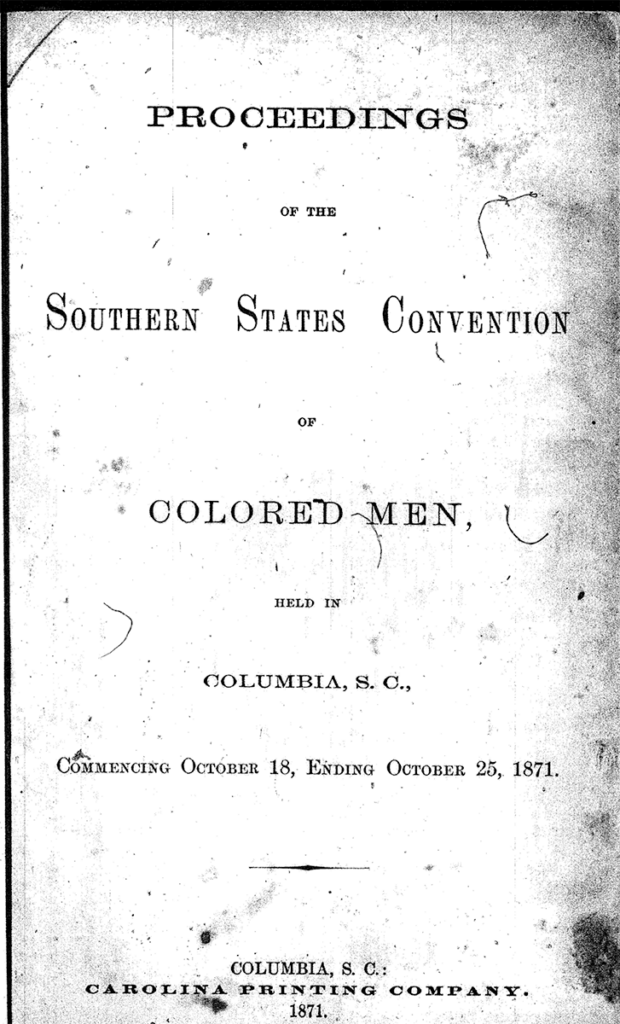
“Proceedings of the Southern States Convention of Colored Men, held in Columbia, S.C., commencing October 18, ending October 25, 1871.,” Colored Conventions Project Digital Records, accessed February 19, 2026, https://omeka.coloredconventions.org/items/show/543.
All throughout the South, Black education was being marginalized. The Committee on Education presented the following statistics to show the egregious situation:
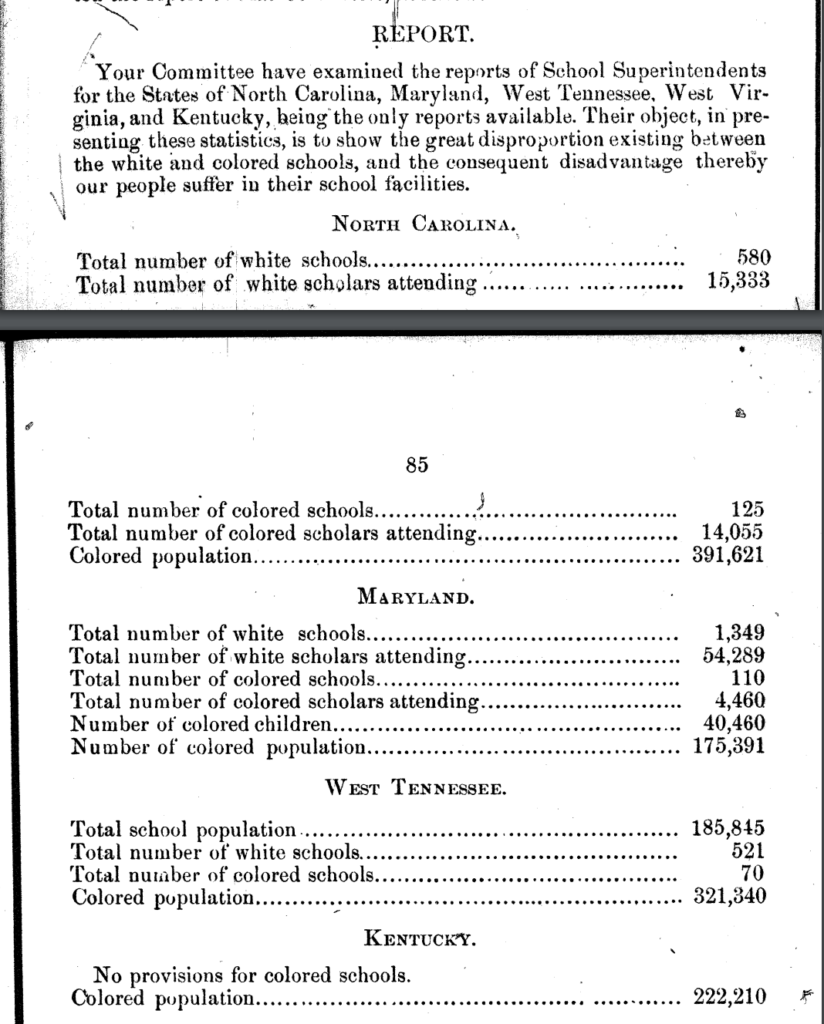
Southern States Convention of Colored Men (1871 : Columbia, SC), “Proceedings of the Southern States Convention of Colored Men, held in Columbia, S.C., commencing October 18, ending October 25, 1871,” pages 84-85, Colored Conventions Project Digital Records, Accessed November 4, 2021, https://omeka.coloredconventions.org/items/show/543.
EQUAL RIGHTS, EQUAL EDUCATION
At the convention, a letter from Charles Sumner was also read. In it, Sumner mentions that he has drafted and introduced a bill to the U.S. Senate to safeguard civil rights, which would later become the Civil Rights Act of 1875. With prescience, Sumner hinted on the separate but equal doctrine, which was coded into law after the Supreme Court confirmed its legality in Plessy v. Ferguson (1896):
It is not enough to provide separate accommodations for colored citizens, even if in all respects as good as those of other persons. Equality is not found in equivalent, but only in equality. In other words, there must be no discrimination on account of color. The discrimination is an insult, a hindrance and a bar, which not only destroys comfort, and prevents equality, but weakens all other rights. [6]
With urgency, Sumner emphasizes that safeguarding equality in all institutions, including schools:
Among cardinal objects is education, which must be insisted on. Here, again, must equality, side by side with alphabet. It is vain to teach equality if you do not practice it. It is vain to recite the great words of the Declaration of Independence if you do not make them a living reality. What is lesson without example? As all are equal at the ballot box, so must all be equal at common school. Equality in the common school is the preparation for equality at the ballot-box. Therefore do I put this among the essentials of education. [7]
Delegates resolved to support Sumner and “to draft a Memorial to the Congress of the United States, setting forth their grievances, and asking for the passage of the “Supplementary Civil Rights Bill.” [8]
NATIONAL PROTECTIVE UNION OF THE COLORED PEOPLE OF THE UNITED STATES OF AMERICA
The Committee on Organization at the convention also established the National Protective Union of the Colored People of the United States of America. The Union was meant to bring together local societies devoted to “securing the rights and general welfare of the colored people.” [9] The committee recommended the establishment of local educational societies “to induce the full acceptance by the people of the benefits of education; to enlighten them as to their rights and their duties, under the educational advantages that they may possess; to encourage the formation of libraries, and the dissemination of useful literature, and to stimulate the desire for literary proficiency and the formation of literary taste and judgment.” [10]
The union’s newly drafted constitution ultimately mandated the creation of committees that would organize educational and industrial societies in various parishes, counties, and districts. Securing Black education was at the center of discussions at the Southern States Convention. Black activists and political leaders knew that state governments could not be relied upon and that they must take steps themselves to secure learning for Black southerners with or without state assistance. It was this same drive that gave birth to HBCUs in the region.
REFERENCES
[1] Southern States Convention of Colored Men (1871 : Columbia, SC), “Proceedings of the Southern States Convention of Colored Men, held in Columbia, S.C., commencing October 18, ending October 25, 1871.,” ColoredConventions.org, 6.
[2] “Proceedings of the Southern States Convention of Colored Men,” p. 10.
[3] “Proceedings of the Southern States Convention of Colored Men,” p. 66.
[4] “Proceedings of the Southern States Convention of Colored Men,” p. 48.
[5] “Proceedings of the Southern States Convention of Colored Men,” p. 21.
[6] “Proceedings of the Southern States Convention of Colored Men,” p. 61.
[7] “Proceedings of the Southern States Convention of Colored Men,” p. 62.
[8] “Proceedings of the Southern States Convention of Colored Men,” p. 86.
[9] “Proceedings of the Southern States Convention of Colored Men,” p. 72.
[10] “Proceedings of the Southern States Convention of Colored Men,” p. 73.
CREDITS
Written by Samantha de Vera, University of California, San Diego, and Rachel Nelson for ENGL/HIST 677, taught by P. Gabrielle Foreman.
Edited by P. Gabrielle Foreman.
Acknowledgements: Michelle Byrnes for further edits, visualization contributions, and technical assistance.