
FOR GENERATIONS TO COME: SOUTHERN HBCUS AND THEIR COLORED CONVENTIONS ROOTS
Ida Alexander Gibbs and Harriet Gibbs
The Gibbs family was active in conventions and educational justice over decades and generations. Although the delegacies of conventions were predominantly male, Black women participated in and contributed to conventions in various ways. The fruits of the Colored Conventions movement’s political labors, activism, and mutual aid shaped the lives of new generations of African Americans. Ida Alexander Gibbs and Harriet Gibbs, Miflin Wistar Gibbs’s daughters, grew up surrounded by convention culture and informed of its many missions. Both women embodied the very goals of the Colored Conventions movement—racial and educational uplift—and continued to work toward Black liberation.

“Wedded to a Consul,” The Colored American (Washington, D.C.), Apr. 16, 1904. Credit: Chronicling America: Historic American Newspapers. Lib. of Congress.
Ida Alexander Gibbs
Ida Alexander Gibbs (later Ida Alexander Gibbs Hunt) was born November 16, 1862 in Victoria, British Columbia, Canada after her father Judge Mifflin Wistar Gibbs emigrated there from Philadelphia. Ida Gibbs studied English at Oberlin College alongside Mary Church Terrell and Anna Julia Cooper. Gibbs later returned to Oberlin to obtain her masters in music. They were the first class of Black women to graduate from the institution in 1884. [1] Their lifelong friendships and roles as race leaders demonstrated the importance of Black political collectives.
She taught higher mathematics and Latin at Huntsville Normal School, now known as Alabama A&M University. In 1892, she became the Second Assistant and Principal of the Preparatory Department at State Normal and Industrial College for Colored Students working with her cousin, Thomas V. R. Gibbs. [2] She then moved to Washington, DC and M Street High School, one of the first public high schools for Black people, was the final school she taught at. [3]
In 1904, she married William Henry Hunt, a Black diplomat and friend of her father, Mifflin. As a result of his occupation, she lived in Madagascar, France, Guadeloupe, and Liberia, among other places. During this time, she also became heavily involved in civil rights work and Pan-Africanism. She supported her friend W. E. B. Du Bois in several organizing efforts including: the Pan-African Congress, the Niagara Movement, and the NAACP (including writing for the Crisis under Iola Gibson). She also supported the Women’s International League for Peace and Freedom, co-chaired the 1923 London Third Pan-African Congress’ Executive Committee, and delivered a paper titled, “The Colored Races and the League of Nations.”[4] Her work was no doubt influenced by the political organizers in her family. Given her expansive work in Black collective organizing, it is likely that she also attended several conventions given her travels from Canada, Ohio, Alabama, Florida, and Washington, DC.
She passed away on December 19, 1957 in Washington, DC. [5]

“Music in the Schools,” The Colored American (Washington, D.C.), Dec. 8, 1900. Credit: Chronicling America: Historic American Newspapers. Lib. of Congress.
Harriet Gibbs
Harriet Gibbs [Marshall] was Ida Gibbs’s younger sister. She was a trained lawyer, educator, and musician. Like her sister, Harriet Gibbs graduated from Oberlin College. Gibbs studied music and furthered her training in Paris. Immensely talented, she made a name for herself in Washington, DC, and elsewhere as she performed in different states. In 1903, she founded the Washington Conservatory of Music and School of Expression in the capital city. She served as the president of the conservatory. W.E.B. DuBois’s magazine The Crisis noted that the conservatory “under the directorship of Mrs. Harriet Gibbs-Marshall, is giving valuable aid in developing a taste for the best music and is becoming an art influence in the District of Columbia.” [6] She also served as the president of the National Association of Colored Musical and Art Clubs, organized in 1908 in New York, New York. Ida and Harriet Gibbs’s life and work testifies to how African Americans’ inculcated the importance of education to the younger generation. Both women educated and trained hundreds of young African Americans, opening up avenues for them and the generations that followed.
News coverage about Ida and Harriet Gibbs
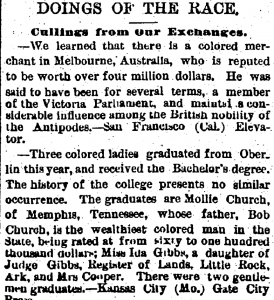
“Doings of the Race.” New York Globe [New York, New York] 9 Aug. 1884: n.p. 19th Century U.S. Newspapers. ©2008 Gale, a part of Cengage Learning, Inc.
Ida Gibbs’ Graduation
This newspaper article congratulates Ida Alexander Gibbs, Mary Church Terrell, and Anna Julia Cooper on graduating from Oberlin College. This is the first time multiple Black women graduated from the college in the same class.

“Multiple News Items.” New York Freeman [New York, New York] 19 Sept. 1885: n.p. 19th Century U.S. Newspapers. ©2008 Gale, a part of Cengage Learning, Inc.
Ida Gibbs Goes to Alabama
This 1885 article congratulates Ida A. Gibbs on her teaching position. That she became a teacher of Higher Mathematics and Latin grants us greater insight into her professional career.

“Odd and Ends.” New York Freeman [New York, New York] 22 May 1886: n.p. 19th Century U.S. Newspapers. ©2008 Gale, a part of Cengage Learning, Inc.
Speech on Black Education
The New York Freeman published a 1886 speech Ida Gibbs made on the role of Black educators in uplifting the race when she was 24 years old and living in Alabama. Her call for “more great men in the realms of thought” demonstrates her activism and passion to undo the harmful effects of enslavement. She gave this speech while teaching at Huntsville Normal School (today Alabama A&M University) and as a leader there she clearly included great women as well as “great men” in the realms of thought she sought to develop. Her eventual move from Alabama to Florida highlights her commitment to Black education as she continued to teach at Normal and Preparatory institutions.
“Success of School Founded by Mrs. Harriet Gibbs Marshall”

Franklin’s paper the statesman. (Denver, Colo.), 01 July 1911. Credit: Chronicling America: Historic American Newspapers. Lib. of Congress.
“Grand Concert and Piano Recital”

The Appeal (Saint Paul, Minn. ;), 17 Sept. 1898. Credit: Chronicling America: Historic American Newspapers. Lib. of Congress.
“Music in the Schools”

The Colored American, Volume 8, Number 27 (Washington, D.C.), 08 Dec. 1900. Credit: Chronicling America: Historic American Newspapers. Lib. of Congress.
REFERENCES
[1] Woodson, C. G. “The Gibbs Family.” Negro History Bulletin 11, no. 1, 1947, p. 3.
[2] “Florida State Normal and Industrial College.” The Ninth Annual Catalogue of the Florida State Normal and Industrial College for Colored Students 1895-1896. Jacksonville, Florida, United States: DaCosta Printing and Publishing Company, 1896.
[3] C. Heung, Ida Alexander Gibbs Hunt (1862-1957). Retrieved from https://www.blackpast.org/african-american-history/hunt-ida-alexander-gibbs-1862-1957/
[4] Baumann, Roland M. Constructing Black Education at Oberlin College, Athens: Ohio University Press, 2010, p. 68.
[5] Carney Smith, Jessie ed. Notable Black American Women, Book II, Detroit: Gale Research Inc., 1996, p. 212-213.
[6] “Art.” The Crisis, vol. 3, no 3, January 1912, p. 98.
CREDITS
Written by: Rachel Nelson for ENGL/HIST 677, taught by P. Gabrielle Foreman, University of Delaware, Spring 2019, and Samantha de Vera, University of California, San Diego.
Edited by P. Gabrielle Foreman.
Acknowledgements: Samantha de Vera and Michelle Byrnes for further edits, visualization contributions, and technical assistance.