
FOR GENERATIONS TO COME: SOUTHERN HBCUS AND THEIR COLORED CONVENTIONS ROOTS
State Conference of the Colored Men of Florida, 1884
The State Conference of the Colored Men of Florida was held in Gainesville on February 5, 1884. It included 84 delegates from Alachua County, which housed Gainesville, and less than 10 delegates from every other county in the state. While records of earlier conventions in Florida are not yet accessible, the 1884 convention document revealed that Black Floridians made remarkable political gains since 1865. Data shows that Black politicians in Florida were heavily involved in conventions, both in Florida and throughout the Southern region. It also revealed that education had been an increasing priority over the years for Black Floridians.
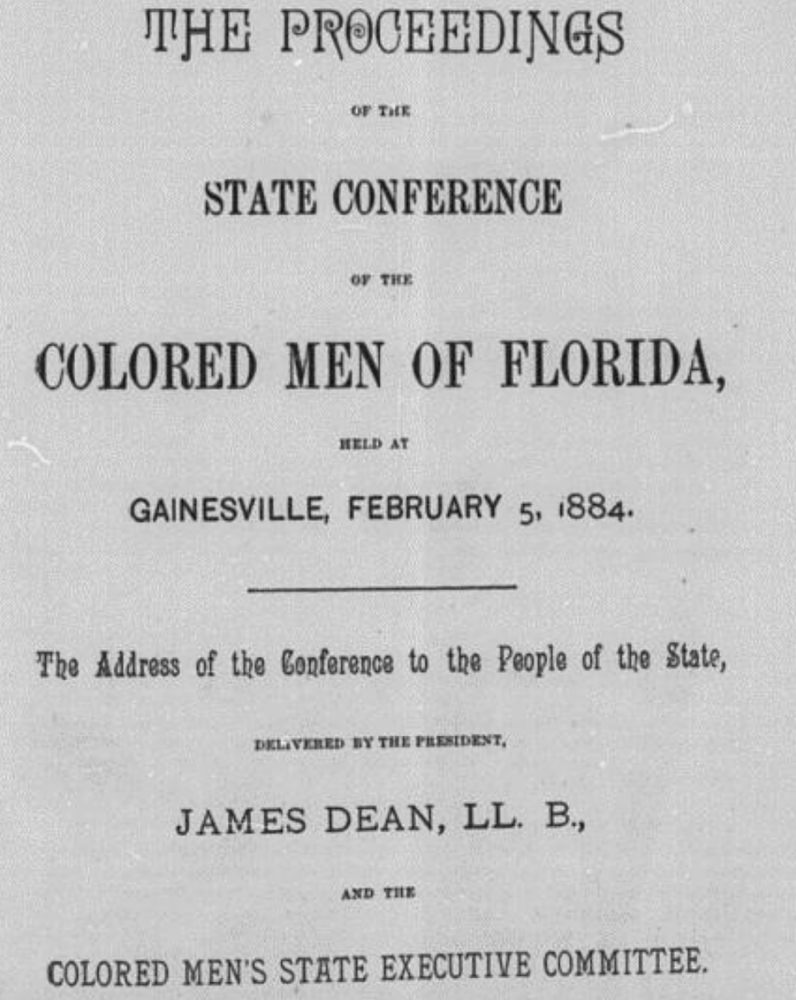
State Conference of the Colored Men of Florida (1884 : Gainesville, FL), “Proceedings of the State Conference of the colored men of Florida, held at Gainesville, February 5, 1884.,” Colored Conventions Project Digital Records, accessed February 19, 2026, https://omeka.coloredconventions.org/items/show/1099.
The convention call was published in Florida News according to Josiah T. Walls. Walls, who was on the Committee on Platform, submitted a report:
“By uniting we can effect the election of such men to office as we secure to our people redress for the following evils and grievances to which we are subject:
1. We want increased facilities of common school education and the highest branches, so as to be able to reduce the high rate of illiteracy which the last census shows to exist among our people in this State.” [1]
That this is the first grievance should not go unnoticed. It is clear that convention delegates understood the role education had in securing full citizenship, especially in the years following Democratic takeover of the South. It should also be noted that delegates at the convention were shifting away from the two-party system, instead seeking to become allies with independent parties that could better serve the interests of Black Americans. Following the radical Readjuster Party’s short-lived success, more Black leaders warmed up to the idea of leaving the Republican Party.
Black Floridians had been involved in state electoral politics for almost 20 years at the time of this convention, including Jonathan C. Gibbs who was the first and only Black Floridian to serve as both Secretary of the State and Superintendent of Public Instruction of Florida. His son Thomas V. R. Gibbs, also a politician, attended the 1884 Conference and is credited with introducing and passing legislation that created Florida Agricultural and Mechanical University. Josiah T. Walls served in the U.S. House of Representatives and Florida Senate prior to this convention. Although they pushed for many political gains during Reconstruction, these delegates knew securing an equal education for younger generations was crucial in a period when white Southerners were actively undoing the Reconstruction gains and reforms.
The failure of the State government to provide ample facilities for this purpose constitutes a grave public grievance among us. Ours is a free government. The people are not compelled to bow at the behest of any one man, or any privileged class of men. Every man, whited and colored, is, in a measure, his own ruler, and we all unite, by means of ballot in exercising the power of sovereignty. Education is indispensable to the success of all form of government, but it is more so to a popular form of government, because experience has shown that good self-government is impossible without an intelligent and honest ballot. Hence the common school bears a most important relation to the welfare and prosperity of the commonwealth of Florida. It is the means by which education is spread among the masses, whose ballots are as effectual, under our system of government as those of the millionaires. [2]
And like delegates in past conventions, Black Floridians connected voting rights to education. To the ends of securing education, property, civil, and political rights, the delegates decided to endorse “the Independent movement in State politics… and we as men and voters should unite with this movement and give it a faithful trial, if the circumstances existing at the proper time warrant it.” [3] The gubernatorial election of 1884 in Florida, however, ended with Democratic victory, installing another white supremacist governor. The delegates thus immediately went to work to establish a school for Black Floridians.
REFERENCES
[1] State Conference of the Colored Men of Florida (1884 : Gainesville, FL), “Proceedings of the State Conference of the colored men of Florida, held at Gainesville, February 5, 1884.,” ColoredConventions.org, 6.
[2] “Proceedings of the State Conference of the colored men of Florida,” p. 13-14
[3] “Proceedings of the State Conference of the colored men of Florida,” p. 22.
CREDITS
Written by: Rachel Nelson for ENGL/HIST 677, taught by P. Gabrielle Foreman, University of Delaware, Spring 2019, and Samantha de Vera, University of California, San Diego.
Edited by P. Gabrielle Foreman.
Acknowledgements: Samantha de Vera and Michelle Byrnes for further edits, visualization contributions, and technical assistance.