
FOR GENERATIONS TO COME: SOUTHERN HBCUS AND THEIR COLORED CONVENTIONS ROOTS
JAMES T. RAPIER
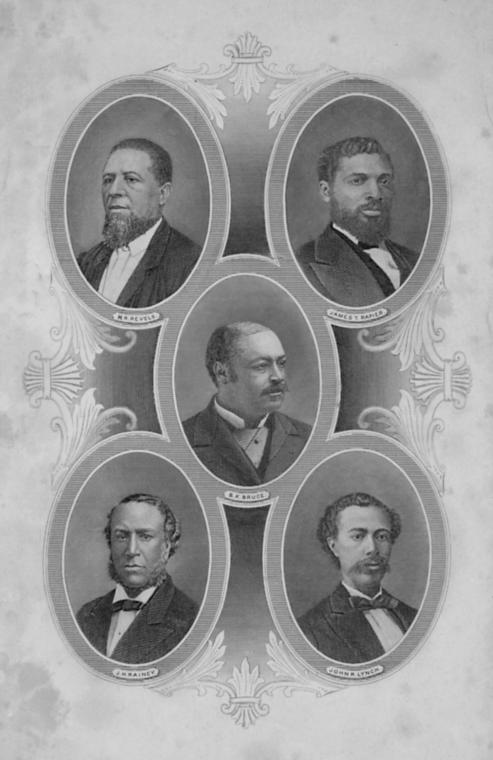
James Rapier was one of three Black Republican congressmen from Alabama during Reconstruction (top right). Schomburg Center for Research in Black Culture, Photographs and Prints Division, The New York Public Library. “H.R. Revels; James T. Rapier; B. K. Bruce; J. H. Rainey; John R. Lynch.” New York Public Library Digital Collections.
James Thomas Rapier, who attended at least five Conventions and served as the Alabama delegate and member of the Committee on Credentials, as well as on the Committee on Education and Labor at the 1871 Southern States Convention, was born free in Florence, Alabama, on November 13, 1837 to John H. and Susan Rapier who were established free people. When his mother died in childbirth in 1841 before he turned five, he was sent to live with his grandmother, Sally Thomas. He attended a secret school for Black children from 1854 to 1856. His father eventually sent him to Ontario, Canada, to live with another family member. In Canada, he became religious, committed his life to helping the effort of racial uplift, and obtained a teaching certificate. He returned to the United States in 1864 and settled in Tennessee. [1]
Histories written about Rapier recognize his role in Alabama and Tennessee State Conventions, as well as in national Colored Conventions such as the 1869 Colored National Labor Convention and the 1873 National Civil Rights Convention. At the 1867 Alabama Republican State Convention, he served as chairman of the Platform Committee and drafted documents calling for free schools, a free press, and equal rights for all citizens. [2] He became a United States Congressman in 1873 but gerrymandering and the violent intimidation of Black voters cut his political career short. [3]
After his political career, he established two newspapers: the Montgomery Republican Sentinel (1872) and the Republican Sentinel and Hayneville Times (1878). [4] He also rented land to Black tenants and gave them low interest loans in line with his commitment to building Black prosperity. In his later years, he became a vocal emigrationist, attending the 1879 National Conference of Colored Men held in Nashville, traveling multiple times to Kansas, and inviting Mifflin Gibbs (brother of Jonathan C. Gibbs) among others to evaluate the prospect of emigration. In 1880, he purchased land for a possible Black colony in Kansas. [5] He died on May 31, 1883 and notice of his death was publicized throughout the country. Rapier dedicated his life to uplifting the race through access to education, wealth, and politics.
A Brief Timeline of James T. Rapier’s Political Career
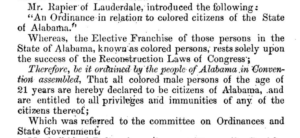
1867
In 1867, Rapier served as a delegate at the Alabama Constitutional Convention, pushing forth the interests of the Republican Party. Rapier was the only Black man from his district to attend the convention.
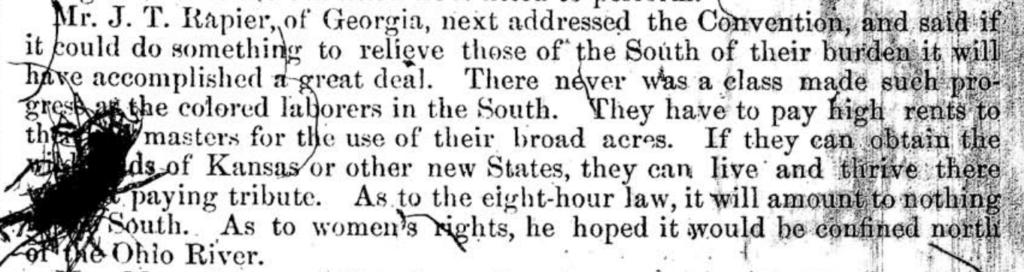
1869
In 1869, Rapier attended the National Colored Labor Convention in Washington, D.C. It was during this convention that the National Negro Labor Union was formed, and Rapier was selected as the new union’s vice president.
1870
In 1870, Republicans nominated Rapier for Alabama’s secretary of state. White Republicans were highly reluctant to support Rapier. Rapier lost in the election.
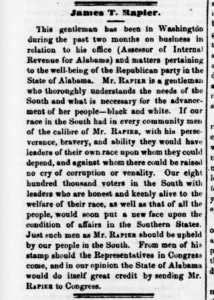
1872
Rapier served as Alabama’s federal internal revenue assessor. In 1872, he defeated a white incumbent and elected into the U.S. congress, representing Alabama’s second congressional district.
1874
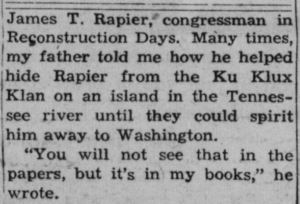
As the Democratic Party and its paramilitary wing, the Ku Klux Klan, began to take over Alabama, Rapier, like many Black politicians, were driven out of public office. Rapier lost his re-election in 1874. Rapier was appointed as a collector for the Internal Revenue Services until 1878.
1875
In 1875, Rapier delivered a speech before the House of Representatives in support of the Civil Rights Act. Read the speech here.
REFERENCES
[1] Loren Schweninger, “James T. Rapier of Alabama and the Noble Cause of Reconstruction,” in Howard Rabinowitz, ed., Southern Black Leaders of the Reconstruction Era (Urbana: University of Illinois Press, 1982): 80.
[2] Ibid, 79.
[3] Ibid, 82.
[4] Ibid, 85.
[5] Ibid, 89.
CREDITS
Written by: Rachel Nelson for ENGL/HIST 677, taught by P. Gabrielle Foreman, University of Delaware, Spring 2019.
Edited by P. Gabrielle Foreman.
Acknowledgements: Samantha de Vera and Michelle Byrnes for further edits, visualization contributions, and technical assistance.