
EQUALITY BEFORE THE LAW: CALIFORNIA BLACK CONVENTION ACTIVISM, 1855-65
Biographies: Jacob Francis
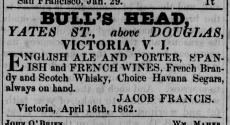
An advertisement for Jacob Francis’s saloon in Victoria, British Columbia, Canada. Pacific Appeal, 14 March 1863. California Digital Newspaper Collection, Center for Bibliographic Studies and Research, University of California, Riverside.
Jacob Francis was a pivotal delegate within the Colored Conventions of 1855 and 1856 in California. He was temporarily chairman of the 1855 convention and his leadership was later characterized as “[shaping] committees in a manner which gave the Convention, at once tone and strength.”[1] In 1849 Francis settled in California. He quickly became an influential leader within the Black community of San Francisco. In 1853 he was elected as the first president of the Young Men’s Society, which was a civil rights organization. The society founded and directed the Athenaeum Institute center for Black intellectual life. The Institute served as a Black library company and debate society. Francis’ involvement on civil rights issues before the conventions indicated a distinct level of awareness of the ban on Black testimony and its subsequent pressure on the Black community. His role as president within the Young Men’s Society and delegate at the conventions demonstrated his deep interest in civil rights. He was also the leader in the campaign for the first state wide Black newspaper of the time, the Mirror of the Times.[2]
Francis’ roots within the Black abolitionist community extended back to his time spent on the East Coast, specifically New York. Francis was a close associate of Frederick Douglass and a prominent convention supporter and abolitionist before migrating to California.[3] In 1858, Francis, along with several hundred other Black Californians, moved to Victoria, British Columbia, and opened a saloon. As a community leader and business owner he continued to advocate against prejudice. Francis fought intolerance by suing two local bar owners who refused to serve him and by publicly campaigning to desegregate churches and schools. He remained connected to his community in San Francisco by frequent correspondence with the editor of the Pacific Appeal, Peter Anderson. In 1863, for example, Francis wrote, “I should like to know how our people are getting along in Frisco. I am interested in their welfare; we have fought side by side to advance and promote their interests.”[4] Francis moved back to New York City at the end of the Civil War and passed away in 1889.
Credits
Written by Lindsay Drapkin. Taught by Sharla Fett, History 213, Occidental College, Spring 2016.
References
[1] Peter Anderson, “P. Anderson- Dear Sir, Pacific Appeal,” 21 November 1863, accessed in ProQuest Black Abolitionist Papers, 16 April 2016.
[2] “Letter from Wellington D. Moses, Jacob Francis, Fortune Richard, William Brown, and Richard H. Johnson to James Douglas,” November 1861, accessed in ProQuest Black Abolitionist Papers, 16 April 2016.
[3] Quintard Taylor, In Search of the Racial Frontier: African Americans in the West, (New York: Norton & Company, 1998), 89.
[4] Jacob Francis, “Letter to Peter Anderson, Pacific Appeal,” 11 July 1863, accessed in ProQuest Black Abolitionist Papers, 16 April 2016.