
Equality Before the Law: California Black Convention Activism, 1855-65
“Advocate Our Own Cause”: Black Newspapers in California
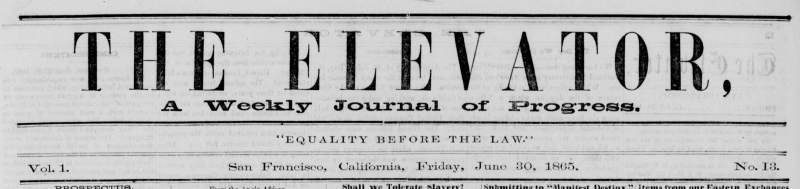
The Elevator, “Masthead of The Elevator, 1865,” California Digital Newspaper Collection, Center for Bibliographic Studies and Research, University of California, Riverside.
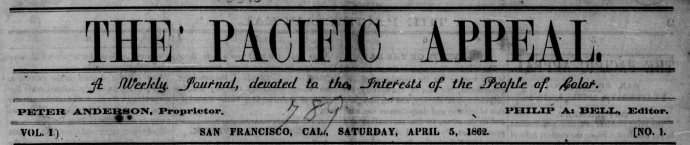
Pacific Appeal, “Masthead of Pacific Appeal Issue No. 1,” California Digital Newspaper Collection, Center for Bibliographic Studies and Research, University of California, Riverside.
The birth of the Colored Conventions movement in California revealed the need to express Black voices through print. The press, similar to the delegates, addressed repressive legislation that threatened the liberty of Black citizens. Civil rights, community, and racial politics were ingrained in the California Black newspapers. Writers and editors established relationships that blurred the distinction between activism and journalism. The Mirror of the Times, The Pacific Appeal, The Elevator were the Black newspapers published in California from 1850 to 1870. Communication underscored the efficacy of political activism and in the case of these historically Black newspapers, inextricably linked both political activists and writers.
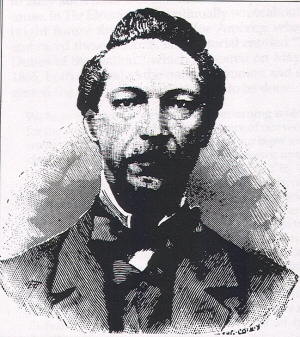
Philip Alexander Bell founded the Elevator in 1865. The Black Past Website, http://www.blackpast.org/aaw/bell-philip-alexander-1808-1889.
The notion for the first Black periodical in California originated in meetings held during the first California State Convention in 1855. The proceedings of the 1856 Convention focused on developing logistical plans for the paper including subscription and circulation. The paper titled The Mirror of the Times, founded and edited by Mifflin Wistar Gibbs, published its first issue by October 31, 1856. Peter Anderson, a prominent voice within the Convention said, “The Convention ought to assume the ownership and responsibility of sustaining the Mirror, as the first step, and then take the entire control of its financial affairs, and see to it, that this department is properly conducted.”[1] The coinciding emergence of Conventions in California with the development of Black newspapers clearly demonstrates the bond between Black politics and the medium of its expression to the public. A year after the last Convention of that decade, The Mirror was forced to stop publishing in 1858, confirming its reliance on Convention support.
As political momentum faltered, Black migration to Canada gained popularity. In 1858 the editor of the Mirror of the Times, Mifflin Gibbs, unsatisfied with the lack of change within the state of California, moved to Victoria, Canada. From 1858 to 1862 there was no Black press within California. The simultaneous lack of press and Conventions at this time in California illuminates how the Black press informed organized political activism and vice versa.
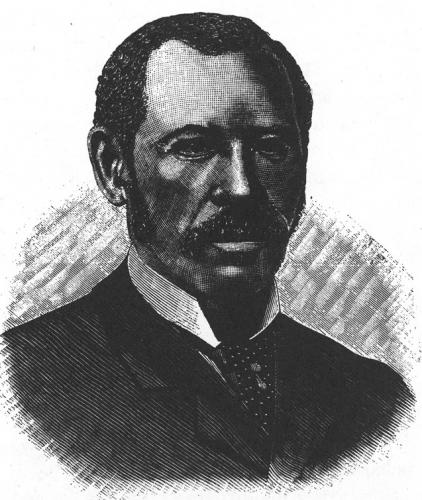
Mifflin W. Gibbs founded the Mirror of the Times. The Black Past, http://www.blackpast.org/aaw/gibbs-mifflin-wistar-1823-1915.
However, despite the lack of active Black publication, the connection between political activists and editors was maintained. A network between both parties remained intact, reinforced by correspondence and visits between political and journalistic leaders. The Pacific Appeal, edited by Peter Anderson detailed the majority of the correspondence between California and Victoria Black political activists and writers. Anderson also traveled to Victoria in person to better understand the dynamics of Black community within the city. On September 16, 1863, a Victoria public meeting was held in order to advertise subscriptions for The Pacific Appeal which had started publishing a year earlier. Editors, Philip A. Bell and Peter Anderson and Jacob Francis, a delegate from the 1856 Convention, were notably in attendance. Bell was a prominent speaker at the meeting and was reported to refer “to the importance of newspapers and the necessity of having an organ in this coast, to advocate our rights and make known our wrongs.”[2] Not only did these relationships demonstrate the salient connection between politics and press but it also demonstrated an increasing geographical range of subscription and circulation.
In 1865, a decade after the first California State Convention, Sacramento hosted its third Convention. However, the 1865 Convention took place in a dramatically different post-emancipation context. The Black press would yet again enter into the discussion reported by convention minutes: “The press is also an important element in this matter, and we should support our newspapers, as a fearless, outspoken periodical is greatly needed.”[3] The Convention acknowledged the role of the white press but continued to emphasize the importance of Black leadership: “We have many white friends whose papers speak nobly in our favor; but we can best tell our own story, and advocate our own cause.”[4] At the time two Black-run periodicals were operational. The Pacific Appeal was owned and edited by Peter Anderson and The Elevator, edited by Philip Bell. Both editors were bitter rivals, but despite their rivalry, had formed a shaky alliance in order to put forward the Black political agenda. Bell’s aggressive “hard-hitting editorials” quickly gained recognition from Black editors across the country.[5] The deeply embedded political discourse in both papers linked them to pressing campaigns and causes and were supplemented by personal relationships with activists.
Despite California’s geographic isolation and small population of Black citizens, political activism against discriminatory racial policy was relatively successful. The periodicals offered a voice to Black political activists that expanded beyond their local meetings, spreading their ideologies across the United States and Canada. The Black press and political activists forged a partnership through mutual reliance and understanding. In the first issue of The Pacific Appeal, Anderson explained that “a weekly paper is needed…one which will be the exponent of our views and principles, our defense against calumny and oppression, and our representative among one of the recognized institutions of civilization.”[6] It was through this close alliance between press and activism that the Black voice was decisively expressed in newsprint.
Credits
Written by Lindsay Drapkin, History 213 taught by Sharla Fett, Occidental College, Spring 2016.
References
[1] “Proceedings of the Colored National Convention Sacramento, 1856 California,” ColoredConventions.org, accessed 18 April 2016.
[2] Jacob, Francis, “Letter to Peter Anderson, Pacific Appeal,” 11 July 1863, Black Abolitionist Papers.
[3] “Proceedings of the Colored National Convention, 1865 California,” ColoredConventions.org, accessed 18 April 2016.
[4] “Proceedings of the Colored National Convention, 1865 California”
[5] William Snorgrass, “The Black Press in the San Francisco Bay Area, 1856-1900,” California History, 69:4 (Winter, 1981/1982), 311.
[6] Snorgrass, “Black Press,” 307