
EQUALITY BEFORE THE LAW: CALIFORNIA BLACK CONVENTION ACTIVISM, 1855-65
Biographies: Biddy Mason
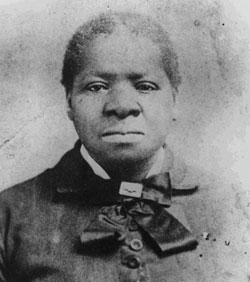
Portrait of Bridget “Biddy” Mason. Image in the public domain.
Bridget “Biddy” Mason was one of the most influential Black women in California, and her wealth, leadership, and philanthropy made a lasting impact in Los Angeles. Born a slave in Georgia, Mason and her children moved west with her master, Robert Smith, from Mississippi to Utah, until Smith settled in San Bernardino in 1851.[1] In 1855, Smith attempted to move Mason and her children to Texas. At the encouragement of other free Blacks in the area, Mason decided to petition for her freedom, along with Smith’s other slaves.[2]
According to the California state constitution, slavery was prohibited. Because Smith brought his slaves to the state after the admission of California to the Union, they were not considered his property. Thus, when Smith attempted to force them to leave the state and move to Texas, Los Angeles judge Benjamin Hayes prevented him.[3] By challenging her master in court, Mason won her freedom. Mason’s experience shows how, despite the testimony bans and other legal restrictions in place for Blacks, some people were still able to use the judicial system to their advantage.
After her remarkable victory, Mason moved her family to Los Angeles and worked her way up to be a nurse and midwife for some of the most prominent Los Angeles families.[4] Through her success, Mason was able to wisely invest much of her money in real estate and was able to amass a considerable amount of wealth.[5] Mason was known throughout Los Angeles for her tireless philanthropic work. She was specifically devoted to the impoverished and the imprisoned.[6] The first African Methodist Episcopal Church of Los Angeles began in Mason’s home, and she took responsibility for supporting the church for its first few years, paying all of its taxes and fees.[7] Despite the fact that she was not directly involved in the California Conventions, Mason contributed to the Black movement for equality through her tireless fundraising and charitable work.
Credits
Written by Lila Gyory. Taught by Sharla Fett, History 213, Occidental College, Spring, 2016.
References
[1] Benjamin Hayes, “A Suit for Freedom in California,” National Anti-Slavery Standard, 5 April 1856. Accessible Archives.
[2] Willi Coleman, “African American Women and Community Development in California, 1848-1900,” in Seeking El Dorado: African Americans in California, edited by Lawrence B. de Graaf, Kevin Mulroy, and Quintard Taylor (Los Angeles: Autry Museum of Western Heritage, 2001), 103.
[3] Hayes, “A Suit for Freedom in California.”
[4] W. Sherman Savage, Blacks in the West (Westport: Greenwood Press, 1976), 14.
[5] Ibid.
[6] Kenneth G. Goode, California’s Black Pioneers: A Brief Historical Survey (Santa Barbara: McNally & Loftin, 1973), 91.
[7] de Graaf and Taylor, “Introduction,” in Seeking El Dorado, 18.