
MUSIC IN THE COLORED CONVENTIONS
Introduction
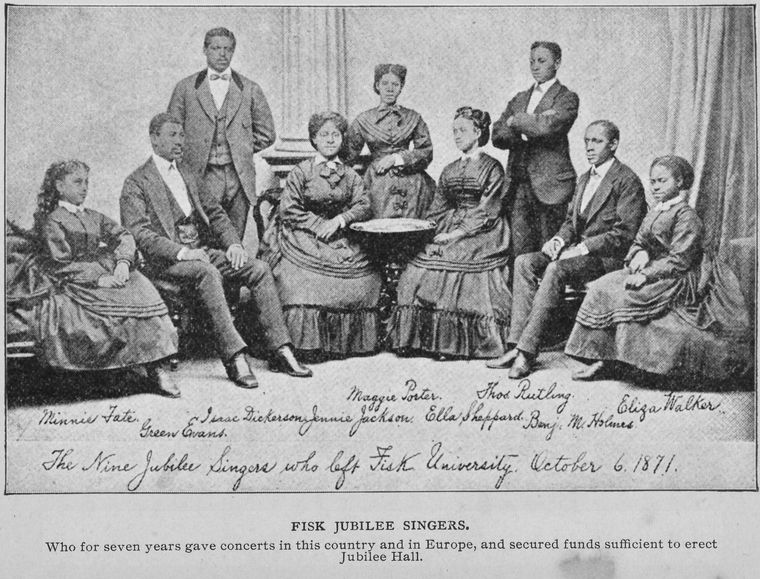
“Fisk Jubilee Singers. Who for seven years gave concerts in this country and in Europe, and secured funds sufficient to erect Jubilee Hall.” New York Public Library Digital Collections, Schomburg Center for Research in Black Culture, Manuscripts, Archives and Rare Books Division, The New York Public Library. Accessed May 10, 2023. https://digitalcollections.nypl.org/items/510d47da-7121-a3d9-e040-e00a18064a99
Singing served multiple purposes for the Colored Conventions in the nineteenth century. More than just a transition between sessions, music provided a moment of reprieve, reflection, and rejuvenation. The genre and lyrics of the songs complemented and aligned with the themes and purpose of the conventions. Emotional, spiritual, and political in their content, these songs helped tie the Black community together. Starting a session with a song set the tone for the discussions to follow. Music allowed both delegates and audiences to pause and be of one voice through song. Concluding a session with a song served as a benediction, inspiring participants to act upon resolutions that had been made during the proceedings. The content of the songs tell us about the emotional connection convention participants had to their values and goals.
Singing often preceded prayer in these conventions, and this underscores the role of what Frances Smith Foster calls Afro-Protestantism in Black political thought and activism at this time.[1] The minutes of the Colored Conventions document a variety of musical activities, including solo and choral performances, as well as moments when all of the participants would sing together as an act of worship, celebration, or both. These moments of musical expression were grounded in Black Christian practices. Eddie Glaude asserts that African American religion is a “practice of freedom,” and that “religion becomes a site for self-creation and for communal advancement with political consequences.”[2] Singing, one of the essential practices in Black culture, and Black Christianity specifically, is the emotional expression of freedom, identity-formation, and communal advancement. This exhibit explores the importance and significance of music within the Colored Conventions movement and shows how singing traditions have endured over the years and across Black movements in the twentieth century. In addition, the following pages present historical audio recordings of songs that enlivened Black activist traditions.
REFERENCES
[1] Foster, Frances Smith. “A Narrative of the Interesting Origins and (Somewhat) Surprising Developments of African-American Print Culture.” American Literary History, vol. 17, no. 4, 2005, pp. 714–40. JSTOR, http://www.jstor.org/stable/3567947. Accessed 8 May 2023.
[2] Glaude, Eddie S. An Uncommon Faith: A Pragmatic Approach to the Study of African American Religion, University of Georgia Press, 2018, p. 17.