
MUSIC IN THE COLORED CONVENTIONS
Delegates and Attendees
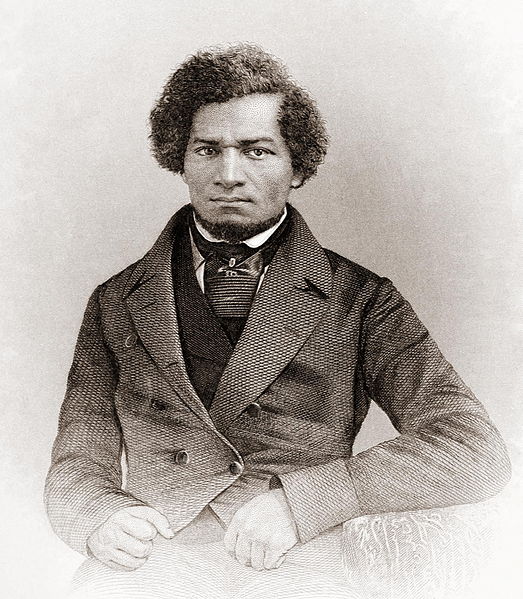
Frederick Douglass
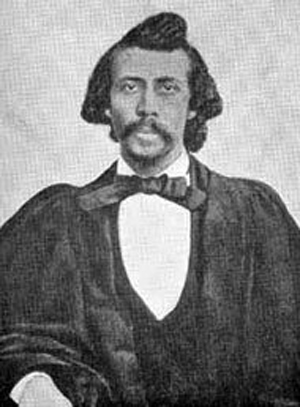
William Howard Day

Joshua McCarter Simpson
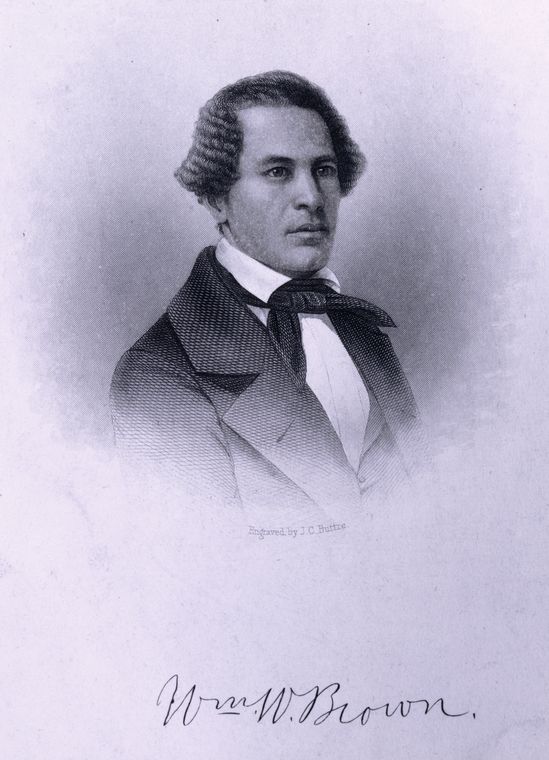
William Wells Brown
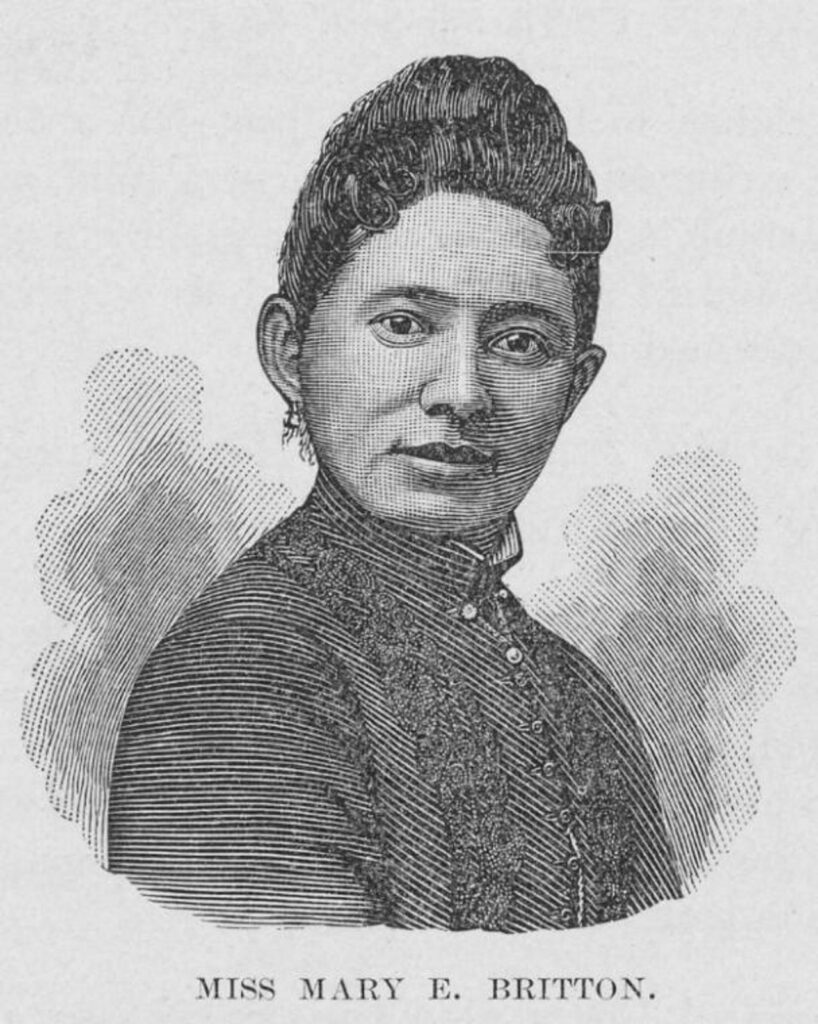
Laura Britton, Ellen Sherman, and “daughters”
Ella Turner
Singing and musical performances are mentioned multiple times in convention minutes. These records often note that the audience sang together with delegates leading them. Many times, however, the minutes do not always specify who sang. Passive phrases like, “the session closed with an anti-slavery song,” and, “hymn of solemn praise to God was sung,” leave much to be speculated. For example, the minutes for the 1865 New Haven, Connecticut State Convention note, “The meeting was opened by singing, ‘My Country ‘Tis of Thee,’” but it is not clear who sang. Nevertheless, the minutes often record the reactions of the audiences to these songs: “John Brown’s Song sung by the audience with great enthusiasm.”[1] These terse statements allow us to understand the power of song and singing as a collective activity. There are several documented instances of women organizers singing at conventions, thus illuminating the multifaceted roles that Black women played in Colored Conventions. Only a few of these women’s identities are specified, and this section highlights them. Still, their lives and activism deserve a more comprehensive scholarship.
Oftentimes, it was the delegates that led the convention in song or who performed a song for enjoyment of fellow participants. In some of the minutes, “a call for song” is mentioned, at which time a delegate answered by initiating some melody. This practice of calling for song is part of a larger tradition of Black gathering and worship, described by Lawrence Schenbeck as spontaneous and decentralized.[2] The spontaneity of these “calls for song” are evidenced by the fact that they are sometimes found in the middle of a convention session between speeches or during the a collection of monetary contributions, instead of at the very end or beginning of a convention. The decentralized nature of these “calls for song” democratized the meeting space, which further unified the participants.
Frederick Douglass, William Howard Day, and other convention delegates were powerful orators who incorporated what Daphne Brooks calls “sacred music performance rituals” into their practice of leadership and public speaking. For the delegates, singing was a mode of communication that accompanied powerful oratory.[3] The convention minutes show a natural flow between speech and song, audience participation and audience observation, echoing the pattern of “call and response” found throughout Black religious, musical, and performance culture at this time.[4]
Read about the delegates and attendees who sang in conventions below.
Frederick Douglass Portrait, 1855, Source: Frontispiece of Frederick Douglass, My Bondage and My Freedom: Part I- Life as a Slave, Part II- Life as a Freeman, with an introduction by James M’Cune Smith. New York and Auburn: Miller, Orton & Mulligan
Frederick Douglass at the National Convention in Cleveland, 1848
During the National Convention in Cleveland in 1848, Frederick Douglass, serving as president of the convention, volunteered a song. It is noted as follows:
“The Convention met, President in the Chair. After some remarks of the President as to the requisites to good order, the Business Committee not being ready to report, opportunity was given for a volunteer speech or song. The time not being taken up, the President sang with applause, a liberty song.”
Douglass had a deeply personal attachment to music. In his childhood, he often heard enslaved people singing as an expression of the sorrow of their predicament. He wrote of the impression this experience had on him and urged that people hear these sorrowful melodies as a testament against slavery. Lawrence Schenbeck states that white northerners were influenced by Douglass’s interpretation, and indeed, Black spirituals and songs of enslaved people were very important to the anti-slavery movement [5]. Douglass’s personal experience with music makes his participation in singing at the convention both a political and personal act.
William Howard Day, approx 1870, Black abolitionist, editor, educator and minister. Source: Wikimedia Commons
William Howard Day, John Watson, Lawrence W. Minor and John L. Watson at the State Colored Convention of Ohio, 1849
During the State Convention of the Colored Citizens of Ohio in 1849, William Howard Day, John Watson, Lawrence W. Minor and John L. Watson were called upon to sing twice. All were delegates, and Day was Chairman. One of the times is noted thus:
“…a song was called for, whereupon Messrs. Day, Watson of Cuyahoga, Watson of Lorain, and Minor came forward and sang “Freedom’s Gathering,” after which the chairman of the business committee reported a platform and resolutions.”
In this contest, calls for songs bridged the business activities, like a sort of intermission.
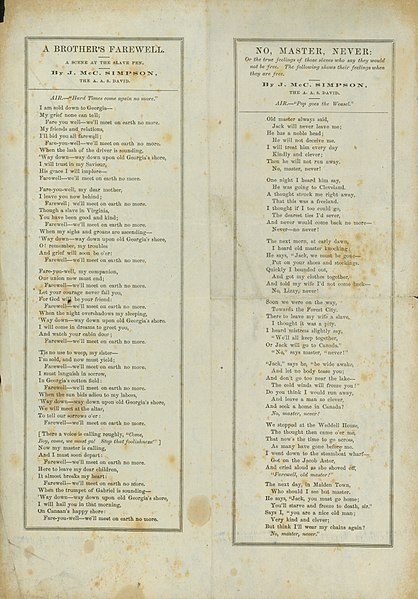
Anti-slavery songs, written by J. McCarter Simpson. Titles: “A Brother’s Farewell” and “No, Master, Never,” 1861-1865. Source: Missouri History Museum.
Joshua McCarter Simpson at the State Colored Convention in Ohio, 1851
Joshua McCarter Simpson, chairman of the 1851 Ohio State Convention of Colored Citizens, “offered a resolution, that a committee of five be appointed to prepare anti-slavery music, for the opening and closing of each session of the Convention.” The motion was carried, and in the evening session, a song composed by Simpson, “Old Liberia is not the place for me,” was sung. At another point in the convention Simpson sang an anti-slavery song. Simpson was an educated free Black poet from Ohio, and in 1852, he published Original Anti-Slavery Songs, a pamphlet with thirteen of his poems. As Vicki Eacklor notes, “Simpson is the first person, black or white, known to have written entire anti-slavery song collections and, further, he was clearly the most prolific antislavery poet, penning more than forty different sets of lyrics before 1860.”[6] Although Simpson remains understudied, during his time, peers and readers alike admired him. Upon Simpson’s death, Black poet Albery Allson Whitman wrote a eulogy to Simpson, titled “To Baby’s Canary, Accidentally Killed.” [7]
“Portrait of William Wells Brown.” New York Public Library Digital Collections, Schomburg Center for Research in Black Culture, Photographs and Prints Division, The New York Public Library. Accessed May 11, 2023. https://digitalcollections.nypl.org/items/510d47db-bd3b-a3d9-e040-e00a18064a99.
William Wells Brown at the New England Colored Convention, 1859
At the 1859 New England Colored Citizens’ Convention, William Wells Brown sang his own composition, “Fling out the Anti-slavery Flag,” to the tune of “Auld Lang Syne.” Brown was active in the Colored Conventions movement, attending at the very least three conventions. Brown, a writer, historian, and activist, greatly enriched the Black literary genre through his use of innovative literary techniques. He compiled his anti-slavery songs along with many others in The Anti-Slavery Harp; A Collection of Songs for Anti-Slavery Meetings (1848).
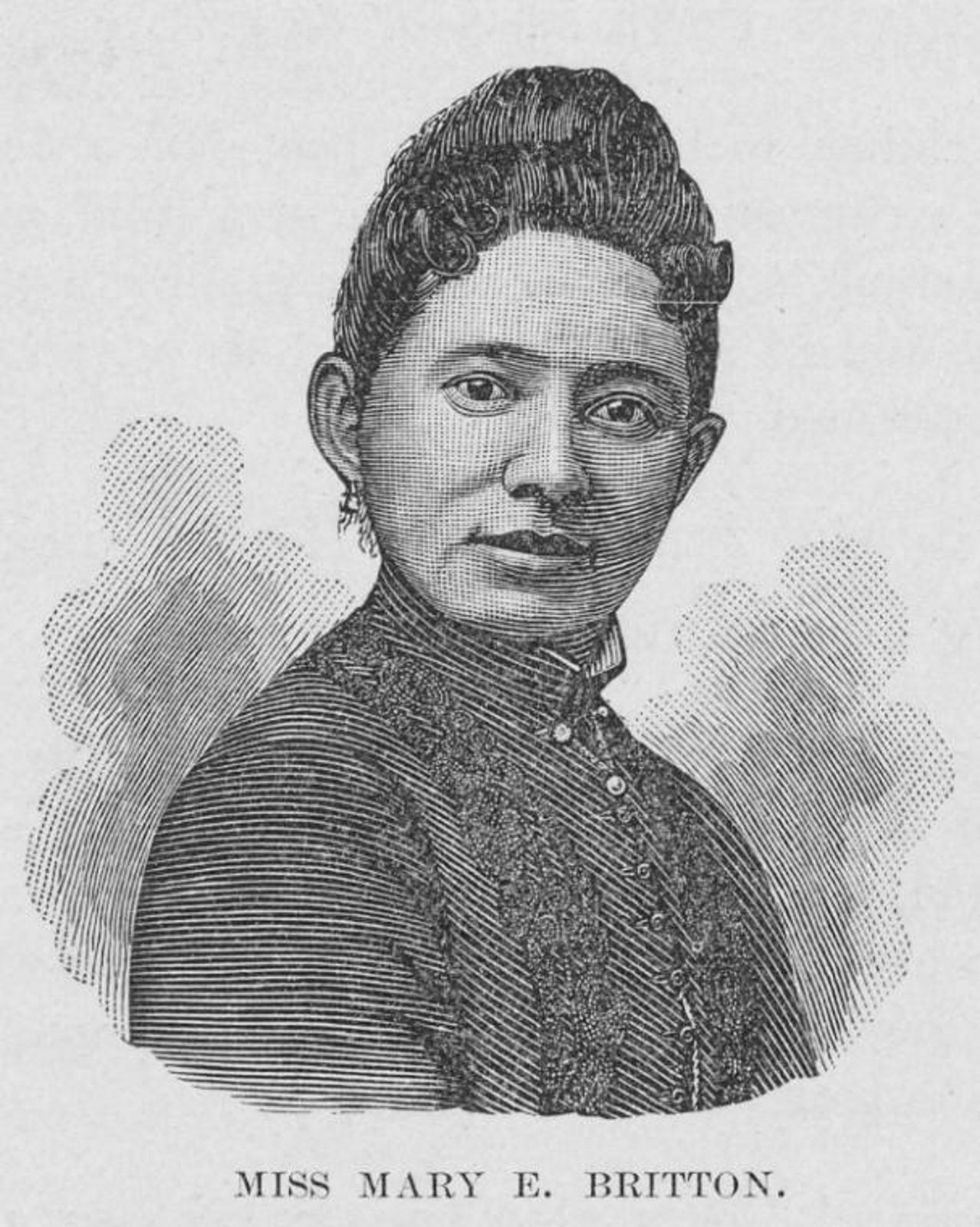
“Miss Mary E. Britton,” 1893. Source: The New York Public Library Digital Collections, Schomburg Center for Research in Black Culture, Manuscripts, Archives and Rare Books Division, The New York Public Library. https://digitalcollections.nypl.org/items/510d47da-734f-a3d9-e040-e00a18064a99.
Ellen Sherman, Laura Britton, and “daughters” at the Colored Convention in Kentucky, 1866
Laura Britton née Trigg and Ellen Sherman sang “Sherman’s March to the Sea” at the First Convention of Colored Men in Kentucky (1866). The identity of Ellen Sherman is unclear, but she was one of the women who “furnished new and choice music” for the convention.[8] The convention would not have been possible without the organizing work of women. Sherman was likely one of the members of the Ladies’ Educational Association, who were in charge of the Ladies’ Hall where the convention took place.
Laura Britton’s husband, Henry Harrison Britton, attended as a delegate. They were a free Black couple who made their livelihoods as a barber and a seamstress. Laura and Henry Britton were the parents of educator, suffragist, and journalist Mary Ellen Britton, who was also the first woman doctor in Lexington, Kentucky. It is highly possible that Mary Ellen also sang at the convention since the minutes note that the delegates tendered thanks to “Mrs. Britton and daughters.”[9] At the time of the convention, Mary Ellen was only 11 years old. Like her mother Laura, Mary Ellen was a talented musician. She later attended Berea College and taught music there. Laura and Henry Britton’s other daughters, Julia Ann and Susan, were also gifted singers and might have joined their mother in the performance.
Ella Turner at the Colored People’s Educational Convention in Missouri, 1870
Ella Turner sang twice at the 1870 Colored People’s Educational Convention. Turner’s husband, activist and diplomat James Milton Turner, was in attendance as a delegate. Ella Turner was born Ella D. Burton in 1843 in Louisiana although it is unclear if her parents, Ella and Gabriel De Burton, were free or enslaved.[10] The Turners were educational activists, and both worked as teachers. She married J. Milton Turner in 1864, with whom she had a daughter named Lillie. The minutes of the 1870 Missouri convention note that Ella Turner “sang, with power and pathos, that patriotic song, ‘The Red, White, and Blue’; after which, by special request, the same lady sang, with all the thrilling sweetness of rendition for which she is remarkable, ‘Hear me, Norma, hear me!’”[11] The latter is a popular duet composed by Vincenzo Bellini, with the words composed by Charles Jeffries in 1851. Although we may never know how Ella Turner sounded like, it is clear that the audience was enthralled by her skills as a singer. Listen to an operatic rendition of the song, recorded in 1914.[12]
References
[1] Colored National Convention (1848 : Cleveland, OH), “Report of the proceedings of the Colored National Convention held at Cleveland, Ohio, on Wednesday, September 6, 1848.,” ColoredConventions.org, accessed June 4, 2019, https://omeka.coloredconventions.org/items/show/280.
[2] Schenbeck, Lawrence. Racial Uplift and American Music, 1878-1943, University Press of Mississippi, 2012, p. 30.
[3] Brooks, Daphne. “Black Theatre and Performance Studies: Seminal Critical Essays and Articles,” ProQuest, 2006. http://gateway.proquest.com/openurl?url_ver=Z39.88-2004&res_dat=xri:bsc:&rft_dat=xri:bsc:ft:essay:17BROO
[4] Brooks, para 2-3.
[5] Schenbeck, p. 32.
[6] Eaklor, Vicki. “Introduction to Joshua Simpson’s Original Anti-Slavery Poems,” The Journal of Black Sacred Music, vol. 3, no. 1, pp.14-21, 1989, Retrieved from <https://read.dukeupress.edu/black-sacred-music/article-pdf/3/1/14/791910/14eaklor.pdf>.
[7] Sherman, Joan R. “ALBERY ALLSON WHITMAN: POET OF BEAUTY AND MANLINESS.” CLA Journal, vol. 15, no. 2, 1971, p. 138. JSTOR, http://www.jstor.org/stable/44321547. Accessed 18 May 2023.
[8] First convention of colored men of Kentucky (1866 : Lexington, KY), “Proceedings of the first convention of colored men of Kentucky held in Lexington, March the 22d, 23d, 24th and 26th, 1866. With the constitution of the Kentucky State Benevolent Association. Printed by order of the convention.,” Colored Conventions Project Digital Records, accessed May 20, 2023, https://omeka.coloredconventions.org/items/show/459.
[9] First convention of colored men of Kentucky, “Proceedings of the first convention of colored men of Kentucky.”
[10] “Ella D. Turner.” Missouri Death Records. Missouri State Archives. Microfilm.
[11] Colored People’s Educational Convention (1870 : Jefferson City, MO), “Proceedings of the Colored People’s Educational Convention held in Jefferson City, Missouri, January , 1870.,” Colored Conventions Project Digital Records, accessed May 9, 2023, https://omeka.coloredconventions.org/items/show/308.
[12] Kerns, Grace, Vincenzo Bellini, and Mildred Potter. Hear me, Norma. 1914. Audio. Retrieved from the Library of Congress, www.loc.gov/item/jukebox-750939/.
CREDITS
Written by Melissa Benbow and Samantha de Vera.