
MUSIC IN THE COLORED CONVENTIONS
RELIGIOUS EXERCISE
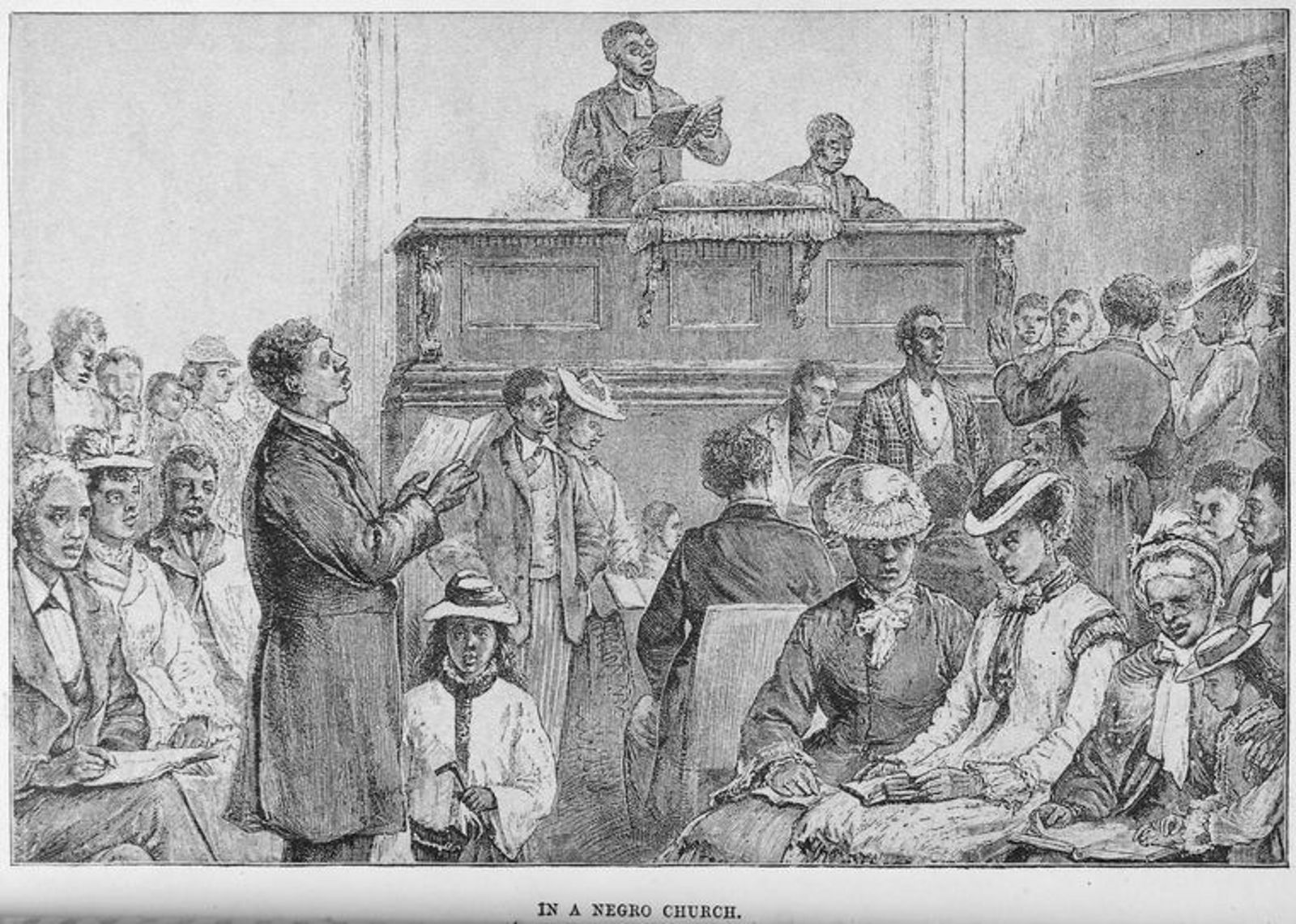
Schomburg Center for Research in Black Culture, Jean Blackwell Hutson Research and Reference Division, The New York Public Library. “In a Negro Church.” The New York Public Library Digital Collections. 1882. https://digitalcollections.nypl.org/items/510d47df-b7a2-a3d9-e040-e00a18064a99.
The Black Church has been essential to Black activism in America. Frances Smith Foster calls the Black Church the only consistent site for African Americans to gather.[1] Whereas the American government called for a separation of church and state, the Black church was the governing body supporting the social, economic, and political uplift of Black people.[2] Many of the convention delegates were religious leaders, and many of the conventions took place in churches, so it was natural that the singing of Black hymns and spirituals were included in convention proceedings. Singing hymns and spirituals affirmed one’s belonging to a community. The histories of the Colored Conventions movement and the African Methodist Episcopal (AME) Church cannot be divorced from one another. Bishop Richard Allen, founder of the AME Church, convened the very first Colored Convention in Philadelphia in 1830, sparking a movement that grew nationwide and spanned throughout the nineteenth century. AME ministers and bishops, such as Henry McNeal Turner, organized numerous conventions. Some of the rituals within the AME Church were carried over to convention proceedings, as each convention opened and closed with a prayer. However, as Sarah Lynn Patterson notes, “while early nineteenth-century meeting provided moral, intellectual, and ceremonial blueprints for leadership, Colored Conventions operated as independent, distinctly public-facing forums beyond the AME Church’s oversight.”[1] Still, praying and singing allowed Black men and women to embody Christian ideals, and participating in Colored Conventions demonstrated their meaningful political engagement.[2] They thus challenged denigrating notions whites used to deprive them of full citizenship.
REFERENCES
[1] Patterson, Sarah Lynn. “As the True Guardians of our Interests: The Ethos of Black Leadership and Demography at Antebellum Colored Conventions.” The Colored Conventions Movement: Black Organizing in the Nineteenth Century, edited by Sarah Lynn Patterson et al., University of North Carolina Press, 2021, p. 217. JSTOR, http://www.jstor.org/stable/10.5149/9781469654287_foreman.14. Accessed 20 May 2023.
[2] Ball, Erica L. “Performing Politics, Creating Community: Antebellum Black Conventions as Political Rituals.” The Colored Conventions Movement: Black Organizing in the Nineteenth Century, edited by P. Gabrielle Foreman et al., University of North Carolina Press, 2021, pp. 154–66. JSTOR, http://www.jstor.org/stable/10.5149/9781469654287_foreman.10. Accessed 20 May 2023.
CREDITS
Written by Melissa Benbow.
Edited by Samantha de Vera.