
MUSIC IN THE COLORED CONVENTIONS
SPIRITUALS
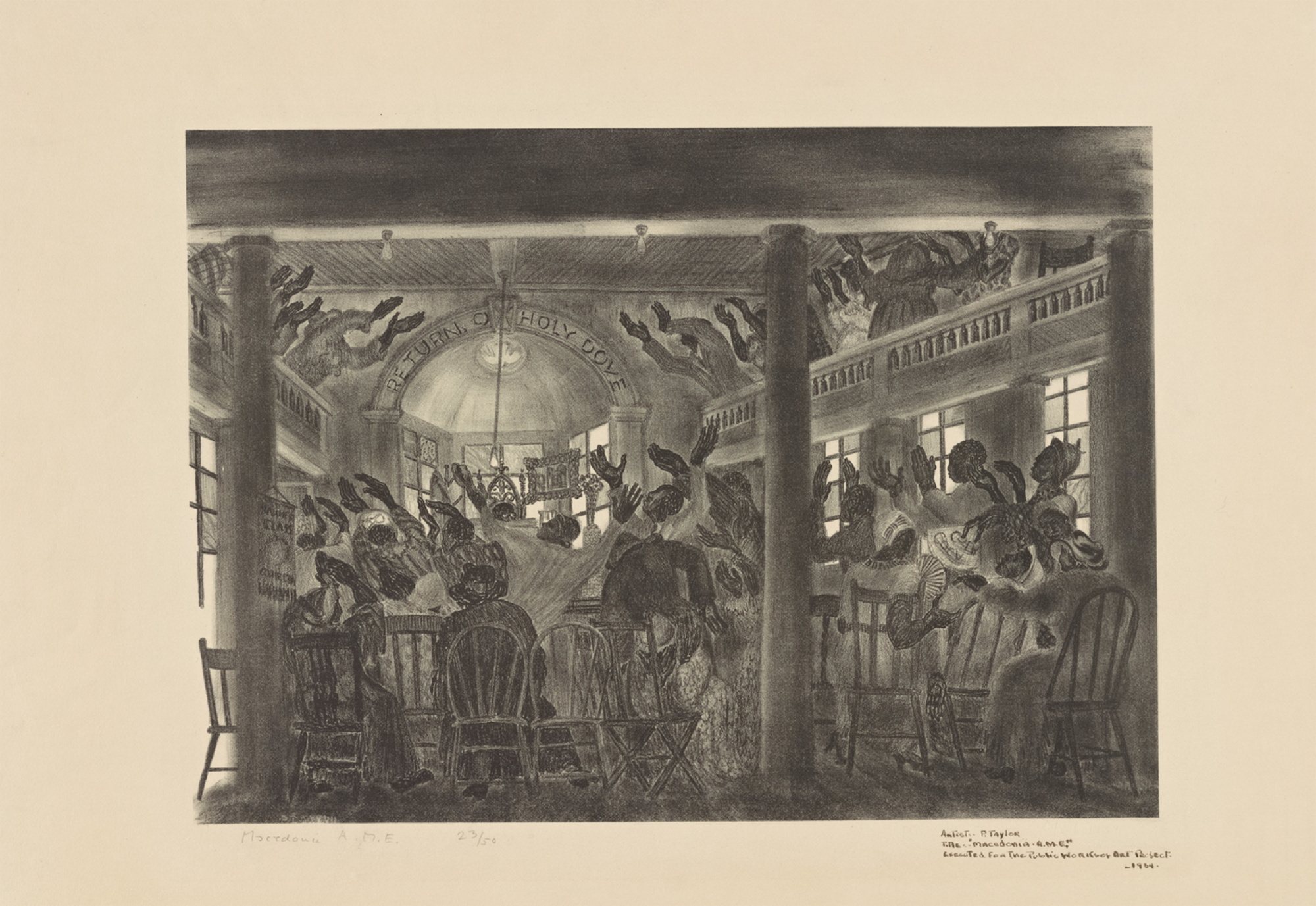
Schomburg Center for Research in Black Culture, Art and Artifacts Division, The New York Public Library. “Macedonia A.M.E.” The New York Public Library Digital Collections. 1934. https://digitalcollections.nypl.org/items/34c85050-2893-0132-2c34-58d385a7bbd0.
Spirituals are religious Black folksongs that speak to the experience of enslavement. Spirituals are different from hymns that emerged from Christianity as practiced by white Americans. As Robert Raboteau notes, whites and enslaved people imagined their version of Exodus in different ways: white settler communities envisioned America as the promised land, whereas enslaved people saw it as Egypt, a place of enslavement and suffering.[1] The theme of resistance and protest are embedded within spirituals:
Spirituals are also regarded as codified protest songs, with songs such as “Steal away to Jesus,” composed by Wallis Willis, being seen by some commentators as incitements to escape slavery. Because the Underground Railroad of the mid- nineteenth century used terminology from railroads as a secret language for assisting slaves to freedom, it is often speculated that songs like “I got my ticket” may have been a code for escape. Hard evidence is difficult to come by because assisting slaves to freedom was illegal. A spiritual that was certainly used as a code for escape to freedom was “Go down, Moses,” used by Harriet Tubman to identify herself to slaves who might want to flee north.[2]
It is, however, difficult to pin down the exact definition of spirituals. W.E.B. Du Bois called them “sorrow songs,” pointing out that through these songs, “the soul of the black slave spoke to men.”[3] These songs, as Du Bois writes, “breathe a hope—a faith in the ultimate justice of things…[faith in] that sometime, somewhere, men will judge men by their souls and not by their skins.”[4] He also places their origins in slavery in the South. Zora Neale Hurston disagreed with such a definition although not entirely; while Hurston agrees that spirituals are religious in nature, she asserts that their themes are not limited to sorrow. Spirituals are constantly evolving and are being “made and forgotten everyday.”[5] As such, Hurston did not see spirituals as a specific product of slavery only.
The idea that the whole body of spirituals are “sorrow songs” is ridiculous. They cover a wide range of subjects from a peeve to gossipers to Death and Judgment. The nearest thing to a description one can reach is that they are Negro religious songs, sung by a group, and a group bent on expression of feelings and not on sound effects.[6]
“Steal Away, Jesus” and “Swing Low, Sweet Chariot,” as noted in previous sections, were quite popular among Colored Conventions delegates and audiences. Both are attributed to Wallace and Minerva Willis, an enslaved couple who lived in Choctaw Nation in Oklahoma. Some scholarship also suggest that they composed the well-known spiritual “Roll, Jordan, Roll.”[7] The creation of spirituals among enslaved communities was crucial to the development of Black liberation theology. Through these songs, enslaved people identified their suffering with that of oppressed people in the Bible, resisted against the biblical interpretations of white enslavers, and imagined a future free of bondage.
Recordings of Black Spirituals
"Steal Away"
Listen to the Dinwiddie Colored Quartet’s rendition of “Steal Away.” [1]
Source
Cruder, Harry B., Dinwiddie Colored Quartet, Sterling Rex, Clarence Meredith, and J. Mantell Thomas. Steal Away. 1902. Audio. Retrieved from the Library of Congress, www.loc.gov/item/jukebox-4649/.
"Swing Low, Sweet Chariot"
Listen to the Fisk Jubilee Singers’ rendition of “Swing Low, Sweet Chariot.”[1]
Source
Work, John Wesley, Fisk University Jubilee Singers, Alfred Garfield King, Noah Walker Ryder, and J. A. Myers. Swing Low, Sweet Chariot. 1909. Audio. Retrieved from the Library of Congress, https://www.loc.gov/item/jukebox-128141/.
'Roll, Jordan, Roll"
Listen to the Fisk Jubilee Singers’ rendition of “Roll, Jordan, Roll.”[1]
Source
Work, John Wesley, Fisk University Jubilee Singers, Alfred Garfield King, Noah Walker Ryder, and J. A. Myers. Roll Jordan roll. 1909. Audio. Retrieved from the Library of Congress, www.loc.gov/item/jukebox-128182/.
"Nobody Knows de Trouble I've Seen"
Listen to a rendition of “Nobody knows de trouble I’ve seen” from 1917.[1]
Source
Burleigh, H. T., and Oscar Seagle. Nobody knows de trouble I’ve seen. 1917. Audio. Retrieved from the Library of Congress, www.loc.gov/item/jukebox-879940/.
"Go Down, Moses"
Listen to the Tuskegee Institute Singers’ rendition of “Go Down, Moses.”[1]
Source
Brown, Leroy, Tuskegee Institute Singers, Alvin J. Neely, Charles Edward Clayton, Alfred Taylor, William P. Smith, William J. Williams, and William Wiley. Go down Moses. 1914. Audio. Retrieved from the Library of Congress, www.loc.gov/item/jukebox-11026/.
REFERENCES
[1] Raboteau, Albert J. J. “African Americans, Exodus, and the American Israel.” In Down by the Riverside, edited by Larry G. Murphy, New York University Press, 2000, pp. 20–25.
[2] “African American Spirituals,” Library of Congress. Retrieved from the Library of Congress, www.loc.gov/item/ihas.200197495/.
[3] Du Bois, W.E.B. The Souls of Black Folk, A.C. McClurg, 1903, p. 250.
[4] Du Bois, The Souls of Black Folk, p. 261.
[5] Hurston, Zora Neale. “Spirituals and Neo-Spirituals (1934).” The New Negro: Readings on Race, Representation, and African American Culture, 1892-1938, edited by Henry Louis Gates and Gene Andrew Jarrett, Princeton University Press, 2007, p. 473. JSTOR, https://doi.org/10.2307/j.ctv1j6675s.91. Accessed 16 May 2023.
[6] Hurston, “Spirituals,” p. 473.
[7] Michener, Judith. “Willis, Uncle Wallace and Aunt Minerva,” The Encyclopedia of Oklahoma History and Culture, https://www.okhistory.org/publications/enc/entry.php?entry=WI018.
CREDITS
Written by Samantha de Vera.