
MUSIC IN THE COLORED CONVENTIONS
The AME Church and Afro-Protestant Leadership
The Black Church has been a highly influential force as African captives and their descendants had to reconstruct their social identities in the Americas. Frances Smith Foster and Eddie Glaude note that as a governing body, Black churches have instituted traditions and created social and political infrastructures that have been pivotal to the experience of Black people in North America. Black churches provided the seeding grounds for schools, hospitals, and banks. Furthermore, they also created spaces for civic engagement and social activism.
Convention minutes reaffirm that Afro-Protestant institutions were at the center of political organizing and social activism. Of the conventions in which singing was mentioned, two-thirds took place in churches, and one third of those took place in African Methodist Episcopal (AME) churches. Regardless of where conventions took place, almost all sessions were opened and adjourned by reverends. Mellonee Burnim points out that in Black religious practice, prayer and song were intertwined, as speech often led into song. Even as reverends led the congregation in prayer, verbal affirmations and singing in unison was expected and valued.[1] This practice of prayer and singing can be found in the minutes. That the audience often participated with the reverends in these activities created a structure of democratic leadership and civic participation, tying together rather than separating church and state.
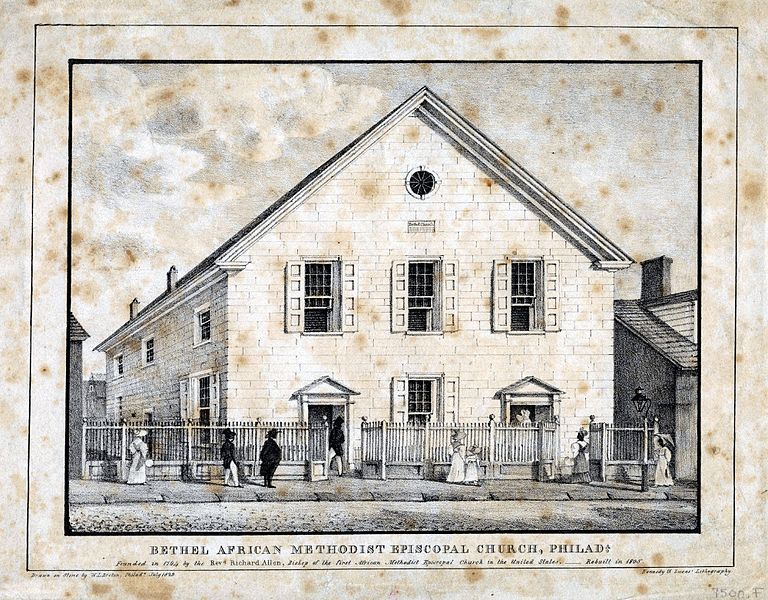
Image of the exterior of Bethel African Methodist Episcopal Church (1805). Source: Wikimedia Commons.
The African Methodist Episcopal (AME) Church has been one of the most influential religious institutions for African Americans. The AME church was founded in 1787 by Richard Allen. The denomination grew quickly, and churches were founded across the United States. AME hymnals were published in 1801, 1818, 1837, 1876, 1892, 1941, and 1954, providing a collection of songs that were familiar to AME church members across America.[2] Given that so many conventions took place at AME churches, it is highly likely that these songs were the very same songs that Colored Conventions delegates and audiences sang.
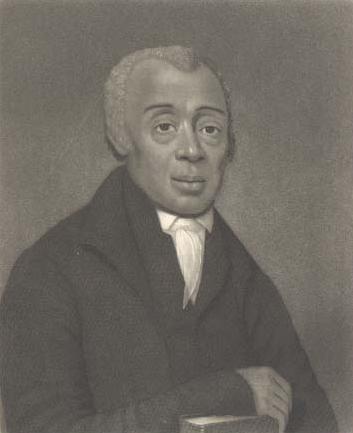
Portrait of Richard Allen, 1891, from the fronti iece of History of the African Methodist Episcopal Church. Source: Wikicommons.
Reverend Allen served as president of the 1830 National Convention of Free People of Colour held at the Mother Bethel AME Church in Philadelphia. Described as “the venerable Bishop Allen,” Richard Allen opened the first Colored Convention with prayer: “The delegation accordingly met in Bethel church, on the 20th September, at 10 o’clock, A. M. and after a chaste and appropriate prayer by the venerable Bishop Allen…”[3] He also delivered the convention’s address, supporting emigration to Canada. At the time, recent white terrorist attacks against Black communities compelled Black activists like Allen to find alternative paths to freedom. Allen was a monumental figure, an expert orator and spiritual leader, who, as Richard Newman notes, “commanded the respect of everyone around him.”[4] Allen is a key figure in the development of Black sacred music, publishing hymnals in 1801 and 1818.[5]
REFERENCES
[1] “Religious Music,” Mellonee Burnim. In Burnim, Mellonee V., and Portia K. Maultsby. African American Music: An Introduction. New York, NY Routledge, Taylor & Francis Group, 2015.
[2] Spencer, Jon M. Black Hymnody: A Hymnological History of the African-American Church. Knoxville: University of Tennessee Press, 1992.
[3] American Society of Free Persons of Colour (1830 : Philadelphia, PA), “Constitution of the American Society of Free Persons of Colour, for improving their condition in the United States; for purchasing lands; and for the establishment of a settlement in upper Canada, also, The Proceedings of the Convention with their Address to Free Persons of Colour in the United States,” Colored Conventions Project Digital Records, accessed May 9, 2023, https://omeka.coloredconventions.org/items/show/70.
[4] Newman, Richard S. Freedom’s Prophet: Bishop Richard Allen, the AME Church, and the Black Founding Fathers. New York University Press, 2008.
[5] For more about Allen’s hymnody, see Barron, Charrise, “Between Free Grace and Liberty: Richard Allen’s Evocations of Eschatological and Immediate Freedom,” in Jeremy Begbie, Daniel K. L. Chua, and Markus Rathey (eds.), Theology, Music, and Modernity: Struggles for Freedom (Oxford, 2021; online edn, Oxford Academic, 18 Feb. 2021), https://doi.org/10.1093/oso/9780198846550.003.0012, accessed 5 June 2023.
CREDITS
Written by Melissa Benbow.