
MUSIC IN THE COLORED CONVENTIONS
Black Civil War Soldiers

“[Arlington, Va. Band of 107th U.S. Colored Infantry at Fort Corcoran],” William Morris Smith, , Library of Congress, 1864. Accessed May 6, 2023: https://www.loc.gov/pictures/item/2018667039/.
The minutes of the 1865 State Convention in Harrisburg, Pennsylvania note that a soldier was invited to sing. Referred to only as “Mr. De Grath,” the soldier enlivened the mood of the audience. Considering that De Grath was a veteran of the Civil War, which had ended several months before this convention, the audience must have had an emotional response. Perhaps De Grath sang the “John Brown Song,” “My Country Tis of Thee,” or another wartime song. The identity of Mr. De Grath is unclear, although he may have been Frank Grath, a quartermaster sergeant of 111th Infantry, US Colored Troops.[1]
“The John Brown Song” was the second most mentioned song in the conventions, after the Doxology/”Praise God From Whom All Blessings Flow.” It was created in 1859 after the death of John Brown, a white radical abolitionist and insurrectionist who attempted to foment a slave revolt at Harpers Ferry. The song, sung to the tune of the famous “The Battle Hymn of the Republic” song, was a very popular marching song among Union troops. Likewise, convention participants performed the song most often during the Civil War years. Both songs include the chorus “Glory, glory, hallelujah,” but the lyrics of “John Brown’s Body” explicitly celebrates the Union cause and proclaims that John Brown’s spirit lives on (“He’s gone to be a soldier in the army of the Lord!”), transcending his physical death. The song, first sang at Fort Warren on May 12, 1861, also anticipates Union victory: “They will hang Jeff Davis to a sour apple tree!”[2]
Click on the audio recordings below to listen and compare “John Brown’s Body” with “The Battle Hymn of the Republic.”[3]
"John Brown's Body"
Source
Steffe, William, William Steffe, and J. W Myers. John Brown’s body. 1902. Audio. Retrieved from the Library of Congress, www.loc.gov/item/jukebox-360367/.
"The Battle Hymn of the Republic"
Source
Steffe, William, et al. The Battle Hymn of the Republic. U.S. Army Band. Audio. Retrieved from the Library of Congress, www.loc.gov/item/ihas.100010422/.
The song often elicited enthusiasm among audiences in Colored Conventions held in 1865. Immediately after the war, Black people organized hundreds of Colored Conventions in states that have never held them before. The popularity of an anti-slavery and anti-Confederate song that venerated a militant abolitionist marked a profound change in national politics, one that Black communities celebrated. Among the conventions where “John Brown’s Body was sung” was First Annual Meeting of the National Equal Rights League in Cleveland, which opened its evening session with the song. At the Equal Rights’ Convention held in Harrisburg, delegates David B. Bowser and Davis D. Turner led the audience to sing “John Brown’s Body.” Moreover, “A collection was then taken up, and ‘John Brown’s’ song sung by the audience with great enthusiasm” during the Connecticut State Convention of Colored Men.[4]
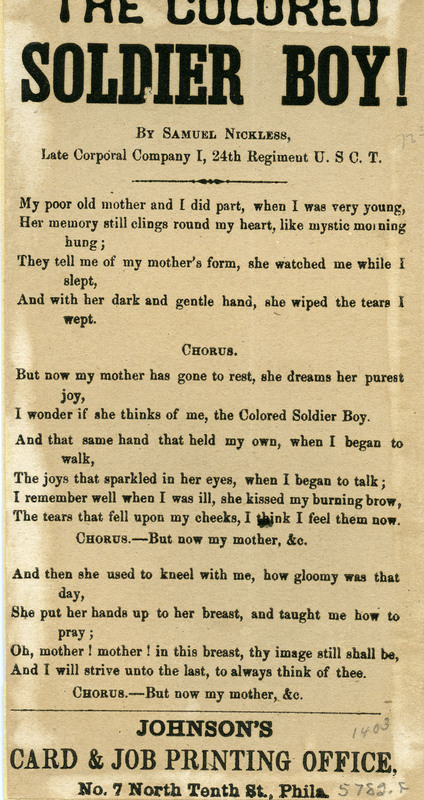
It is also possible that Mr. De Grath sang “The Colored Soldier Boy!,” composed by Black officer Samuel Nickless. Prior to his enlistment, Nickless worked as a barber in Philadelphia.[5] “The Colored Soldier Boy!” stands out among songs about USCT soldiers at the time, a lot of which were written by white minstrel composers and, as such, contain denigrating depictions of Black men. These minstrel songs often include stereotyped vernacular and paint a patriarchal relationship between Black soldiers and Abraham Lincoln or Union generals. In contrast, Nickless’s song expresses longing for one’s mother who has passed. It speaks of the pain of separation, and it does not include explicit references to plantations and enslavers. Instead, it professes to keep the memory of one’s mother alive. See the lyrics of “The Colored Soldier Boy!” below.
“The Colored Soldier Boy!” by Samuel Nickless
My poor old mother and I did part, when I was very young,
Her memory still clings round my heart, like mystic morning
They tell me of my mother’s form, she watched me while I slept,
CHORUS.
But now my mother has gone to rest, she dreams her purest joy,
I wonder if she thinks of me, the Colored Soldier Boy.
And that same hand that held my own, when I began to walk.
The joys that sparkled in her eyes, when I began to talk;
I remember well when I was ill, she kissed my burning brow.
The tears that fell upon my cheeks, I think I feel them now.
CHORUS.—But now my mother, &c.
And then she used to kneel with me, how gloomy was that
She put her hands up to her breast, and taught me how to pray;
Oh, mother! mother! in this breast, thy image still shall be.
And I will strive unto the last, to always think of thee.
CHORUS.—But now my mother, &c.
SOURCE
Nickless, Samuel. “The Colored Soldier Boy!,” Johnson’s Card & Job Printing Office, 1864. Retrieved from Duke University Libraries Exhibit, https://exhibits.library.duke.edu/items/show/7003.
References
[1] “Grath, Frank,” Compiled Military Service Records of Volunteer Union Soldiers Who Served the United States Colored Troops: 56th-138th USCT Infantry, 1864-1866, Record Group 94, National Archives and Records Administration, Fold3.com. Retrieved from https://www.fold3.com/image/302907169.
[2] Nudelman, Franny. John Brown’s Body: Slavery, Violence, and the Culture of War, University of North Carolina Press, 2015, p. 14.
[3] Steffe, William, J. W Myers, and William Steffe. John Brown’s body. 1902. Audio. Retrieved from the Library of Congress, www.loc.gov/item/jukebox-360367/; and Steffe, William, et al. The Battle Hymn of the Republic. U.S. Army Band, 1861. Audio. Retrieved from the Library of Congress, www.loc.gov/item/ihas.100010422/.
[4] “Proceedings of the Conn. State Convention of Colored Men, Held at New Haven, June 6th and 7th, 1865.,” Colored Conventions Project Digital Records, accessed May 8, 2023, https://omeka.coloredconventions.org/items/show/1220.
[5] Samuel Nickless’s last name also appears in the records as “Nichols” and “Nickles.” “Nickless, Samuel,” Compiled Military Service Records of Volunteer Union Soldiers Who Served the United States Colored Troops: 20th-25th USCT Infantry, 1864-1866, Record Group 94, National Archives and Records Administration, Fold3.com. Retrieved from https://www.fold3.com/image/265294088.
Credits
Written by Samantha de Vera and Melissa Benbow.