
MUSIC IN THE COLORED CONVENTIONS
CHOIRS
The Colored Conventions movement used Black churches as spaces for political gatherings and spiritual exercise. Convention organizers never lost sight of the importance of music, and so delegates invited the churches’ choirs to perform. The 1855 and 1856 California State Colored Conventions were held in Sacramento’s AME Church, and in both conventions, the church’s choir were invited to perform. The choir at the 1855 convention chanted the Psalm of David (“The earth is the Lord’s and the fullness thereof”). Although the minutes do not indicate other songs, it is likely that the choirs drew from the AME Church’s hymn book.
Choirs were not limited to hymns. At the first Colored Convention held in Illinois in 1853, delegate C.W. Campbell led his choir to sing the anti-slavery song, “Emancipation Song.” Spirits were high at the 1853 convention as the audience was excited to see and hear Frederick Douglass. However, Douglass could not make it on the first day of the convention, much to everyone’s dismay. He arrived the next day and delivered a speech on the last day of the convention:
After the adoption of a number of resolutions of thanks to the officers of the Convention, to C. W. Campbell and his choir, etc., and the election of officers of the School Board, the immense crowd becoming impatient to hear Frederick Douglass, there was one deafening shout throughout the hall for Douglass. He came forward, and made one of his happy and soul-stirring speeches, which was listened to with much interest by the people, and sat down amid the plaudits of the whole house.
The choir, with its enchanting power, then sang, in an animated manner–
FREEDOM’S GLORIOUS DAYLet waiting throngs now lift their voices, As Freedom’s glorious day draws near; While every gentle tongue rejoices, And each bold heart is filled with cheer,” &c., &c.[1]
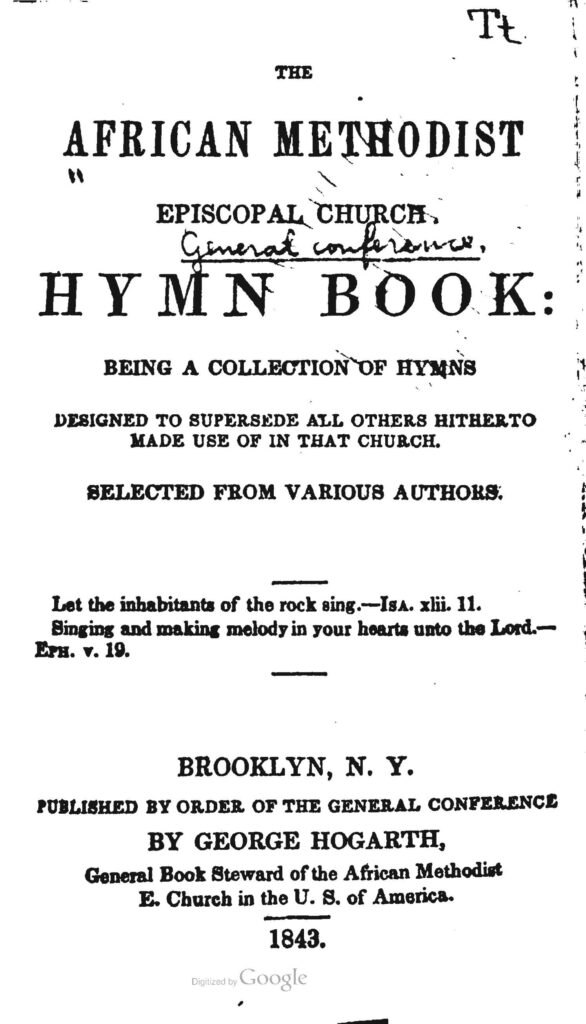
The African Methodist Episcopal Church Hymn Book, 1843. Source: Google Books.
Here, the choir served to complement the excitement over Douglass’s speech. As William Wells Brown’s Anti-Slavery Harp indicates, “Emancipation Song” was sung to the tune of “Crambambuli,” a traditional German song celebrating a type of wine. Listen to the tune of “Crambambuli” here and read the lyrics of “Emancipation Song” below.
“Emancipation Song”
Let waiting throngs now lift their voices,
As Freedom’s glorious day draws near,
While every gentle tongue rejoices,
And each bold heart is filled with cheer;
The slave has seen the Northern star,
He’ll soon be free, hurrah, hurrah!
Though many still are writhing under
The cruel whips of “chevaliers,”
Who mothers from their children sunder,
And scourge them for their helpless tears—
Their safe deliverance is not far!
The day draws nigh!—hurrah, hurrah!
Just ere the dawn the darkness deepest
Surrounds the earth as with a pall;
Dry up thy tears, O thou that weepest,
That on thy sight the rays may fall!
No doubt let now thy bosom mar;
Send up the shout—hurrah, hurrah!
Shall we distrust the God of Heaven?—
He every doubt and fear will quell;
By him the captive’s chains are riven—
So let us loud the chorus swell!
Man shall be free from cruel law,—
Man shall be MAN!—hurrah, hurrah!
No more again shall it be granted
To southern overseers to rule—
No more will pilgrims’ sons be taunted
With cringing low in slavery’s school.
So clear the way for Freedom’s car—
The free shall rule!—hurrah, hurrah!
Send up the shout Emancipation—
From heaven let the echoes bound—
Soon will it bless this franchised nation,
Come raise again the stirring sound!
Emancipation near and far—
Swell up the shout—hurrah, hurrah!
Black choirs were central to the development of Black gospel music in the twentieth century. As they performed traditional hymns, anti-slavery songs, and spirituals, they helped preserve musical traditions that would later give birth to different musical genres distinct to Black culture, such as Black gospel music. “African American Gospel music is a form of euphoric, rhythmic, spiritual music rooted in the solo and responsive church singing of the African American South. Its development coincided with—and is germane to—the development of rhythm and blues.”[2] As Colored Convention delegates and audiences incorporated singing during the proceedings, they drew upon long-held traditions that intertwined acts of resistance and music. The two could not be disentangled from one another. Spirituals and anti-slavery songs enlivened the Colored Conventions movement much in the same way gospel music did with the Civil Rights movement of the 1960s.
REFERENCES
[1] First Convention of the Colored Citizens of the State of Illinois (1853 : Chicago, IL), “Proceedings of the First Convention of the Colored Citizens of the State of Illinois, Convened at the City of Chicago, Thursday, Friday and Saturday, October 6th, 7th and 8th, 1853.,” Colored Conventions Project Digital Records, accessed May 12, 2023, https://omeka.coloredconventions.org/items/show/261.
[2] “African American Gospel.” Retrieved from the Library of Congress, https://www.loc.gov/collections/songs-of-america/articles-and-essays/musical-styles/ritual-and-worship/african-american-gospel/.
CREDITS
Written by Samantha de Vera.