
Music in the Colored Conventions
MUSIC AND ACTIVISM THROUGH THE YEARS
As the Colored Conventions movement was tapering in the late nineteenth century, new Black movements were emerging. These movements had, in one way or another, roots in the Colored Conventions movement; Black women, who had been previously marginalized in Colored Conventions, went on to organize a club movement of their own. Younger generations of activists, whose parents had been Colored Conventions delegates and organizers, founded organizations and led the fight against white supremacist laws and terrorism. Figures like Marcus Garvey continued the work of Bishop Henry McNeal Turner, bringing Black nationalism to an unprecedentedly large platform and scale.
At the turn of the century, writer and activist James Weldon Johnson and his brother, John Rosamond Johnson, wrote and composed what would become known as “the Black National Anthem”: “Lift Every Voice and Sing.” James Weldon Johnson later on led the National Association for the Advancement of Colored People (NAACP), and the organization adopted the hymn. The twentieth century witnessed the rise of generations of Black activists and organizers who picked up the mantle, keeping the spirit of the Colored Conventions movement alive even as the conventions slipped from public memory. Music remained integral to Black activism, and just as convention delegates and audiences sang together, every march and gathering led by Black activists incorporated singing.
"Lift Every Voice"
Listen to The Southern Son’s 1942 rendition of “Lift Every Voice and Sing” below.
As African Americans organized new movements to respond to changing social, political, and economic conditions, likewise, Black music evolved and new forms emerged. In the South, African Americans developed the blues, drawing from spirituals, work songs, and other Black musical and oral traditions. Blended with blues, ragtime, and marches, jazz spread throughout the nation and outside of the US. For many Black musicians, their art and activism could not be disentangled. Jazz artist Billie Holiday’s “Strange Fruit” exemplifies Black musical activism in the first half of the twentieth century. Adapted into a song from Abel Meeropol’s poem of the same title, “Strange Fruit” protested the lynchings of African Americans, poetically detailing its brutalities. The FBI relentlessly and unjustly targeted Billie Holiday for her musical activism. Although protest came with consequences, Black musicians continued to wield their talent against white supremacy. Listen to their songs below:
Billie Holiday's "Strange Fruit"
Sam Cooke's "A Change is Gonna Come"
Nina Simone's "Mississippi Goddam"
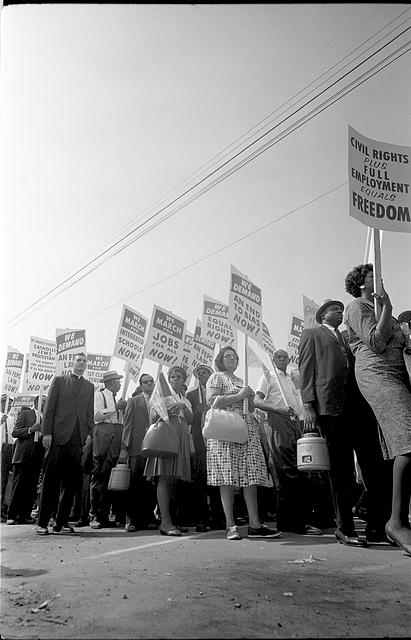
Trikosko, Marion S, photographer. Demonstrators marching in the street holding signs during the March on Washington,/ MST. Photograph. Retrieved from the Library of Congress.
Gospel and blues were consistent features of the Civil Rights movement. As ethnomusicologist and scholar Charisse Barron shows, faith and social justice are closely intertwined in Black movements. It is no surprise, therefore, that gospel songs served as rallying songs during the Civil Rights era. Gospel music took off in the 1930s. Spirituals are widely believed to be the precursor to gospel music, as both are rooted in folk traditions. As Joyce Marie Jackson notes, “While gospel music is strongly entrenched in the African American ‘folk church’ tradition, it also attracts many who identify as much with its expression of African American values, aesthetics, and life experiences as with its expression of religion.”[1] Musician and composer Thomas Andrew Dorsey, considered the father of gospel music, “pioneered the form,” writing thousands of gospel songs.[2] Collaborating with Mahalia Jackson, the two “[spread their vision] through their alliance with a few like minded musical pioneers to form the National Convention of Gospel Choirs and Choruses, which is still thriving today.”[3] Mahalia Jackson enjoyed international renown as an artist, earning the title Queen of Gospel. She was also an integral figure in the Civil Rights movement. During the historic March on Washington for Jobs and Freedom on August 28, 1963, Mahalia Jackson sang “How I Got Over” and “I Been ‘Buked and I Been Scorned” before Martin Luther King Jr.’s momentous “I Have a Dream” speech. As Black artists performed before activist audiences, they kept the tradition of call-and-response alive, reminding listeners that they were together in their struggle.
Mahalia Jackson
Mahalia Jackson was fully committed to social justice. As Craig Werner writes, her presence at the March was no accident; “During the early days of the Montgomery bus boycott, Mahalia met King and Ralph Abernaty at the 1955 National Baptist Convention meeting in Denver. When the two young ministers asked her to lend her voice to the struggle, she embraced the opportunity.”[4] Jackson also performed rallying songs during the bus boycott in spite of the dangers it posed to her safety.
"How I Got Over" by Mahalia Jackson at MLK's Civil Rights Campaign (Washington, 1963)
SNCC Freedom Singers
The SNCC (Student Nonviolent Coordinating Committee) Freedom Singers was a group formed by Cordell Reagon and Bernice Johnson Reagon in October 1962 to raise money for SNCC. The group consisted of Bernice Johnson Reagon, Rutha Harris, Charles Neblett, and Bertha Gober, all of whom were trained musicians and SNCC field secretaries. They, much like the delegates of the Colored Conventions, incorporated singing into their political activism. The SNCC Freedom Singers toured until 1966, but reunited throughout the years to perform, and in 2010 some members of the group performed for then President Barack Obama at the White House.
Watch the video below to see the group perform “We Shall Not Be Moved” at the March on Washington for Jobs and Freedom in Washington D.C. on August 28, 1963.
The Freedom Singers perform "We Shall Not Be Moved" at the March on Washington, 1963
Songs of the Black Lives Matter Movement
The Black Lives Matter movement has likewise produced a number of songs protesting the killings of Black people by the police. Although the movement gained traction years before the pandemic, the murders of Breonna Taylor (March 13, 2020) and George Floyd (May 25, 2020) by police incited an unprecedented wave of protests in the US and throughout the globe, as people from different nations saw on video—some for the first time—what white supremacist violence looked like in the US. As activists organized protests and rallies, Black artists created music to express the movement’s struggle and hopes. In some songs, artists use the phrase and popular hashtag “say her name,” a rallying cry to call attention to Black women, whose deaths have been overshadowed. Other musicians incorporated Floyd’s last words, “I can’t breathe,” reminding listeners how police brutality and white supremacy are literally and figuratively suffocating.
Listen to some of the songs inspired by and/or adopted by the Black Lives Matter movement: Beyonce, “Freedom”; H.E.R, “I Can’t Breathe”; Kendrick Lamar, “Alright”; Janelle Monae, “Hell You Talmbout”; and Prince feat. Eryn Allen Kane, “Baltimore.”
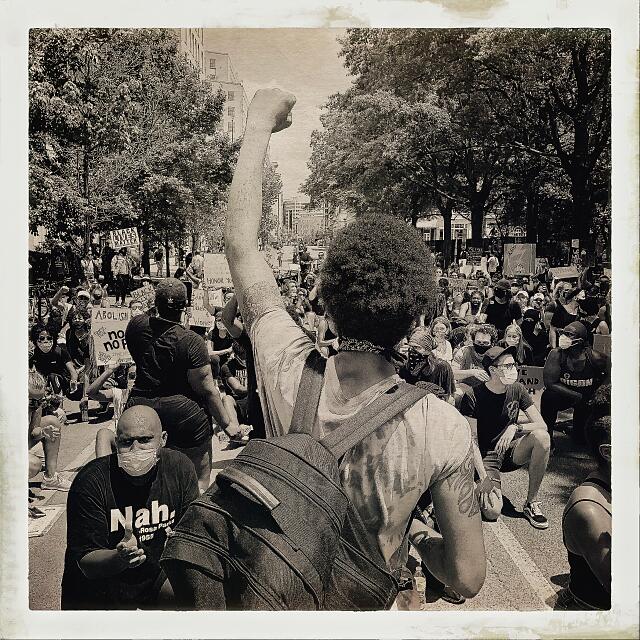
Meehleib, Tracy, photographer. Black Lives Matter rally H Street, Washington, DC. June 4. Photograph. Retrieved from the Library of Congress.
REFERENCES
[1] Jackson, Joyce Marie. “The Changing Nature of Gospel Music: A Southern Case Study.” African American Review, vol. 29, no. 2, 1995, pp. 185–200. STOR, https://doi.org/10.2307/3042290. Accessed 6 June 2023.
[2] “African American Gospel,” Library of Congress. Retrieved from the Library of Congress, Retrieved from https://www.loc.gov/collections/songs-of-america/articles-and-essays/musical-styles/ritual-and-worship/african-american-gospel#.
[3] “African American Gospel,” Library of Congress.
[4] Werner, Craig. A Change is Gonna Come: Music, Race, and the Soul of America, University of Michigan Press, 2006, 5.