
THE FIGHT FOR BLACK MOBILITY: TRAVELING TO MID-CENTURY CONVENTIONS
MARY WEARS DORSEY
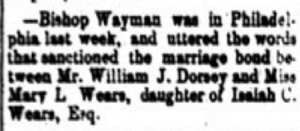
Notice of Mary Wears’s marriage. “Bishop Wayman was in Philadelphia last week,.” The Christian Recorder, 25 Feb. 1886. From Accessible Archives © 2016 Accessible Archives Inc
A school teacher and sometime essayist, Mary Wears Dorsey, daughter of delegate Isaiah C. Wears, was born around 1845.[note]”United States Census, 1850,” and “United States Census, 1880,” Ancestry Library Edition, accessed 19 Mar 2013.[/note] She spoke publicly at holiday events and, along with her family, associated with the “who’s who” of Philadelphia.[note]Silcox, Harry C, “The Black “Better Class” Political Dilemma: Philadelphia Prototype Isaiah C. Wears,” Pennsylvania Magazine of History and Biography 113.1 (Jan. 1989): 45-66.[/note] Through the Union A.M.E. she came to know other prominent African Americans, like Andrew Burris and Anthony L. Stanford.[note]“Philadelphians, Adieu,” The Christian Recorder, 25 May 1867, accessed 19 Mar 2013.[/note] She married William J. Dorsey in 1886.[note]“Bishop Wayman was in Philadelphia Last Week.” The Christian Recorder. 25 feb. 1886[/note] Beyond this, little information is known of her life.
While it is not clear whether Mary Wears Dorsey attended conventions, it is likely that she did, given her position in the Philadelphia community as a member of the influential and publicly active Wears family. Mary did participate in local events such as the annual church Thanksgiving celebration.[note]“Thanksgiving,” The Christian Recorder, 3 Dec. 1864, accessed 19 Mar 2013; “Thanksgiving Day,” The Christian Recorder, 10 Dec. 1864, accessed 19 Mar 2013.[/note] In 1864 she spoke publicly on the “Uses of Adversity,” reminding her audience that “the Lord loveth those whom he chastises.”[note]ibid., 10 Dec. 1864.[/note] On another occasion, she delivered an original essay that was “so full of feeling and pathos…that every eye was bedewed with a tear, in fact, some of the children cried aloud.”[note]“Philadelphians, Adieu,” The Christian Recorder, 25 May 1867, accessed 19 Mar 2013.[/note]What little is known of Mary Wears Dorsey must be deduced from the few extant records of her life. Importantly, though, incomplete data ought not preclude serious appreciation of her work. Archival silences work very much according to the patriarchal and racial structures of Mary’s time. That is, the politics of naming and of marking race in nineteenth-century government documents renders definitive biographical data questionable for persons of color, as scholar Yen Le Espiritu has argued.[note]Espiritu, Yen Le, Asian American Panethnicity: Bridging Institutions and Identities, (Philadelphia: Temple UP, 1992): 113-114.[/note] Even though it just might be possible to trace Mary in government records using her married name, we cannot trust markers of race and other personal identifiers (e.g. birthplace) to be accurately recorded by government workers.
Credits
Jessica D. Conrad, English 634, Spring 2013. Taught by Professor P. Gabrielle Foreman, University of Delaware.