
THE FIGHT FOR BLACK MOBILITY: TRAVELING TO MID-CENTURY CONVENTIONS
JACOB R. GIBBS
Jacob R. Gibbs had not been a resident of New York for long when he attended the National Colored Convention of 1855 as a delegate from the state of New York. Gibbs was originally from Baltimore, Maryland and lived there at least until 1845, when his name appeared in The Sun as part of a list requesting that certain citizens pick up letters that the post office was holding for them.[note]“List of Letters.” The Sun [Baltimore, MD]. 15 Feb. 1845: 1. America’s Historical Newspapers. Web. 8 Mar. 2013.[/note] Gibbs’s date of birth is uncertain due to two conflicting records. First, there is a list of passengers arriving in Baltimore that indicates Jacob Gibbs’s age as 40 in the year 1840; its lack of detail implies that that was probably an estimation.[note]Ancestry.com. Baltimore, Passenger Lists, 1820-1948 and 1954-1957 [database on-line]. Provo, UT, USA: Ancestry.com Operations Inc, 2006. Web. 8 Mar. 2013.[/note] The death certificate from Connecticut declaring that Jacob R. Gibbs died on June 11, 1867, at the age of 62 is more likely to be accurate.[note]Ancestry.com. Connecticut, Deaths and Burials Index, 1650-1934 [database on-line]. Provo, UT, USA: Ancestry.com Operations, Inc., 2011. Web. 8 Mar. 2013.[/note] Due to the scarcity of information in the death certificate, it is difficult to determine with complete certainty that it is referring to the same Jacob R. Gibbs from the Philadelphia convention. However, considering his lifelong mobility, it is highly likely that he did indeed end up in Connecticut. Just two years after the convention, in fact, Gibbs traveled to San Francisco to assist in the induction of new members to the Freemasons; according to the California paper Mirror of the Times, he was acting as the “P. Deputy G.M. of the United Grand Lodge of N.Y. State” at that time.[note]“Masonic Notice.” Mirror of the Times [San Francisco, CA] 12 Dec. 1857: n. pag. Ancestry.com. Web. 8 Mar. 2013.[/note]
While living in the slave state of Maryland, Gibbs worked as a painter while also secretly assisting the Underground Railroad.[note]C. Peter Ripley, ed. The Black Abolitionist Papers: Vol. III: The United States, 1830-1846. The University of North Carolina Press, 1991. Print.[/note] He “aided as many as two thousand fugitives” before moving to New York, where he continued to provide a refuge for runaways while becoming a more vocal member of colored society.[note]Ibid.[/note] In William Still’s collection The Underground Railroad, Gibbs is mentioned several times as harboring runaway slaves in New York City. S. H. Gay wrote, “There is now no other sure place, but the office, or Gibbs’, that I could advise you to send [fugitives].”[note]Still, William. The Project Gutenberg EBook of The Underground Railroad. Amy Overmyer and the PG Online Distributed Proofreading Team, 2005. Web. 8 March 2013. [/note] This was Gibbs’s greatest passion, which is evidenced in his speech recorded by the The North Star from a meeting of Black citizens in New York in 1850. He was quite angered at the recent passage of the Fugitive Slave Act, and the minutes of the meeting summarized his emotional speech as: “[Gibbs] will give assistance and shelter to every fugitive that wants it, and the bloodhounds of the law are welcome to take his life.”[note]“Meetings of Colored Citizens of New York.” The North Star [Rochester, NY] 24 Oct. 1850: n. pag. Accessible Archives. Web. 8 Mar. 2013.[/note]
Although much of Gibbs’s activism was directed toward assisting runaway slaves, he clearly cared deeply about the rights of all African Americans. His leadership position in the Freemasons demonstrates that he believed in the importance of education, which was a major theme of the 1855 National Colored Convention. Currently, the Freemasons provide “millions of dollars in scholarships each year,” and it is quite likely that with that mindset, Gibbs would have been in favor of the Industrial School that was discussed at the 1855 National Colored Convention.[note]“Freemasonry Explained.” Michigan Masons. Grand Lodge of Michigan, 2008. Web. 8 Mar. 2013.[/note] Having lived in a slave state for the first half of his life, he understood the importance of providing opportunities for African Americans to escape from both literal and societal bondage.
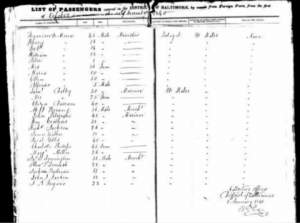
This is a list of passengers arriving at Baltimore, Maryland, in December of 1840, and it includes Jacob R. Gibbs. Courtesy of Ancestry.com.
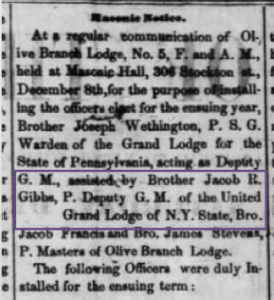
“Masonic Notice.” Mirror of the Times. Courtesy of Ancestry.com.
“Special Notices. Call for a State Convention of the Colored People of the State of New York.” Frederick Douglass’ Paper. Courtesy of Accessible Archives.
“Letter From New York.” The National Era. Courtesy of Accessible Archives.
Credits
Submitted anonymously, University of Delaware.
Revised and Edited by Gwendolyn Meredith, University of Delaware.