
THE FIGHT FOR BLACK MOBILITY: TRAVELING TO MID-CENTURY CONVENTIONS
CHARLES BENNETT RAY
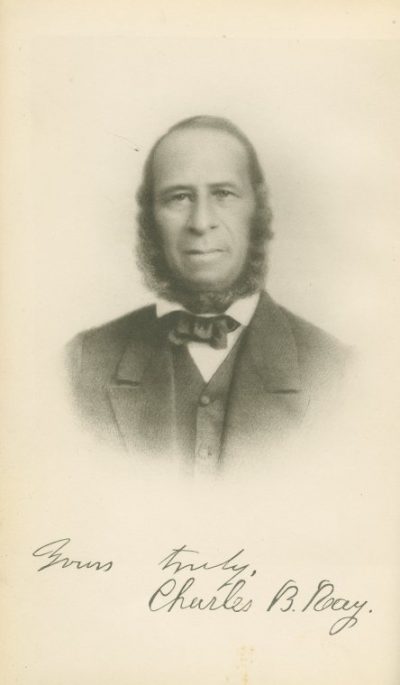
Portrait of Rev. Charles B. Ray of New York City. Ray was an active conductor on the Underground Railroad, editor of The Colored American, and a prominent minister and business owner. Image courtesy of northcountryundergroundrailroad.com
Charles Bennett Ray (1807-1886), born free in Falmouth, Massachusetts, was a well-known anti-slavery activist, newspaper journalist, editor, and ordained minister. In 1834, Ray married Henrietta Green Regulus, but she died two years later. Ray remarried Charlotte Augusta Burroughs in 1840. The Rays raised seven children.[note]Ray, Cordelia H. and Florence Ray. Sketch of the Life of Rev. Charles B. Ray. New York: Press of J. J. Little, 1887, 8.[/note] Several of the Ray daughters became notable professionals in law and education. After graduating from Howard University School of Law, Charlotte E. Ray became the first African American woman lawyer in the United States.[note]“Miss Charlotte E. Ray,” Weekly Louisianan, May 25, 1872.[/note] Henrietta Cordelia and Florence Ray were New York City public school teachers, biographers, and poets. H. Cordelia and Florence co-penned a biography of their father’s life, Sketch of the Life of Rev. Charles B. Ray, in 1887, a year after Ray’s death.
Charles B. Ray became affiliated with the abolition movement and pursued business ventures through various mediums including educational attainment, newspaper editing, and entrepreneurship. Ray spent his earliest years balancing formal studies in academies located in the reportedly picturesque Falmouth village, with working on his grandfather’s farm in Westerly, Rhode Island.[note]Ray, Cordelia H. and Florence Ray. Sketch of the Life of Rev. Charles B. Ray. New York: Press of J. J. Little, 1887, 8.[/note] Ray later studied at Wesleyan Seminary at Wilbraham, Massachusetts where he received a theological education.[note]Ray, Cordelia H. and Florence Ray. Sketch of the Life of Rev. Charles B. Ray. New York: Press of J. J. Little, 1887, 8.[/note] Ray entered Wesleyan University in Middletown, Connecticut in 1832 as the institution’s first African American pupil. However, Ray soon withdrew from Wesleyan U. due to white student protests and racial prejudice in 1833.[note]Ray, Cordelia H. and Florence Ray. Sketch of the Life of Rev. Charles B. Ray. New York: Press of J. J. Little, 1887, 8.[/note] Ray resettled in New York City where he opened the Boot and Shoemaker Shop at No. 527 Pearl Street. The shop was adjacent to the popular Pearl Street residential and business district. Ray’s business expanded and formed a partnership with Samuel Cornish, boot maker, abolitionist, and editor of Freedom’s Journal, the nation’s first African American newspaper. Ray’s ties with Cornish created other connections with prominent Black leaders in the city. Before becoming a proprietor of The Colored American (1836-1842) in 1838 and editor in 1839, he worked as an itinerant journalist and subscriptions agent for the periodical, “a paper of acknowledged ability.”[note]“Death of Charles B. Ray,” New York Freeman, Aug. 21, 1886.[/note] Although short-lived, the The Colored American was considered to be a predecessor of the Anglo-African and won Ray the reputation as “a pioneer of colored literature in New York” by the editorial staff for the California paper, The Elevator.[note]“Our Papers,” The Elevator, December 12, 1874.[/note]
In 1837, a debate over the Anti-Slavery Society’s view on non-resistance caused a political divide between Black New York leaders in attendance. Charles Ray was deeply involved in the debate as he advocated the continuation of non-resistance. This debate sparked a divide that would persist among the Black leaders of New York and continue to split views regarding other significant issues for over ten years. In 1849 at a meeting at Shiloh Presbyterian Church, Ray gave a speech opposing colonization in response to the ACS and Henry Highland Garnet’s support for emigration. Ray was also against female participation in political meetings and Colored Conventions. He was known as an enthusiastic campaigner for Black suffrage and education, and he fervently believed in the power of Black unity to overcome white oppression.
Between 1840 and the late 1880s, Charles B. Ray remained engaged in church leadership, missionary work and political activism. Strongly devoted to his theological roots while in New York, Ray worshipped with the Crosby Street Congregational Church and later pastored at Bethesda Congregational Church from 1845 to 1868. Bethesda Congregational Church occupied many edifices in New York City, including a site on Sullivan Street and another on Sixth Avenue.[note]Ray, Cordelia H. and Florence Ray. Sketch of the Life of Rev. Charles B. Ray. New York: Press of J. J. Little, 1887, 18.[/note] In the 1840s and 50s, Ray was actively involved in and founded many organizations, including the Society for the Promotion of Education Among Colored Children, New York State Vigilance Committee, American Missionary Association, the African Society for Mutual Relief, the Manhattan Congregational Association, and the Congregational Clerical Union.[note]Ray, Cordelia H. and Florence Ray. Sketch of the Life of Rev. Charles B. Ray. New York: Press of J. J. Little, 1887, pp. 19, 13, 30.[/note] Ray represented New York at many national colored men’s conventions and was a firm supporter of the Liberty Party. An avid supporter of fugitive slaves and their well-being, Ray worked as an agent on the Underground Railroad and held executive positions in fugitive slave conventions such as the 1850 Cazezevia Convention.[note]“Cazezevia Convention,” The North Star, September 5, 1850.[/note] Ray’s interracial company of contemporaries included Joshua Leavitt, Oliver Johnson, Sidney Howard Gay, Arthur and Lewis Tappan, Theodore S. Wright, Rev. Henry Highland Garnet, Samuel E. Cornish, Charles L. Reason, and Frederick Douglass.[note]“Death of Charles B. Ray,” New York Freeman, Aug. 21, 1886.[/note] In 1886 Charles B. Ray died in New York City and is buried in Cypress Hills Cemetery at 833 Jamaica Ave. in Brooklyn, New York.
Credits
Written by Sarah Patterson, Black Literary History taught by P. Gabrielle Foreman, Spring 2013.
With contributions from Elizabeth Sobel, Black Literary History taught by P. Gabrielle Foreman, Spring 2013.