
MURAL EXHIBIT: THE COLORED CONVENTIONS MOVEMENT AND BEYOND IN PHILADELPHIA
BISHOP RICHARD ALLEN
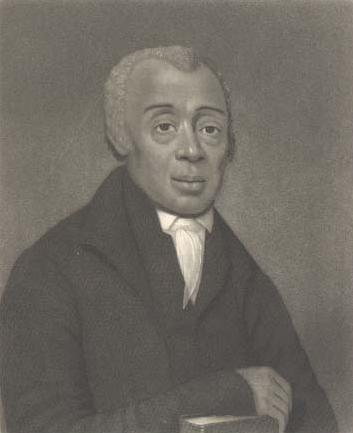
Bishop Richard Allen portrayed in Daniel Payne’s History of the African Methodist Episcopal Church (1891).
Bishop Richard Allen (February 14, 1760 – March 26, 1831) was an esteeemed minister, activist, educator, and writer. Aptly called a Black founding father, Allen was likely the most influential Black thinker in the early nineteenth century. Allen was born enslaved until he bought his freedom in his early twenties. Having heard a Methodist preacher castigate slavery as an institution against the laws of God, Allen converted to Methodism and began preaching against slavery. Bishop Allen moved to Philadelphia and joined St. George’s Methodist Episcopal Church, where he met Absalom Jones. He and Jones were the first Black men licensed by the Methodist Church. Together, they also organized the Free African Society in 1787, which was instrumental in raising for establishment of an independent Black church. Their dissatisfaction with St. George’s Church’s racist and segregationist practices was the impetus for the founding Bethel African Methodist Church on Sixth and Lombard Streets. In 1803, nine years after Bethel opened its doors, the church had attracted 457 members, all of whom received the communion.[note] Allen, Richard, and Absalom Jones. “Some Letters of Richard Allen and Absalom Jones to Dorothy Ripley.” The Journal of Negro History, vol. 1, no. 4, 1916, pp. 436–43. JSTOR, https://doi.org/10.2307/3035615. Accessed 12 Oct. 2022.
[/note] Further disappointed by the Methodist Episcopal Church, Allen and other congregation leaders met at Bethel and decided to split from the Church. They thus organized the African Methodist Episcopal Church (AME), and Allen was elected as the first bishop of this first independent Black denomination. Bishop Allen’s work and achievements were not limited to his ministry and the breadth of his influence cannot be underestimated. As Richard S. Newman writes:
Richard Allen’s world was filled with high hopes and dashing disappointments… Yet Allen did not live through these immense changes passively, a black man adrift in a sea of impersonal and malevolent forces. Rather he shaped, and was in turn shaped by, the events swirling around him. As the most prominent black preacher of his era, he helped inaugurate a moral critique of slavery and slaveholding that shaped abolitionism for years to come. As one of the first black pamphleteers, he pushed not only for slavery’s demise but also for black equality. As a black institution building, he spurred the creation of autonomous organizations and churches that nurtured African American struggles for justice throughout the nineteenth century… As a leader of the first national black convention, he defined continent-wide protest tactics and strategies for a new generation of activists.[note] Newman, Richard S. Freedom’s Prophet: Bishop Richard Allen, the AME Church, and the Black Founding Fathers. NYU Press, 2008, p. 5.[/note]
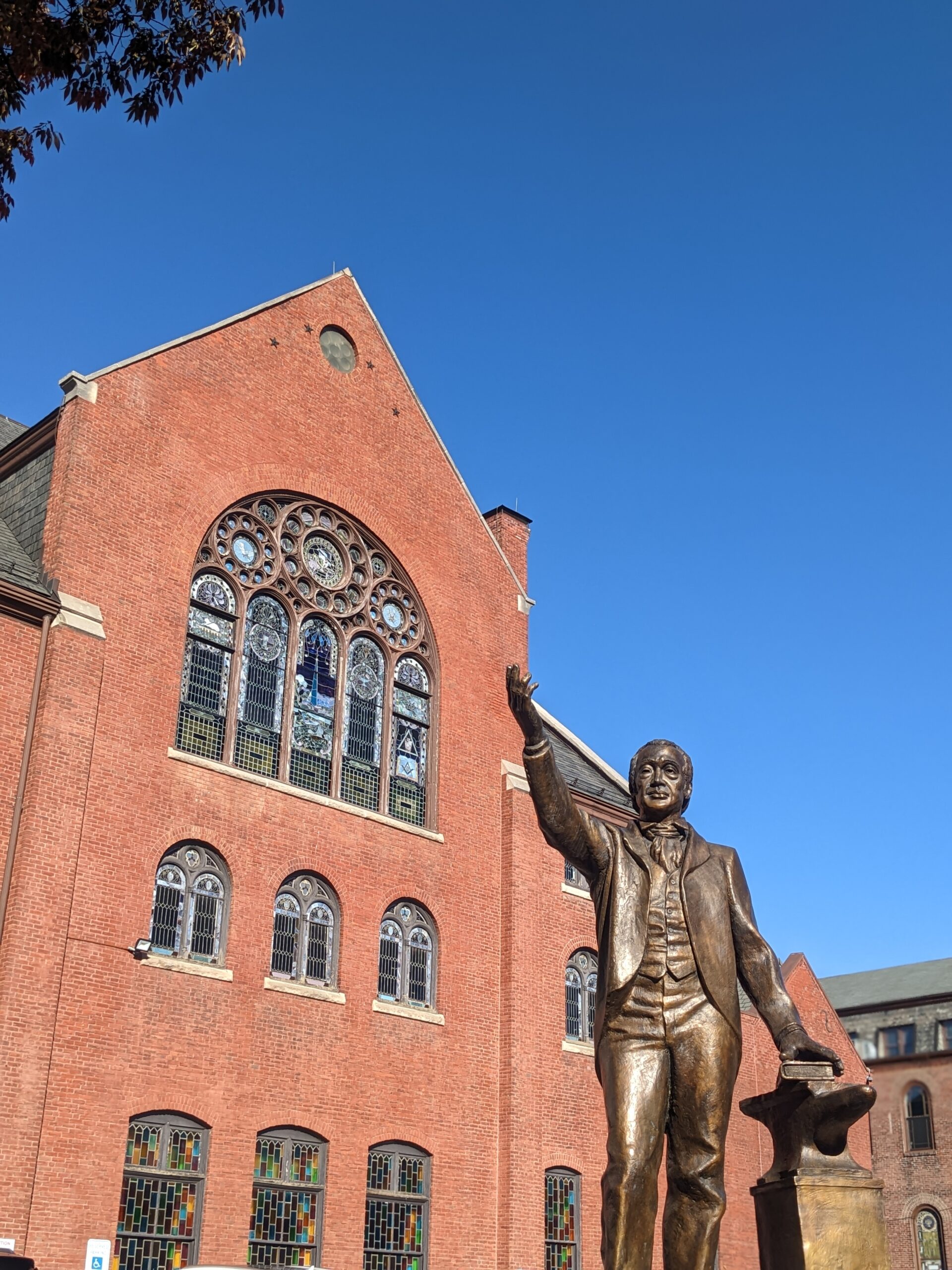
Unveiled in 2016, a bronze statue of Bishop Richard Allen stands next to Mother Bethel AME Church. It was created by sculptor Fern Cunningham-Terry. Photo taken by Samantha de Vera, October 29, 2022.
Bishop Richard Allen indeed served as the president of the very first Colored Convention in 1830. Along with other delegates, Bishop Allen castigated the African Colonization Society, seeing through the organization’s racist motivations. However, delegates supported both freedom seekers and free African Americans who moved or wanted to move to Upper Canada “in order to afford a place of refuge” and “ with the view of improving their condition.”[note] American Society of Free Persons of Colour (1830 : Philadelphia, PA), “Constitution of the American Society of Free Persons of Colour, for improving their condition in the United States; for purchasing lands; and for the establishment of a settlement in upper Canada, also, The Proceedings of the Convention with their Address to Free Persons of Colour in the United States,” Colored Conventions Project Digital Records, accessed October 11, 2022, https://omeka.coloredconventions.org/items/show/70 [/note] As someone who had to buy his freedom and built his own business, Bishop Allen was deeply aware that freedom also meant “the freedom to negotiate an advantageous labor contract, the freedom to accumulate, and the freedom to secure economic independence.”[note] Will, Thomas E. “Liberalism, Republicanism, and Philadelphia’s Black Elite in the Early Republic: The Social Thought of Absalom Jones and Richard Allen.” Pennsylvania History: A Journal of Mid-Atlantic Studies, vol. 69, no. 4, 2002, pp. 558–76. JSTOR, http://www.jstor.org/stable/27774446. Accessed 11 Oct. 2022.[/note] Allen’s theology upheld the ideals of independence and liberty, extending them beyond what white American revolutionaries imagined them to be. As Cedrick May argues, Allen and his contemporaries—Maria Stewart, David Walker, and Cyrus Bustill—imbued Christian principles with activism, asserting that slavery and all forms of oppression could never be compatible with Christianity and the purported ideals of the new nation.[note]May, Cedrick. “Richard Allen and the Further Institutionalization of Black Theologies.” Evangelism and Resistance in the Black Atlantic, 1760-1835, University of Georgia Press, 2008, pp. 98–115. JSTOR, http://www.jstor.org/stable/j.ctt46nbjn.9. Accessed 30 Oct. 2022.[/note]
Six months after the first Colored Convention, Bishop Allen died in his home on Spruce Street. But he had planted the seeds: the Colored Conventions movement grew to be the largest Black civil rights movement in the nineteenth century. Although he passed away before the AME Church could spread throughout the South, after the Civil War, members grew in the region in unprecedented numbers as Black Southerners sought to worship independently.
To read more about the life and work of Bishop Richard Allen, explore the tabs below.
- Bishop Richard Allen's autobiography
- 1794 Pamphlet by Bishop Richard Allen and Absalom Jones
- 1891 History of the African Methodist Episcopal Church
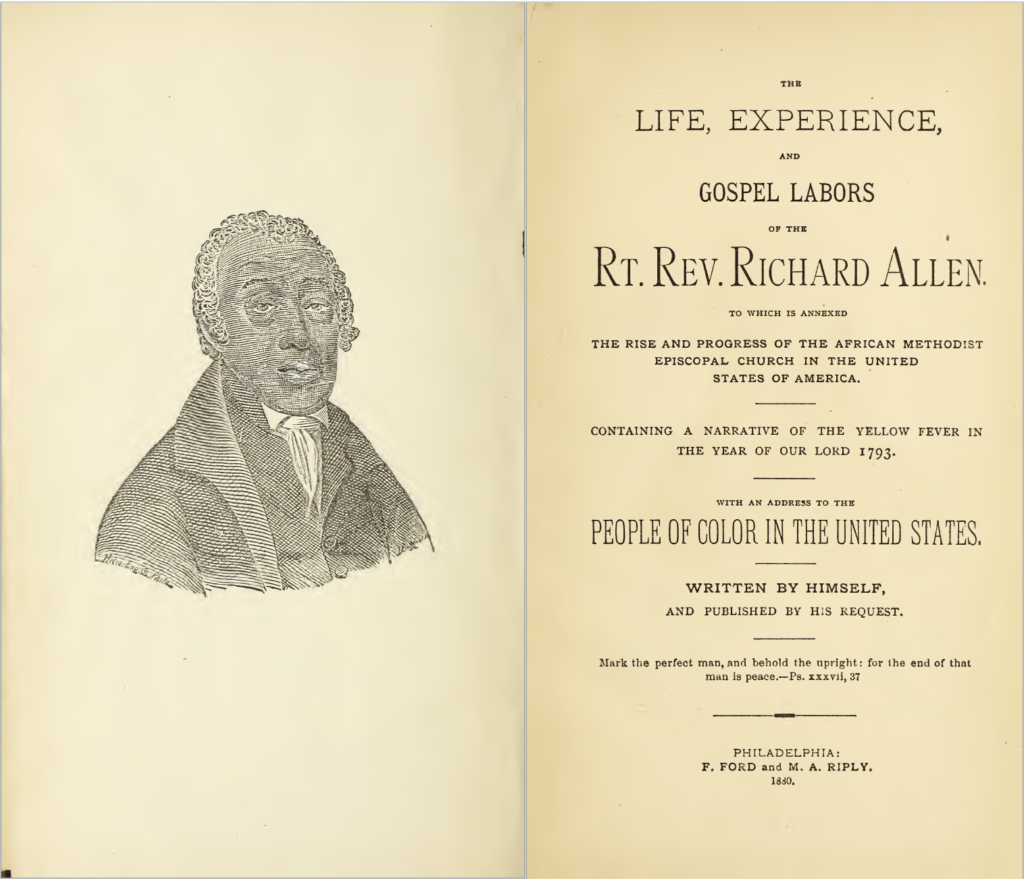
The life, experience, and gospel labors of the Rt. Rev. Richard Allen, to which is annexed the rise and progress of the African Methodist Episcopal Church in the United States of America. Containing a narrative of the yellow fever in the year of our Lord 1793. With an address to the people of color in the United States by Richard Allen.
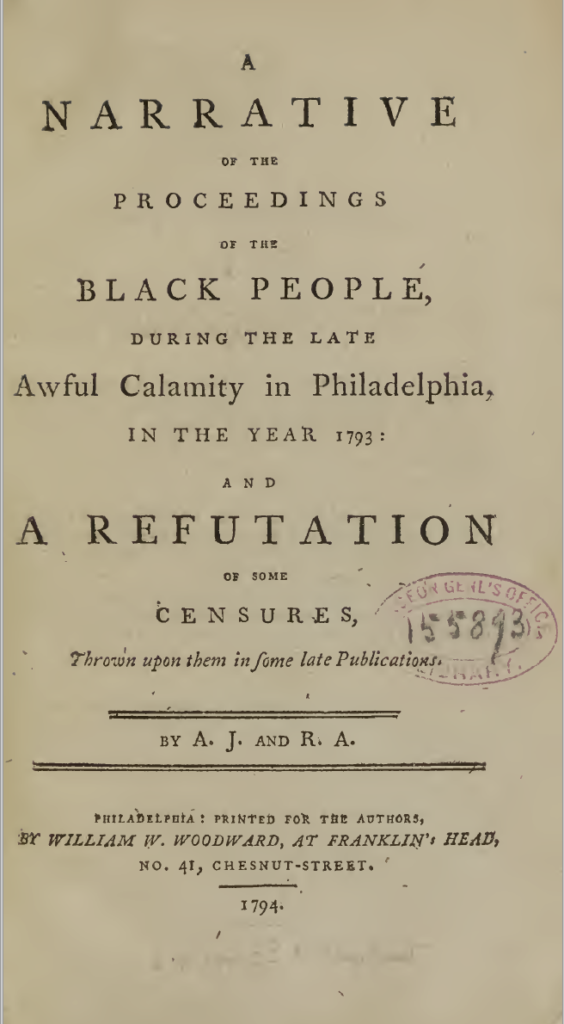 In 1793, yellow fever struck the city of Philadelphia. Leading doctors at the time wrongly believed that persons of African descent were immune to the disease and therefore asked them for assistance. Throughout the epidemic, Black Philadelphians nursed the sick, cleaned public facilities, and buried the dead—essentially helping the city survive a public health disaster at the cost of their own well-being. Shortly after, an Irish immigrant published a pamphlet denigrating Black Philadelphians and accusing them of taking advantage of the epidemic. In response, Bishop Richard Allen and Absalom Jones published a pamphlet of their own, refuting the former’s racist claims and depictions of Black persons.
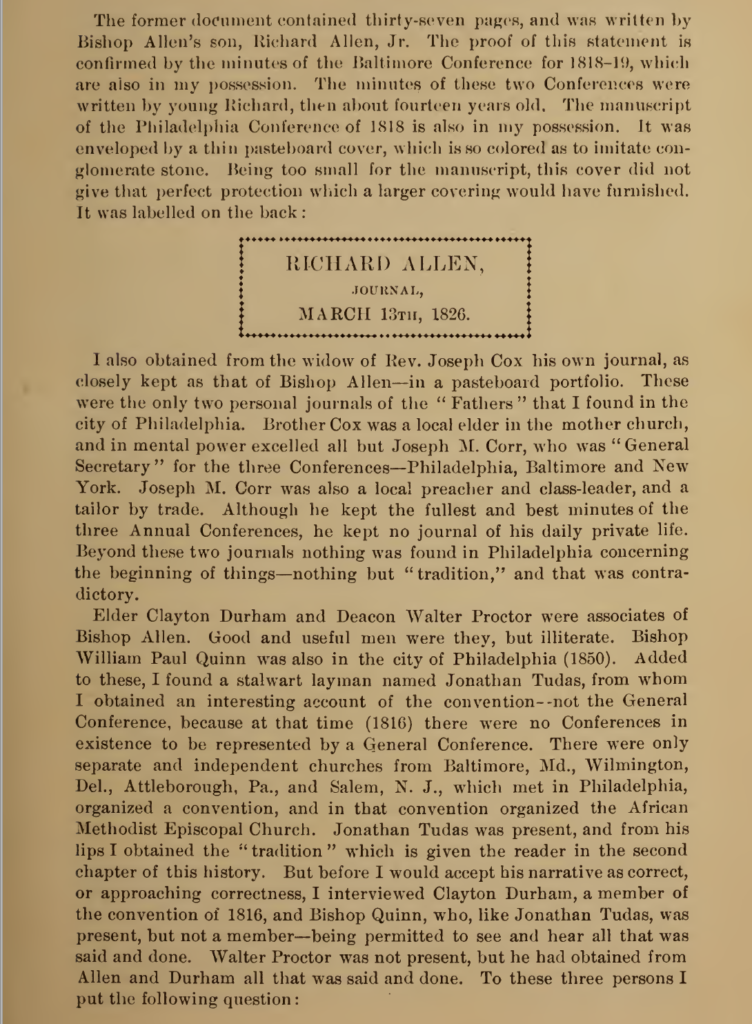 In 1891, AME Bishop Daniel Payne published the History of the African Methodist Episcopal Church, the first extant history of the AME Church. Bishop Richard Allen figures prominently in the book. Click on the left image to read the full text.
CREDITS
Written by Samantha de Vera.