
MURAL EXHIBIT: THE COLORED CONVENTIONS MOVEMENT AND BEYOND IN PHILADELPHIA
WILLIAM WHIPPER
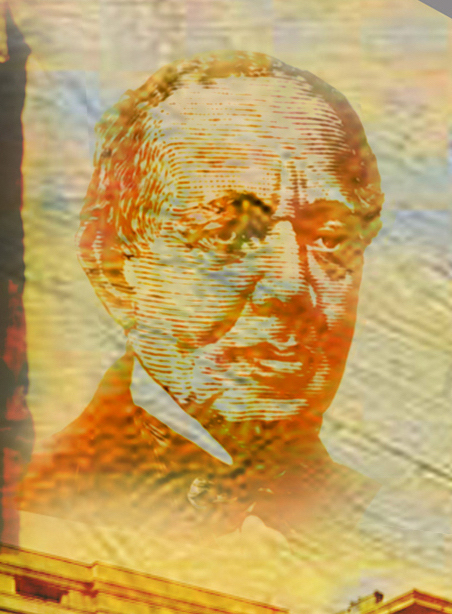
Whipper as portrayed on the mural.
William Whipper (February 22, 1804 – March 9, 1876) was a prolific anti-slavery activist, businessman, and regular convention delegate during the Colored Conventions movement’s formative years. Born in Lancaster, Pennsylvania, Whipper moved to Philadelphia as a young man. There, Whipper opened a free labor and temperance grocery store.[note] Free labor stores only sold goods that were produced through paid labor. [/note] The store was located at the heart of Philadelphia’s Black community, next to Bethel AME Church. Black economic power in Philadelphia was deeply tied to this community’s activist pursuits. Whipper’s store had a “constant supply of Anti-Slavery Books, Pamphlets, &c.”[note] Whipper, William. “FREE LABOR AND TEMPERANCE GROCERY STORE.” The Liberator, 10 May 1834. p. 4.[/note] Along with other Black business owners, Whipper also disseminated tickets to anti-slavery public speaking events and reading materials about the cause.
Whipper played an instrumental role in the first five years of the Colored Conventions movement. He served as a secretary for the first Colored Convention held in Philadelphia in 1830. The following year, Whipper helped organize and put out public notices about the upcoming second Colored Convention and served as the convention’s secretary. During the following three conventions held in Philadelphia and New York (1833-1835), Whipper worked with Black Philadelphian businessmen and activists James Forten and Robert Purvis, and Samuel E. Cornish, minister and editor of The Colored American and Freedom’s Journal, to organize the American Moral Reform Society (AMRS). AMRS upheld temperance and encouraged boycotting goods produced by unfree labor. William Watkins, Baltimore minister and uncle of Frances Ellen Watkins Harper, delivered an address before AMRS lauding the role of education and the press in “[elevating] man to the true dignity of his nature” and “humanizing those insane and bitter prejudices which impiously forbid a large portion of the human race to occupy the stations assigned them by their benevolent God.”[note] Watkins, William. “An address delivered before the Moral Reform Society in Philadelphia, August 8, 1836.” Merrihew and Gunn, 1836, p. 14. https://digitallibrary.hsp.org/index.php/Detail/objects/8197[/note] Whipper also founded AMRS’s newspaper, the National Reformer in 1838. The AMRS held six conventions before its dissolution in 1841. In the years that it was active, the AMRS sparked lively debates regarding its ideology. In particular, Samuel Cornish, William Watkins, and Charles B. Ray, minister and co-editor of The Colored American, took issue with Whipper’s broad vision of reforming the entire American society, suggesting instead that reform initiatives should focus on uplifting Black people.[note] Roberts, Rita. Evangelicalism and the Politics of Reform in Northern Black Thought, 1776–1863. Louisiana State University, 2011, p. 112-113.[/note]
While living in Lancaster County, Pennsylvania, Whipper was “implicated by association” in the Christiana resistance, in which free Black residents protected freedom seekers from an enslaver who was eventually killed.[note] Reid-Maroney, Nina.The Reverend Jennie Johnson and African Canadian History 1868-1967. University of Rochester Press, 2013, p. 25.[/note] The affair endangered the lives of free Black residents in the area, prompting Whipper and the others to relocate. A long-time proponent of emigration, Whipper secured land properties in Canada West, moving his wife Harriet Whipper and his other family members there while he regularly traveled to Philadelphia to conduct business and help freedom seekers.
Whipper remained active in the Colored Conventions movement, attending the Colored National Convention held in Rochester, New York, in 1853, and the Colored National Convention held in Philadelphia in 1855. In the latter convention, Whipper joined a new generation of activists whose parents he had worked with, including William J. Watkins, the son of Reverend William Watkins, and Mary Ann Shadd Cary, whose father Abraham Shadd sat in committees with Whipper in earlier conventions in Philadelphia. [note] It is not clear from the minutes of the 1855 convention whether or not Whipper voted to approve Mary Ann Shadd Cary’s delegacy.[/note] The connections between the Shadd Cary and Whippers were numerous; Whipper’s brother Alfred Whipper attended the 1858 Chatham Convention, in which Black and white delegates met with John Brown to discuss his plans to overthrow the institution of slavery. Also in attendance was Mary Ann Shadd Cary’s brother, Isaac Shadd. According to W.E.B. Du Bois’s account, William Whipper’s nephew, James Whipper Purnell, was also present.[note] Du Bois, W.E.B. John Brown, edited by David Roediger. Random House Publishing Group, 2010, p. 153.[/note] Whipper Purnell was married to Julia A. Shadd, Mary Ann Shadd Cary’s cousin, until his death in 1879.[note] Maillard, Mary, editor. Whispers of Cruel Wrongs: The Correspondence of Louisa Jacobs and Her Circle, 1879-1911. University of Wisconsin Press, 2017, p. 193-194n.[/note]
By 1867, William Whipper settled back in Philadelphia, having partnered with his nephew James Whipper Purnell in a lumberyard business. Whipper continued to be active in efforts to better the condition of formerly enslaved people in Pennsylvania and New Jersey, where he had lived for a time. In 1870, Whipper was appointed as the head of the Philadelphia branch of the doomed Freedmen’s Bank. As Richard P. Cormick writes, records do not indicate any mismanagement on the part of Whipper.[note] Richard P. “WILLIAM WHIPPER: MORAL REFORMER.” Pennsylvania History: A Journal of Mid-Atlantic Studies, vol. 43, no. 1, 1976, pp. 22–46. JSTOR, http://www.jstor.org/stable/27772321. Accessed 1 Sep. 2022.[/note] He died in his Philadelphia home on Lombard Street in 1876, leaving his widow, Harriet Whipper, an array of properties and considerable wealth. Whipper’s legacy is that of a man with incredible business acumen who used his economic power to secure refuge and a decent way of living for enslaved and formerly enslaved persons.
To read more about Whipper’s works, explore the tabs below.
- National Reformer
- William Whipper and William Still's Letter to Frank Lloyd Garrison, February 16, 1866.
In 1838, Whipper founded National Reformer, the AMRS’s newspaper.
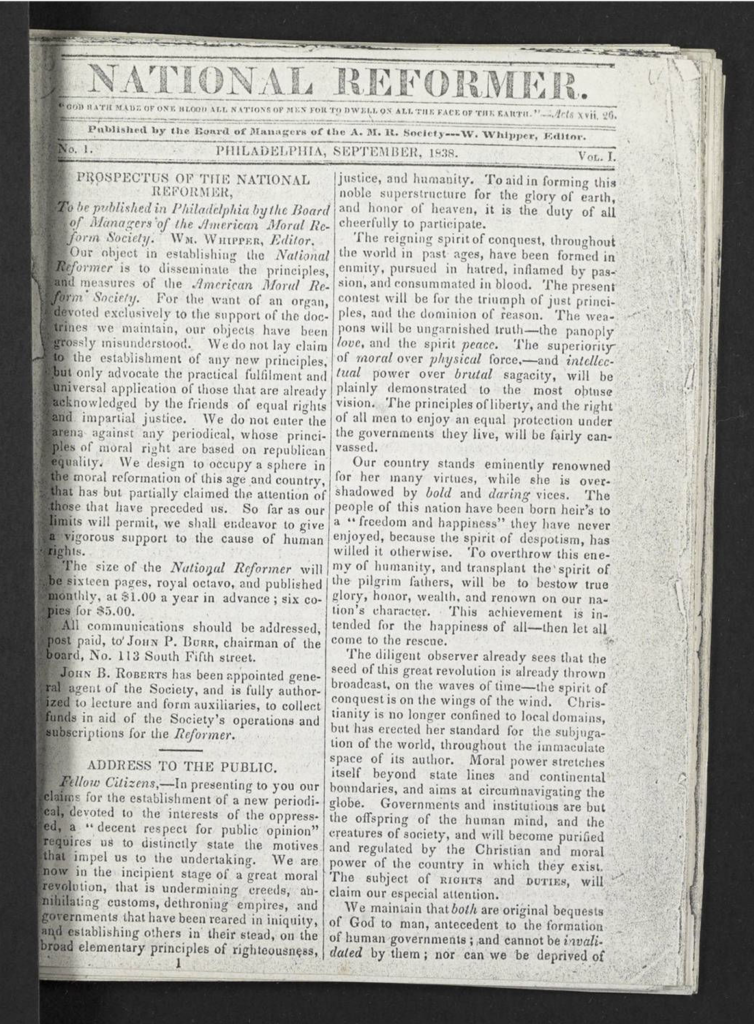
Front page of the September 1838 issue of National Reformer.
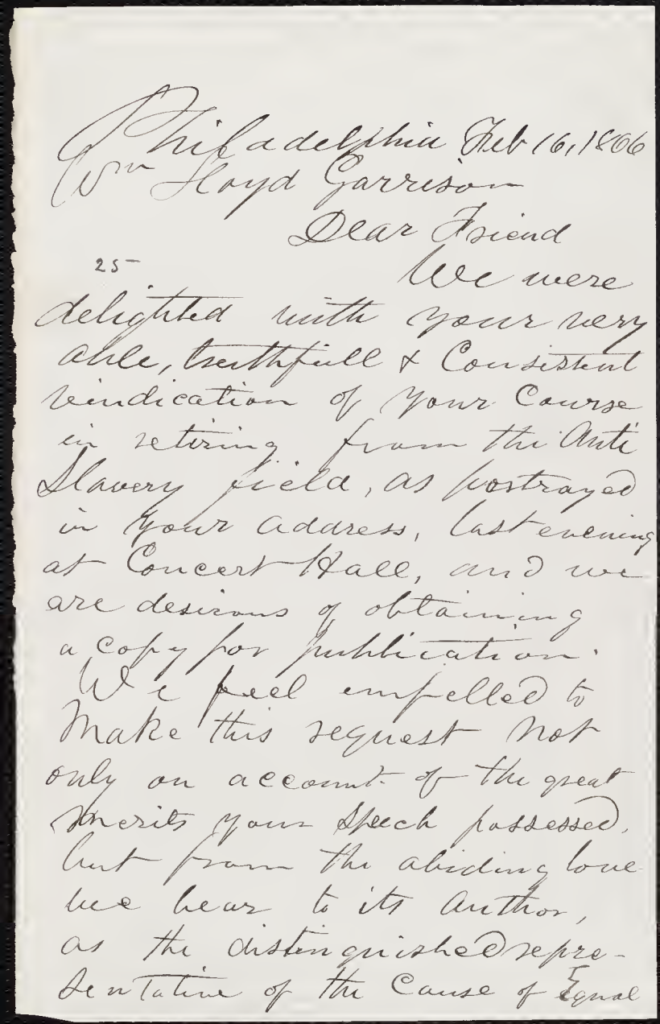
To read the entirety of the letter, click on the image above.
CREDITS
Written by Samantha de Vera.