
MURAL EXHIBIT: THE COLORED CONVENTIONS MOVEMENT AND BEYOND IN PHILADELPHIA
FRANCES ELLEN WATKINS HARPER
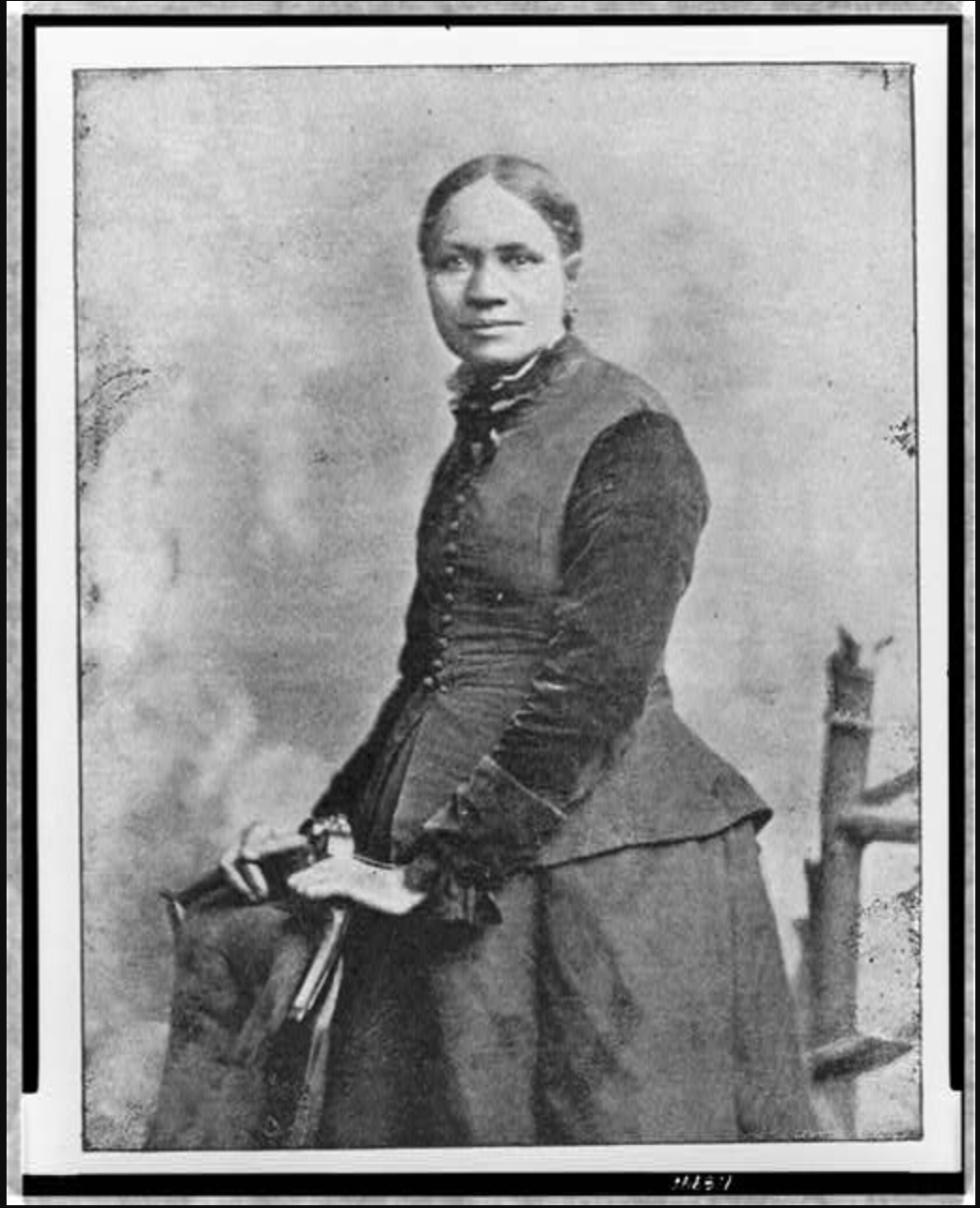
Frances E.W. Harper, three-quarter length portrait, standing, facing front. Photograph. Retrieved from the Library of Congress, <www.loc.gov/item/97513270/>.
Frances Ellen Watkins Harper was born to free Black parents on September 24, 1825, in Baltimore, Maryland. Following the death of her mother when Harper was three-years-old, her aunt and uncle took her in and raised her through adolescence.[note] Washington, Margaret, “Frances Ellen Watkins: Family Legacy and Antebellum Activism,” The Journal of African American History 100, no. 1 (Winter 2015): 59-86.[/note] Her uncle, the Reverend William J. Watkins, Sr. was a civil rights activist and leader in Baltimore’s Black Sharp Street Church. He also deeply valued education. He and four of his sons were teachers at the school he founded, Academy for Negro Youth. As a teenager, Harper worked as a seamstress and domestic for a white Quaker family. While working, she continued reading and writing, and published her first book of poetry, Forest Leaves, around 1846.[note] Gates, Henry Louis, and Evelyn Brooks Higginbotham. African American Lives. New York: Oxford UP, 2004. 374-75. Print.
[/note] This work was published well before Harper became very active in abolition and gives us insight into her early life in Baltimore.
In 1851 Harper relocated to Ohio for a brief period. She taught domestic science at Union Seminary, an African Methodist Episcopal (AME) school located outside of Columbus, Ohio. She was the first woman faculty member at this school, which was later merged into Wilberforce University. Not long after, she moved to Little York, Pennsylvania, where she again attempted teaching.[note]Harper, Frances Ellen Watkins, 1825-1911, Letter from Frances Ellen Watkins Harper, August, 1854, in The Underground Rail Road: a Record of Facts, Authentic Narratives, Letters, &c : Narrating the Hardships, Hair-breadth Escapes, and Death Struggles of the Slaves in Their Efforts for Freedom. Still, William, 1821-1902. Philadelphia, PA: Porter & Coates, 1872, pp. 780.[/note]
JOINING THE ANTI-SLAVERY CIRCUIT
The catalyst for Harper’s career came in early 1850s. Her home state of Maryland had a law forbidding free people of color from entering the slave state. One free Black man who violated the statute was sold into slavery in Georgia, attempted to escape, was recaptured, and died of exposure while being punished. The law also forced Harper to leave Maryland and live with William and Letitia Still in Philadelphia. So in 1854, she inquired with anti-slavery societies, first in Philadelphia and then in Boston. In both places, she found a willing audience. In a letter in 1854, she said that she was “out lecturing. I have lectured every night this week.”[note] Harper to Still in The Underground Rail Road.[/note] For almost a decade, Harper traveled and delivered lectures in various states. Like the Stills, Harper spoke against the racist treatment of African Americans in Philadelphia streetcars and refused to be seated in “colored” trolleys.
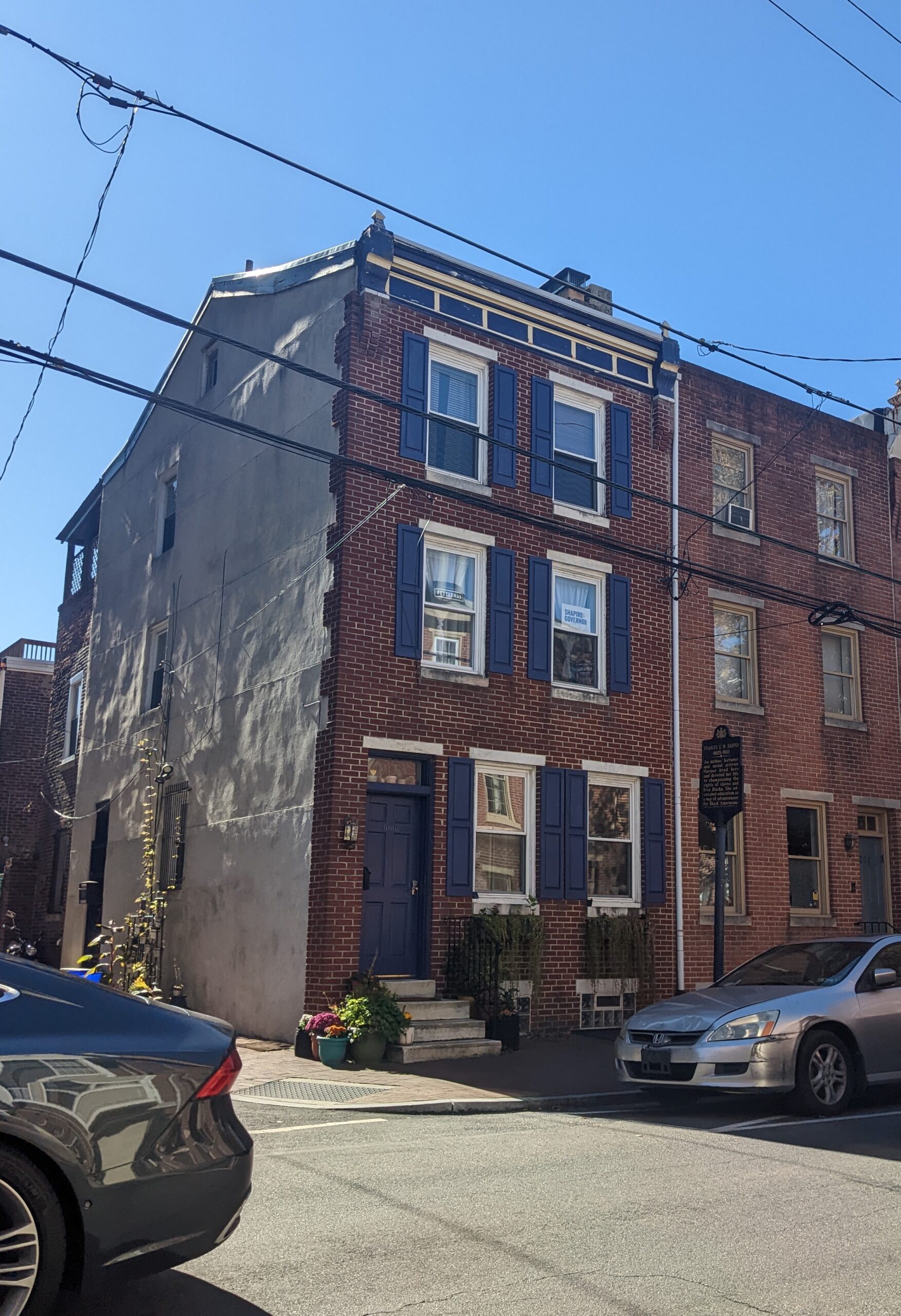
Frances Ellen Watkins Harper’s house in Philadelphia where she lived from 1871 to 1911. The house is located close to William and Letitia Still’s house and was added to the Philadelphia Register of Historic Places in 2021. Photo taken by Samantha de Vera, October 29, 2022.
1858 CONVENTION
In the late 1850s, Harper traveled to a number of anti-slavery meetings and Colored Conventions, including the 1858 Convention of Colored Citizens of Ohio in Cincinnati. Harper had attended Colored Conventions before, as had her cousin William J. Watkins. William was even present at the 1855 Convention where Mary Ann Shadd had to fight for her delegacy. Indeed, he spoke on her behalf when other attendees questioned the propriety of a woman delegate.
Perhaps William J. Watkins spoke again on behalf of his cousin in 1858 when Frances Ellen Watkins Harper sought the status of delegate in Cincinnati. Considering how few women delegates served at the Conventions and the attitudes towards respectable women in the public sphere at the time, it seems likely there was opposition to her request. If so, it was overlooked or intentionally left out of the official minutes. The only reference to her entry was a single sentence: “Miss F. E. Watkins was requested to take part in the Convention.”[note] Convention of the Colored Men of Ohio (1858: Cincinnati, OH), “Proceedings of a Convention of the Colored Men of Ohio, Held in the City of Cincinnati, on the 23d, 24th, 25th and 26th days of November, 1858,” ColoredConventions.org, accessed October 3, 2017, https://omeka.coloredconventions.org/items/show/254.[/note] Other sources, however, tell us that Harper’s relative absence from the minutes is misleading. Coverage of the 1858 convention in both the Anti-Slavery Bugle and the Liberator listed Harper among the “principal speakers” in the lengthy and spirited debate on Emigration, although unfortunately neither printed or summarized her speech.[note]“State Convention of the Colored People of Ohio.” The Liberator, December 3, 1858.; “Convention of Colored People for the State of Ohio.” The Anti-Slavery Bugle, December, 4, 1858.[/note] We can surmise that the speech strongly and eloquently castigated colonization schemes. Harper’s uncle and guardian, William Watkins Jr., was fiercely opposed to colonization and wrote on the issue frequently. Frances Ellen Harper would have heard that rhetoric growing up.[note]See Washington, “Frances Ellen Watkins.”[/note]
By the late 1850s, Harper may have been more sympathetic toward voluntary emigration to free countries. Life for free people of color in the US had gotten more difficult since the passage of the Fugitive Slave Act, and even her uncle William Watkins and several family members had moved Canada.[note] See Washington, “Frances Ellen Watkins.”[/note] Frances Ellen Watkins Harper herself wrote of her first visit to Canada, “Well, I have gazed for the first time upon Free Land! And would you believe it, tears sprang to my eyes, and I wept.”[note] Harper, Frances Ellen Watkins. Poems on Miscellaneous Subjects. Philadelphia: Merrishaw & Thompson, Printers, 1857.[/note] When it came to African Colonization schemes, however, Harper was as staunchly opposed as her uncle. In a scathing 1862 essay in The Christian Recorder, she lambasted Lincoln for considering colonization:
[W]e neither see the wisdom nor expediency of our self-exportation from a land which has been in large measure enriched by our toil for generations, till we have a birth-right on the soil, and the strongest claims on the nation for that justice and equity which has been withheld from us for ages.[note] Sinha, Manisha. “The Other Frances Ellen Watkins Harper,” Common Place, vol. 16, no. 2, 2016. http://common-place.org/book/the-other-frances-ellen-watkins-harper/[/note]
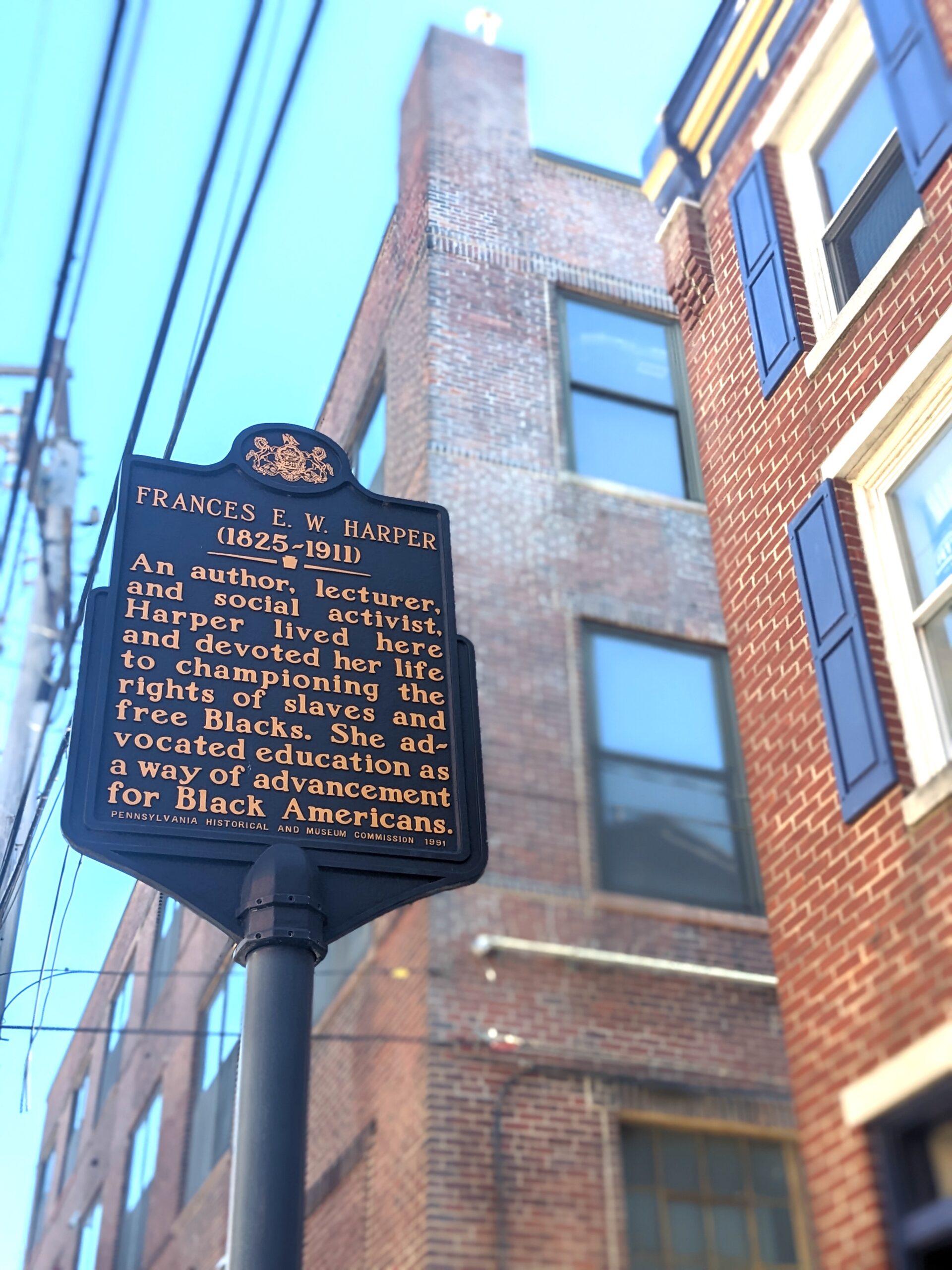
A historical marker dedicated to Frances Ellen Watkins Harper stands in front of her house along Bainbridge St. Photo taken by Samantha de Vera, October 29, 2022.
LATER YEARS
In 1860, Frances Ellen Watkins married Fenton Harper, an anti-slavery activist based in Ohio. When he died four years later, Harper moved back to the East Coast with her daughter Mary Frances. She eventually settled back in Philadelphia and supported her family through lecturing. Harper addressed the 1873 Colored Convention. Only a brief description of her address appears in the minutes: “She spoke in eloquent terms of the efforts of the colored people and hoped they would not cease until equal rights were in fact within the reach of all.”[note] The Convention of Colored People (1873 : Dover, DE), “Proceedings of the Convention of Colored People Held in Dover, Del., January 9, 1873.,” Colored Conventions Project Digital Records, accessed October 20, 2022, https://omeka.coloredconventions.org/items/show/297.[/note] The convention focused on the state’s exclusion of African Americans in the education system in spite of the tax contributions of Black residents. She continued to be active in progressive causes including women’s suffrage, anti-lynching, and the abolition of the convict-lease system. Harper died in 1911 in Philadelphia and is buried in Eden Cemetery, among numerous nineteenth-century Black activists who fought for the same causes as she did.
CREDITS
Written by Preeya Waite, Taught by Dr. Christine Anderson, Xavier University, Spring 2016.
Edited by Nancy Yerian, Independent Historian.
Edited and revised by Samantha de Vera.