
MURAL EXHIBIT: THE COLORED CONVENTIONS MOVEMENT AND BEYOND IN PHILADELPHIA
State Convention of the Colored Freemen of Pennsylvania, Held in Pittsburgh, on the 23d, 24th and 25th of August, 1841, for the Purpose of Considering their Condition, and the Means of Its Improvement
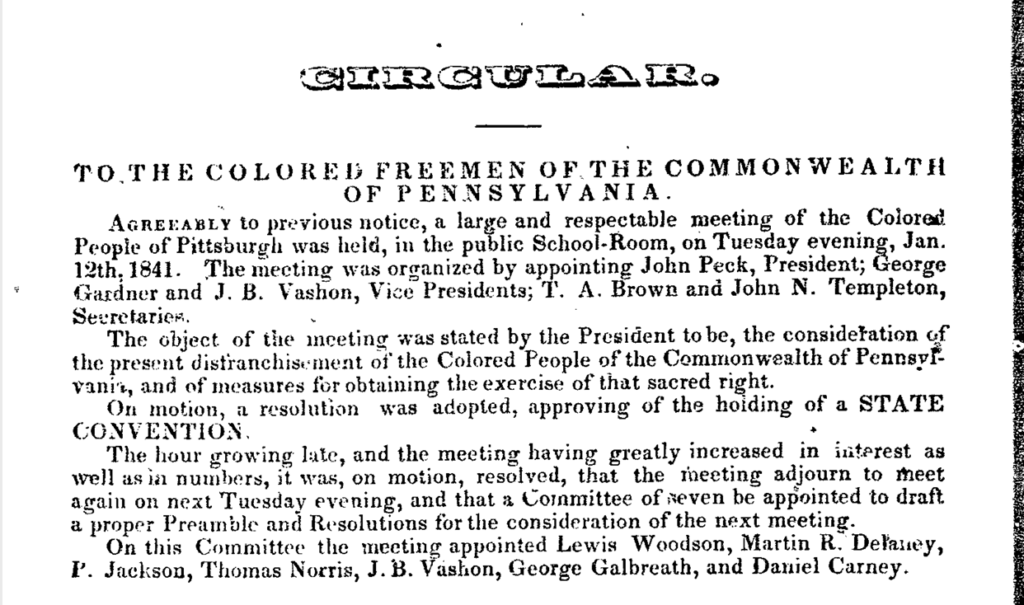 When Pennsylvanians ratified their new Constitution in 1838, they officially and legally coded Black disenfranchisement. As a result, men of color in Pennsylvania—some of whom had previously enjoyed the right to vote, including John B. Vashon—lost such right, as the new Constitution restricted it to “white freemen, citizens of the United States, between the ages of twenty-one and twenty-two years.”[note] In order for white men to gain the right of suffrage in the state, they would have to have resided in Pennsylvania for a year. See The Constitution of the Commonwealth of Pennsylvania, As Amended by the Convention of One Thousand Eight Hundred and Thirty-Seven-Thirty-Eight. Wikisource, 16 September 2022, https://en.wikisource.org/wiki/Constitution_of_the_Commonwealth_of_Pennsylvania_1838 [/note] Seeking to persuade Pennsylvanians to vote against the ratification of the new Constitution, anti-slavery activist and businessman Robert Purvis publicly declared, “This is not the first time that northern statesmen have “bowed the knee to the dark spirit of slavery, but it is the first time that they have bowed so low!”[note]Purvis, Robert. Appeal of Forty Thousand Citizens, Threatened with Disfranchisement, to the People of Pennsylvania. Philadelphia, Merrihew & Gunn, 1838.[/note] The Constitution’s racist qualification for voting was a crushing blow to Black Pennsylvanians, who rightly saw southern slave power’s encroachment upon the North. Black Pennsylvanians unrelentingly lobbied for constitutional rights, and Philadelphia and Pittsburgh were hotbeds for such political activism. By 1840, the Colored Conventions movement had already spread from Pennsylvania to Ohio, New York, Maine, and New Hampshire. In 1841, Black activists once again held another convention in its state of origin, this time in Pittsburgh, instead of Philadelphia.
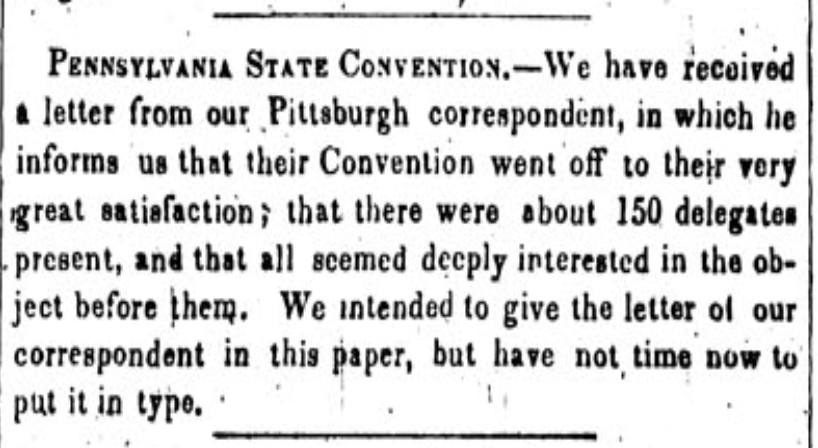
“Pennsylvania State Convention.” The Colored American, 11 September 1841, Accessible Archives.
The 1841 State Convention of the Colored Freemen of Pennsylvania was organized by Pittsburgh’s well-established and influential community members, John Peck, John B. Vashon, George Gardner, Thomas A. Brown, and John Templeton.[note] Reverend John Peck was a wigmaker, barber, and a conductor of the Underground Railroad. He also served as a delegate in conventions held in New York and Pennsylvania. His son, Dr. David Jones Peck, was the first African American person to receive a medical degree from an American medical school in 1847. His daughter Louisa Peck attended Oberlin College; Thomas Brown and his wife Frances Scroggins Brown were Underground Railroad conductors and ran a boarding house in Pittsburgh, which they used to aid freedom seekers. See Griffler, Keith P. Front Line of Freedom: African Americans and the Forging of the Underground Railroad in the Ohio Valley. Lexington, UP of Kentucky, 2021; Templeton and his wife Matilda J. Ware Templeton were members of Pittsburgh’s Moral Reform Society. Ware devoted her life to Black education, teaching well into her seventies. See Wickersham, James Pyle. A History of Education in Pennsylvania. Lancaster, Inquirer Publishing Co., 1886, 254.[/note] As they declared in the minutes of the convention, “The object of the meeting was stated by the President to be, the consideration of the present disfranchisement of the Colored People of the Commonwealth of Pennsylvania, and of measures for obtaining the exercise for obtaining the exercise of that sacred right.”[note] State Convention of the Colored Freemen of Pennsylvania (1841 : Pittsburgh, PA), “Proceedings of the State Convention of the Colored Freemen of Pennsylvania, Held in Pittsburgh, on the 23d, 24th and 25th of August, 1841, for the Purpose of Considering their Condition, and the Means of Its Improvement.,” Colored Conventions Project Digital Records, accessed September 18, 2022, https://omeka.coloredconventions.org/items/show/240[/note] In states where Black men were allowed to vote, they were still severely restricted. In the same year, Black New Yorkers held a convention in Troy to address the state’s restrictive laws that were meant to eliminate Black political power. While New York had not entirely banned free Black men from voting, the State Constitution of New York required them to have property worth 250 dollars, a qualification from which white men were exempt.
Convention delegates in the 1840s not only presented a powerful protest against Black disenfranchisement, they also strategized and discussed how their communities would navigate new terrains of discriminatory laws. The delegates at the Pittsburgh Colored Convention saw education as the primary means to elevate Black communities. At the same time, delegates raised funds for traveling lecturers and the establishment of benevolent, education, literary, and temperance societies in different counties. The 1841 Pittsburgh Colored Convention was also among the first Black political meetings to collect statistical data about Black communities. As Sarah Lynn Patterson argues, “Statistical and qualitative reports helped justify the very existence of Colored Conventions…The reports define their [delegates’] participation in nation building as inhabitants, landowners, skilled workers, parents, and club and church members, among other categories.”[note] Patterson, Sarah Lynn. “As the True Guardians of Our Interests: The Ethos of Black Leadership and Demography at Antebellum Colored Conventions.” The Colored Conventions Movement: Black Organizing in the Nineteenth Century, edited by P. Gabrielle Foreman, Jim Casey, and Sarah Lynn Patterson, Chapel Hill, University of North Carolina Press, 2021, 213.[/note] Delegates in following conventions continued to appoint statistical committees, leaving rich records about Black communities throughout the US.
CREDITS
Written by Samantha de Vera.
REFERENCES