
MURAL EXHIBIT: THE COLORED CONVENTIONS MOVEMENT AND BEYOND IN PHILADELPHIA
INTRODUCTION
Below is a map that shows the location of the Courtyard Apartments and the murals. Hover and click over the map to learn more about the community’s population, number of housing units, renter and homeowner statistics, and data on senior well-being as of 2020.
A BRIEF HISTORY OF SOUTHWARK
The community north of Jefferson Square has a rich history of resilience and resistance. The neighborhood of Southwark, where the murals now stand, is one of Philadelphia’s oldest ethnic communities. Before its incorporation into Philadelphia in 1854, Southwark was a Swedish settlement. Throughout the nineteenth century and early twentieth centuries, migrants from the Caribbean, Spain, and Mexico came and settled in the district. As Victor Vázquez notes, “The ongoing trade between the Caribbean and Philadelphia, especially in sugar and tobacco, drew many immigrants from Cuba and Puerto Rico to Philadelphia.[note] Vázquez, Víctor. “The Development of Pan-Latino Philadelphia, 1892-1945.” The Pennsylvania Magazine of History and Biography, vol. 128, no. 4, 2004, p. 370.[/note] Nineteenth-century Spanish-speaking immigrants lived among African Americans in the neighborhood, whose roots in Philadelphia ran deep. Indeed, W.E.B. Du Bois’s sociological study of the city’s Black community, The Philadelphia Negro (1899), was partly based on the west side of Southwark. Arguing against pathologization of Black persons, Du Bois asserted that the problems that plagued the Black community in late nineteenth-century Philadelphia were due to long-standing practices of racial discrimination, exclusion and centuries of enslavement.
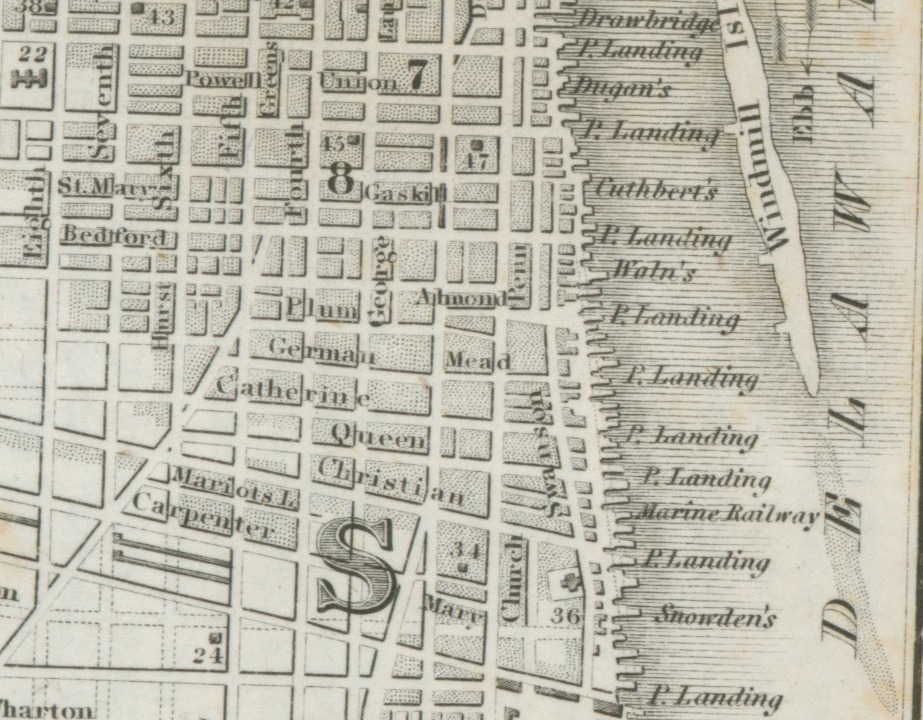
A map of Southwark from 1836. Lionel Pincus and Princess Firyal Map Division, The New York Public Library. “Philadelphia and environs.” The New York Public Library Digital Collections. 1836.
A century after Du Bois pointed out the dire consequences racist exclusion in urban areas, Black Philadelphians would find themselves struggling against its long-term impacts. By the 1960s, Black Philadelphians had been pushed out of Old City and other parts of the city through a series of urban renewal projects and gentrification. Many of them moved to Southwark. In 1969, the northern part of Southwark was renamed Queen Village, and resources quickly poured to improve the latter. The inequality and disjunction between the two neighborhoods became stark. Queen Village was heavily developed with modern housing and old town houses were restored.[note] See Kyriakodis, Harry. Philadelphia’s Lost Waterfront. The History Press, 2011.[/note] Meanwhile, Southwark, neglected by city officials, became run-down, and by the early 2000s, public housing projects remained vacant. Resources were being spent on an increasingly white neighborhood at the cost of Black neighborhoods.
Gentrification and Resistance
In the late 1990s, First District City Councilperson Frank DiCicco proposed redeveloping the area around Jefferson Square in Southwark. The plan’s targeted area was largely occupied by African American residents. “They soon learned that the city councilperson’s official plan for Jefferson Square’s redevelopment threatened to forcibly take thirty owner-occupied homes, displace renters, and confiscate the property from landlords and absentee owners.”[note] Becher, Debbie. “Political Moments with Long-term Consequences.” Remaking Urban Citizenship: Organizations, Institutions, and the Right to the City, edited by Andrew M. Greeley, Taylor& Francis, 2017, p. 211.[/note] Residents were vocal about their grievances regarding DiCicco’s Jefferson Square Revitalization Plan, with some calling it an “ethnic cleansing” during a city council hearing.[note] Kromer, John. Fixing Broken Cities: The Implementation of Urban Development Strategies, Taylor & Francis, 2009, p. 227.[/note] Residents of Southwark mobilized and garnered support to resist efforts to displace them and their neighbors.
Among those who supported the residents were “Marcella, the professional community organizer connected to the settlement house, and Pastor Rick, the preacher at St. John Evangelist Church,” as well as a local attorney; as a consequence of their decision to ally themselves with locals, both the church and settlement house lost members and supporters.[note] Becher, p. 216-217.[/note] Nevertheless, a new coalition was formed in this redevelopment struggle, the St. John’s Leadership Team. With the assistance of an attorney from Community Legal Services of Philadelphia, the Team announced that residents would put forth a class-action discrimination suit if residents were not included in the implementation of the redevelopment plan.[note] Becher, Debbie. “Race as a Set of Symbolic Resources: Mobilization in the Politics of Eminent Domain.” Race and Real Estate, edited by Adrienne Brown and Valerie Smith, Oxford University Press, 2015, p. 134.[/note] As Becher argues, racial representation was important in this struggle. In her interviews with organizers, “they claimed that their race gave them a solid grounding from which to speak for other black people.”[note] Becher, p. 134.[/note] City officials acquiesced, realizing that residents’ tenacious fight for their homes would not abate. Eventually, through dialogue with city officials and developers, residents and their advocates secured a compromise: residents who were being displaced would be offered the first opportunity to purchase the newly developed houses. They would receive financial assistance from the Redevelopment Authority, compensation for their previous property, a relocation payment, and other subsidies. [note] Kromer, p. 228.[/note]
“They stand on their own”: Keeping the Community at Courtyard at Riverview
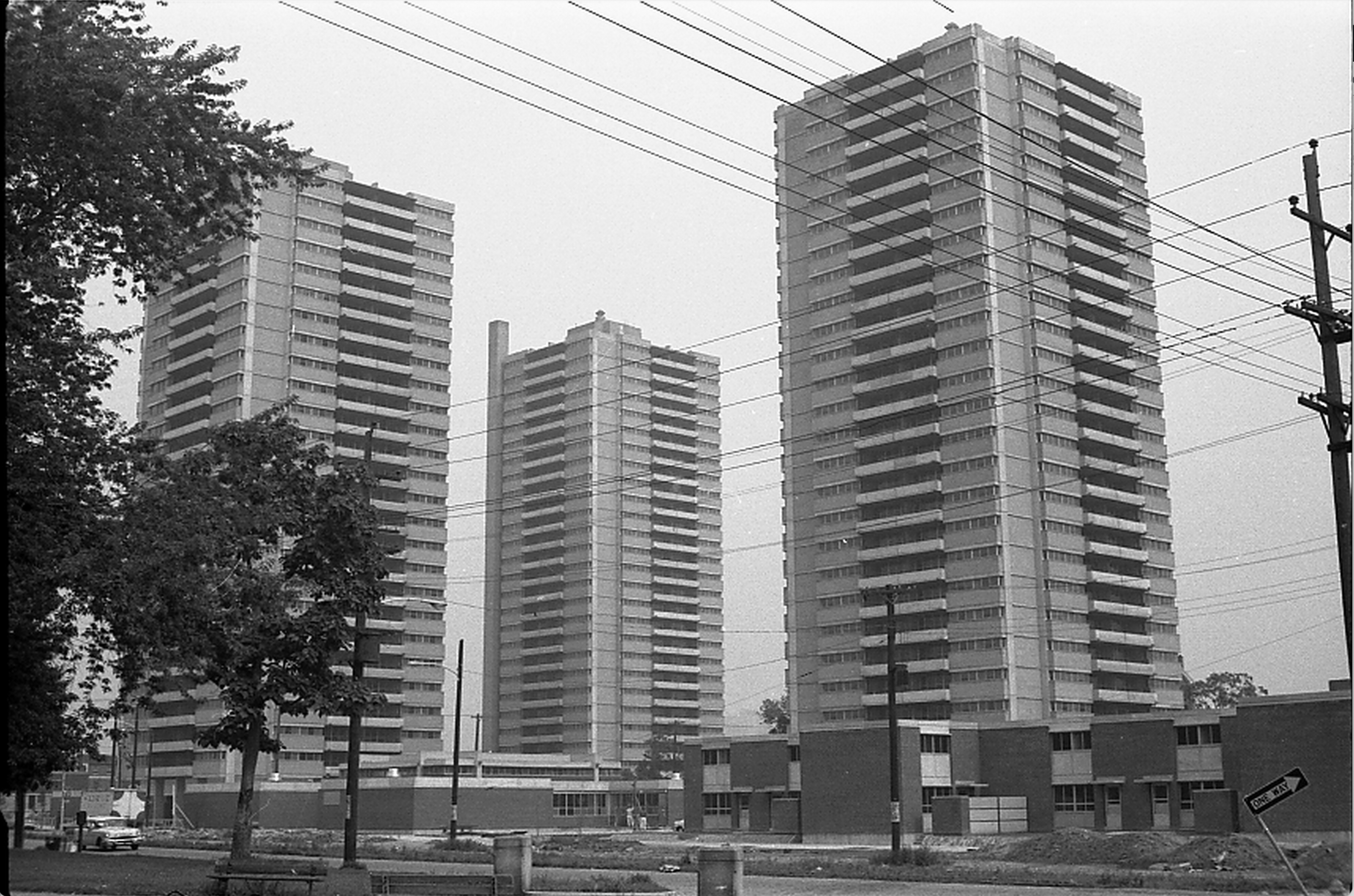
“S. 4th Street, Christian to Washington, 1964,” Courtesy of PhillyHistory.org. A view of the old public housing in Southwark before they were demolished.
Neighborhood revitalization, as the people of Southwark have asserted, should serve the needs of the community. In resisting efforts to displace them, residents of Southwark have made it clear that they should be prioritized in every growth and development plan of their neighborhood. In place of the demolished Southwark public housing that dated back to the 1960s now stands the Courtyard at Riverview Apartments. Queen Village residents had hoped for the demolition and a construction of new housing but not for low-income families. But the people of Southwark would not let themselves be displaced. The women who lived there formed the Southwark Plaza Tenant Council (SPTC). Resident Mrs. Rebecca Washington served as president of the council. She reached out to many politicians but did not receive any help. Knowing that they had to fight on their own, Mrs. Washington once asked her SPTC co-board member Delores Y. Green, “We want to keep it. But how do we keep it?”[note] Green-Hatcher, Inez. Interview. Conducted by Samantha de Vera, 6 October 2022.[/note] The women led a series of organizing efforts to advocate for their community and their homes, essentially fighting against the forces of gentrification. The planned construction of Courtyard at Riverview itself created tensions among unionized and non-unionized construction workers. The women of SPTC proposed a solution, equally dividing the work between the two groups. As the renovation soon came under way, Mrs. Washington fell ill, and Delores Y. Green became president of SPTC, a position she held for a long time. When Courtyard was erected to replace the former public housing, it remained preserved for low-income families and seniors.
In 2017, the Michaels Organization, the city of Philadelphia, and the Philadelphia Housing Authority worked together to renovate all 470 units, with the goal of improving the quality of public housing and preventing them from falling into disrepair. This renovation would not have been possible without the input and demands of the community. SPTC was instrumental in making this renovation happen. Its current president, Inez Green-Hatcher, is Delores Y. Green’s daughter, who grew up watching her mother go to endless organizing meetings and create programs for people at Courtyard. Today, SPTC’s service to the community is multifaceted; the Council has programs for children and seniors. Among them is a mentoring program that takes young adults on an immersion trip to Africa. The Council has also empowered the residents of Courtyard in unprecedented ways. As Inez Green-Hatcher told me, while the Philadelphia Housing Authority (PHA) owns the land on which Courtyard stands, Southwark Development Corporation—essentially the SPTC—owns and manages the building. The SPTC, in other words, evolved into a nonprofit managing company to keep Courtyard home to the people that most need it and fought for it. As a result, the authority over Courtyard and decision-making regarding it do not rest only on city officials but the very people who live there. Residents are therefore not left vulnerable to changes in city policies on housing and urban development. As Inez Green-Hatcher said, “They [residents] stand on their own.”[note] Green-Hatcher. Interview.[/note]
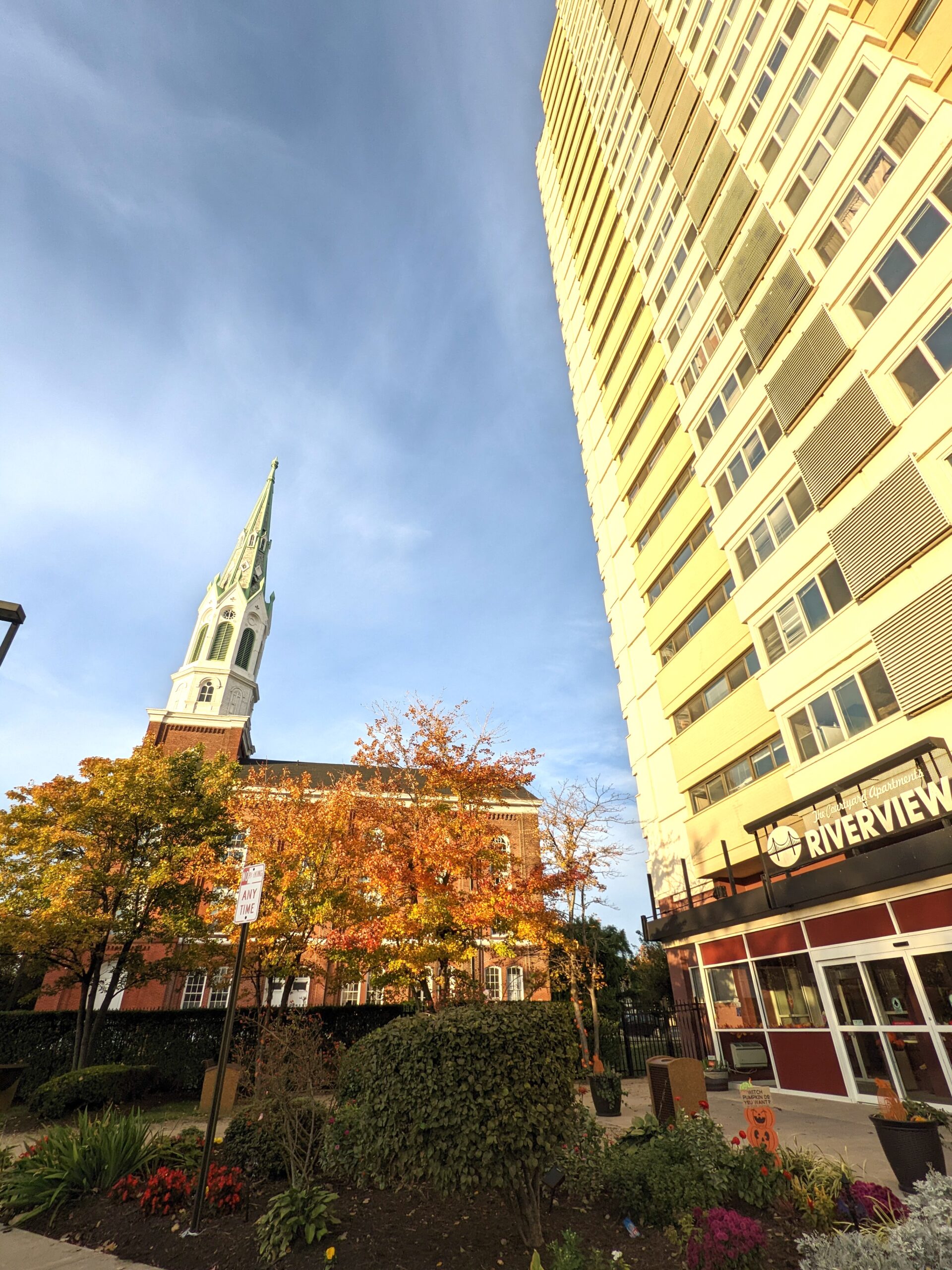
A view of Courtyard Apartments at Riverview. Photo taken by Samantha de Vera, October 29, 2022.
When I asked Inez Green-Hatcher about her mother’s drive and commitment, she said, “It’s the people.”[note] Green-Hatcher. Interview.[/note] Although Delores Y. Green had no previous experience in organizing a housing movement, in Southwark she found a community. Green worked alongside Rebecca Washington, Dorothy Erving, Mildred Leftwich, Rachel Fogan, and Irene Foust, Doreen Green, and Patricia Jones—women who were just as determined and fierce as she was in fighting for the people. The labors and achievements of the women of Southwark Plaza Tenant Council cannot be underplayed or understood in isolation. They created precedents for expanding tenant rights; for collaborations between residents and city officials; a new form of long-term residence security; and a model for fair and just public housing. In resisting and speaking against displacement, gentrification, and unfair housing projects, they mobilized to assert their place in this city and their voice in public policy. Today, the murals are displayed at Courtyard, honoring the activist and organizing tradition that animated the Colored Conventions movement and continues to galvanize Philadelphians.
To read more about the Women of Southwark Plaza Tenant Council, click on the next page.
CREDITS
Written by Samantha de Vera.