
MURAL EXHIBIT: THE COLORED CONVENTIONS MOVEMENT AND BEYOND IN PHILADELPHIA
THE NATIONAL CONVENTION OF THE COLORED MEN OF AMERICA: HELD IN WASHINGTON, D.C., ON JANUARY 13, 14, 15, AND 16, 1869
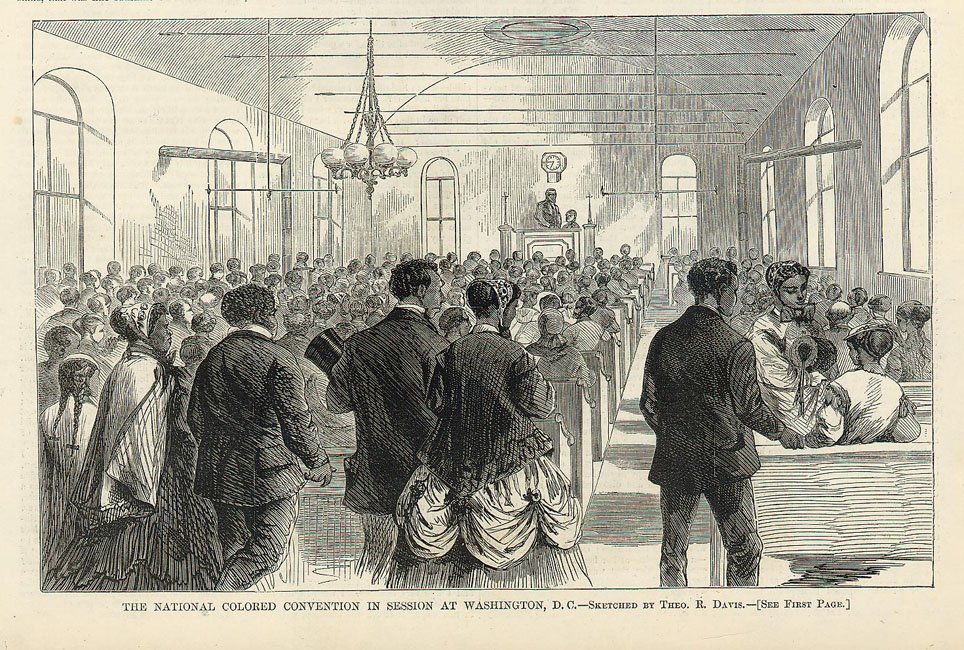
The mural depicts part of an illustration created by Theodore R. Davis for the magazine Harpers Weekly. While Black women certainly attended, actively participated, and supported the Colored Conventions movement, convention minutes and illustrations of the meetings underplay their roles. The illustration above, on the other hand, prominently shows Black women as audience members at the National Convention of the Colored Men of America in Washington, DC.
The National Convention of the Colored Men of America convened in Washington, DC, from January 13 through January 16, 1869 to assess the state of Black people in the US and the obstacles they encountered as a race. The delegates strategized toward securing suffrage, educational access, and protecting Black people’s constitutional rights. At the Convention, delegates appointed a committee to meet with President-elect Ulysses S. Grant at the army headquarters to send their congratulations. The committee, chaired by John Mercer Langston, subsequently met both with Grant and Vice President Schuyler Colfax. The committee relayed Grant’s reply before the Convention: “I thank the Convention of which you are the representatives for the confidence they have expressed, and I hope sincerely that the colored people of the nation may receive every protection which the laws give them.”[note] National Convention of the Colored Men of America (1869 : Washington, D.C.), “Proceedings of the National Convention of the Colored Men of America: held in Washington, D.C., on January 13, 14, 15, and 16, 1869.,” Colored Conventions Project Digital Records, accessed October 5, 2022, https://omeka.coloredconventions.org/items/show/452[/note] In this interview, John Mercer Langston also congratulated Colfax on behalf of the Convention. The delegates at the 1869 Colored Convention agitated for positions in public office under Grant’s administration, holding him accountable to his campaign promises. Shortly after the 1869 Colored Convention met at DC, Ebenezer Bassett, also a delegate, was appointed by Grant as Minister of the Republic of Haiti, and in 1871, Grant appointed Langston as a member of the Board of Health for Washington, DC. Both men were the first African Americans to hold such positions.
Notably, there was debate regarding the admittance of a Black woman delegate, “Miss H.C. Johnson” from Pennsylvania. Harriet C. Johnson was an educator and suffragist, who recently became the principal of the preparatory and ladies’ departments of Avery College in Pittsburgh. Henry Highland Garnet, also in attendance at the Convention, served as the college’s president during Johnson’s tenure. When Black Washingtonian John F. Cook objected to Johnson’s delegacy, one delegate reminded everyone “that this was a progressive age” and strongly implied the injustice of excluding women when they have yet to gain suffrage.[note] Ibid.[/note] Garnet dismissed Cook’s objection by demanding that they move on. Johnson thus served as the only woman delegate at the 1879 Colored Convention.
CREDITS
Written by Morgan Robinson and Samantha de Vera, Pennsylvania State University.