
HARPER AT 200
VICTORIA EARLE MATTHEWS
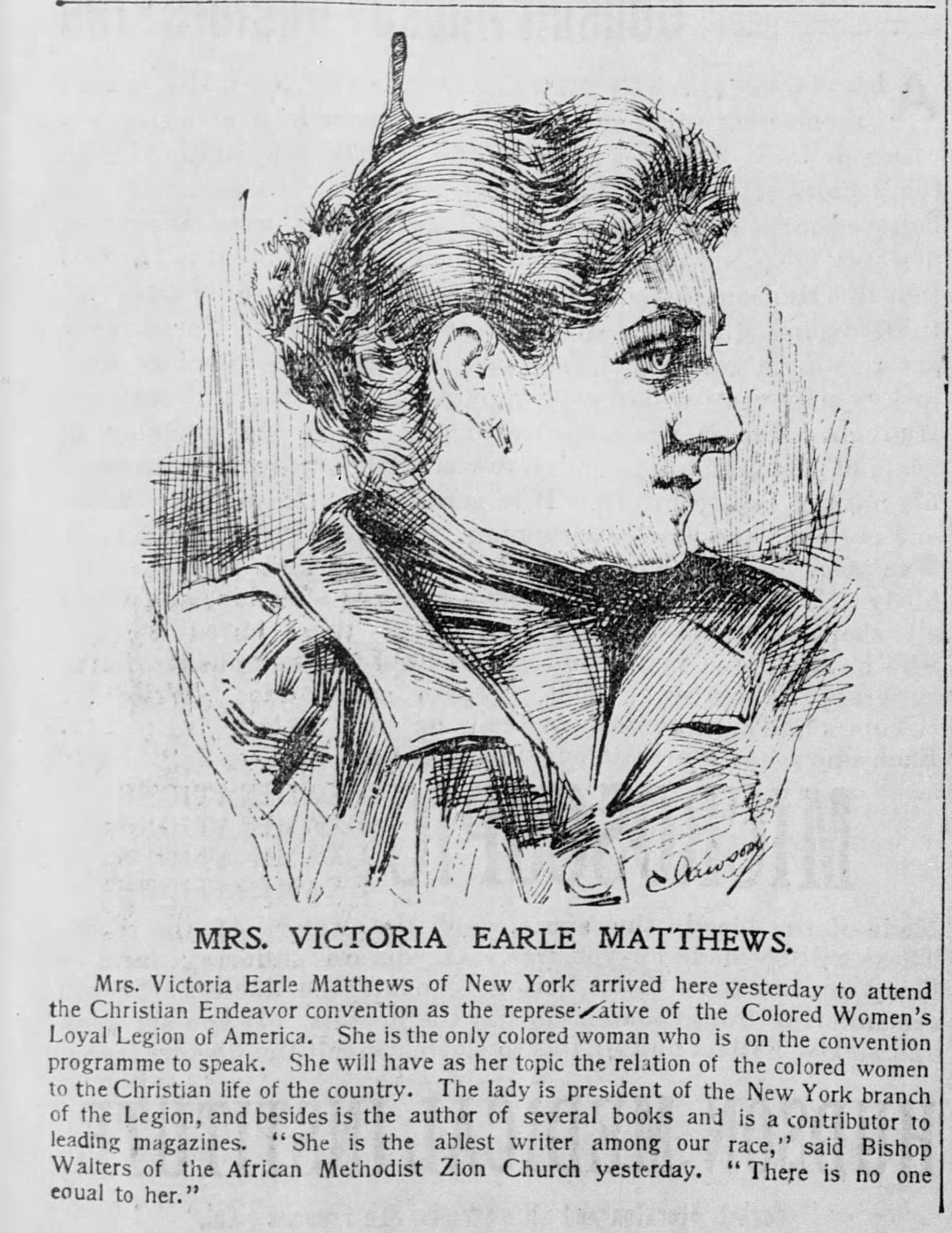
“Mrs. Victoria Earle Matthews,” The San Francisco Call and Post, July 8, 1897, p. 3. Newspapers.com
Victoria Earle Smith was born on May 27, 1861, into slavery in Fort Valley, Georgia to Caroline Smith, with her father suspected to be their enslaver. Smith fled from the plantation at the beginning of the Civil War but eventually returned to confront Georgia’s court system for custody of her children. Caroline was successful, taking Victoria and her sister to New York City. Victoria Smith excelled in public school until financial hardships forced her to leave and enter domestic service. Smith educated herself by using her employer’s library. At 18, she married William Matthews, a coachman from Virginia. Together, they had a son named Lamartine. [1]
By her early 20s, Victoria Earle Smith Matthews became a journalist for the Times, Herald, and Sunday Mercury, along with notable Black newspapers like the New York Globe and Boston Advocate. Smith went on to write short stories and novels such as Aunt Lindy, Eugenie’s Mistake, and Zelika often centering the lives of young Black women. Smith traveled considerably, giving lectures like “The Awakening of the Afro-American Woman” to teach social uplift and racial equality. [2]
Victoria Matthews founded the Woman’s Loyal Union in 1892 and played a critical role in supporting Ida B. Well’s anti-lynching campaign. She also helped establish the National Federation of Afro-American Women in 1895 and was instrumental in the merger of this organization with the National Colored Women’s League to form the National Association of Colored Women (NACW) in 1896. Matthews served as the first national organizer of the combined group from 1897 to 1899.
After the death of her son, Lamarine at 16, she took to mourning and began to focus on young Black women. Matthews, a white-passing mixed woman, investigated the system of sexual slavery that thrived in post-emancipation America. She traveled back down South to help young mothers with practical work like laundry, cooking, and cleaning, but also took her journalistic skills to uncover the trade that targeted poor Black girls to northern cities with the promise of work, only to be sold into sexual slavery. Smith later described this system as “a perfect network of moral degradation for the unknowingly unfortunate who may happen to fall into its toils.” [3]
Matthews took her work further, establishing the White Rose Industrial Home for Working Class Negro Girl in 1897 on East 86th Street in New York City. White Rose taught Black girls and women reading, writing, math, life skills, and most important to Matthews, Black history. [4]
Smith died in 1907 from tuberculosis.
References
[1] “Matthews, Victoria Earle (1861-1907).” BlackPast. Accessed September 20, 2024. https://www.blackpast.org/african-american-history/matthews-victoria-earle-1861-1907/
[2] C-SPAN. “Female Reporter Victoria Earle Matthews.” C-SPAN Video Library. Accessed September 20, 2024. https://www.c-span.org/video/?c4963387/female-reporter-victoria-earle-matthews
[3] Gross, Terry. “Victoria Earle Matthews.” Time, August 3, 2016. https://time.com/4429159/victoria-earle-matthews/
[4] Ibid.
Credits
Written by Victoria McKeller-Peoples