
HARPER AT 200
INTRODUCTION
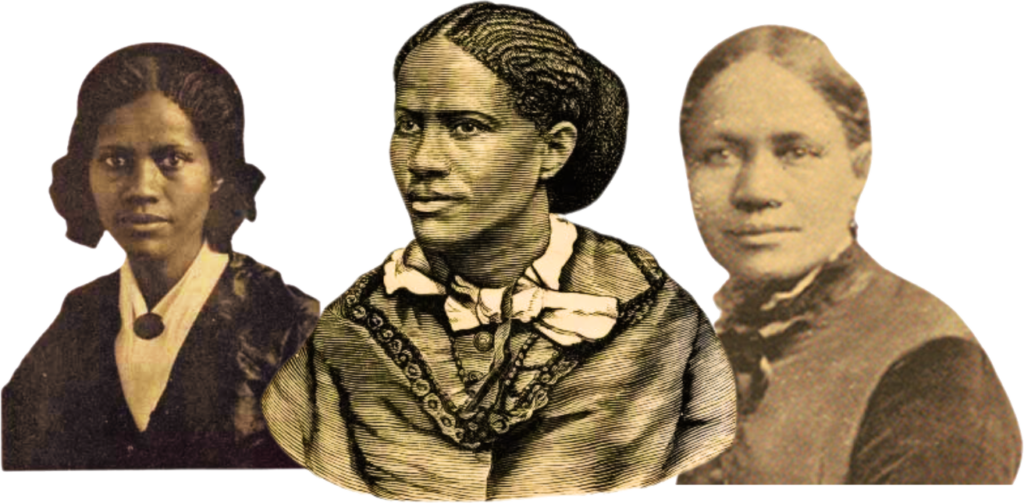
Image collage of Frances E. W. Harper. Sources: “Women of distinction – remarkable in works and invincible in character (1893).” Wikipedia, “Frances Ellen Watkins Harper, 1825-1911.” Library of Congress, “Frances Ellen Watkins Harper (1825–1911).” Library of Congress.
Frances Ellen Watkins Harper lived an extraordinary life as a creative artist, activist, and public intellectual. She was the most prolific African American writer who stood among the most distinguished orators of the nineteenth century. Born on September 24, 1825, much of Harper’s early life however remains a mystery due to the death of her parents by the time she was three years old. Harper’s grandmother had purchased her mother’s freedom; thereby ensuring that Frances Ellen was indeed “free from birth,” although she would grow up in Maryland where slavery still was widely practiced. She was raised by her uncle William J. Watkins and aunt Henrietta Russell Watkins in Baltimore within a tight-knit community of enterprising free Blacks. Counted among the city’s population were progressive political leaders, skilled craftspeople, and highly educated African Americans. Until about the age of fourteen, Frances Ellen attended the William Watkins Academy for Negro Youth, where she studied under her uncle’s strict supervision a curriculum of Christian theology, classical literature, and elocution. Such training prepared her well to become the kind of reformer her uncle envisioned, “one whose tongue should sting like a thousand scorpions, and whose pen should manufacture words of fire.”
As a young woman, Frances Ellen Watkins would indeed speak eloquently with a conviction of truth, often performing her poetry to bring attention to the causes of freedom. Watkins’ first known publication, Forest Leaves (c. 1840s), is evidence of the burgeoning talents she possessed. It was likely written and self-published while she spent time working as a seamstress and teaching full time to support herself. By the early 1850s, Watkins had left Baltimore under the threat of the Fugitive Slave Law which exposed even freeborn Black people to kidnapping and enslavement. Soon after leaving Maryland, she found work again teaching near Columbus, Ohio and later Little York (or York), Pennsylvania. Then, in 1854, she would make another bold decision to become an anti-slavery lecturer traveling throughout the northeast. She spent time living and working in Philadelphia with William Still and his family where she often encountered fugitives aided by the Underground Railroad. Still was the lead conductor of this intricate network of escape routes leading to freedom. Frances used the fugitives’ stories as rich material for her abolitionist lectures and writing. She continued to publish her poetry and short fiction in widely-circulating abolitionist newspapers, Black periodicals, and religious publications like The Liberator, Frederick Douglass’ Paper, Anglo-African Magazine, and The Christian Recorder. In 1859, Watkins penned one of the first short stories by an African American author, “Two Offers,” which features a strong-willed female protagonist contemplating her future (as a precursor to much of Watkins’ later works). Like her characterizations, it was her voice that also propelled Watkins’ reputation as a popular orator drawing large, diverse audiences as it was reported in newspapers across the country.
Married in 1860 to Fenton Harper while living in Ohio but soon became a widow in 1864, Frances Harper’s unconventional domestic life ended abruptly. Not content to be simply a farmer’s wife, she had remained active attending political conventions, publishing poetry, and delivering speeches throughout her marriage. When she became a single mother raising her daughter Mary (born 1862), Harper moved back to Philadelphia after the death of her husband but she continued working on the lecture circuit traveling once again across the nation throughout the Civil War and Reconstruction. This period also marked the most productive phase of her writing career with the publication of an epic poem Moses: A Story of the Nile (1869), poetry collections (Poems in 1871 and Sketches of Southern Life in 1872), and serialized novels Minnie’ Sacrifice (1869), Sowing and Reaping (1876-77), and Trials and Triumphs (1888-1889). Scholars are working to recover even more of Harper’s periodical literature, essays, and correspondences “lost” in archival collections.
Frances Watkins’ activism was boundless, converging the intersectionality of racism and sexism experienced by African American women in particular. She participated in colored conventions in Ohio, New York, and Delaware, where she took part in the deliberations among her male peers and her dignified oratory was duly recorded. She was the most prominent African American woman leading the suffrage movement. In 1866, Harper spoke at the National Woman’s Rights Convention in New York where she delivered her speech “We Are All Bound Up Together” calling on a unified coalition with white feminists to fight for gender and racial equality. She was also an outspoken temperance advocate. Concerned about the mental health and wellness of Black families and communities extending beyond slavery, Harper’s anti-drink reform literature removed the stigma of racial deviance and immorality to bring attention to alcoholism as an indiscriminate illness. While there are reviews of Harper’s extensive lecture tours, only a few full speeches have been recovered along with other materials (letters, photographs, and poems) scattered in archival collections. Fragments of her serialized novels and slim volumes of poetry is evidence of her steady progression to becoming a novelist with a broader vision as when Iola Leroy appeared in 1892, the now canonical work crowning Harper as a foremother in the African American literary tradition.
By the end of the nineteenth century, Frances Ellen Watkins Harper had become an iconic race woman inspiring generations of Black feminists like Mary Church Terrell and Fannie Barrier Williams. Harper’s leadership in the National Association of Colored Women (NACW) as an elder stateswoman motivated Williams to conceptualize the work of Black women intellectuals as “educators of public opinion.” At the World’s Congress of Representative Women, organized at the World’s Columbian Exposition in 1893, Harper’s speaking about “Women’s Political Future” was a clarion call for younger feminists internationally. Losing her daughter Mary in 1908 however would bring Harper’s storied life to a tragic end. She died the following year on February 22, 1911 and, as she had vowed years before, Frances Harper was buried in a free land where her legacy as a passionate freedom fighter charted the path for a rising generation of civil rights leaders into the modern era.
References
Frances Smith Foster, ed. A Brighter Coming Day: A Frances Ellen Watkins Harper Reader. New York: Feminist Press, 1990.
Margaret Washington, “Frances Ellen Watkins: Family Legacy and Antebellum Activism,” The Journal of African American History, Vol. 100, No. 1, “Centennial Perspectives, 1915–2015,” (Winter 2015), pp. 59-86.
Eric Gardner, “Frances Ellen Watkins Harper’s ‘National Salvation’: A Rediscovered Lecture on Reconstruction,” Commonplace: the journal of early American life, accessed September 30, 2024, https://commonplace.online/article/vol-17-no-4-gardner/
—– “Frances Ellen Watkins Harper’s Civil War and Militant Intersectionality,” The Mississippi Quarterly, Vol. 70/71, No. 4, Special Issue on Expanding the Archive in Civil War Studies (Winter 2017/2018), pp. 505-518.
William J. Watkins, “The Reformer,” Frederick Douglass’ Paper, April 7, 1854, rptd. Frances E.W. Harper’s Iola Leroy; Or, Shadows Uplifted, edited by Koritha Mitchell, Broadview Editions: Ontario, Canada, 2018: 327-328.
Johanna Ortner, “Lost No More: Recovering Frances Ellen Watkins Harper’s Forest Leaves,” Commonplace: the journal of early American life, accessed September 30, 2024,https://commonplace.online/article/lost-no-more-recovering-frances-ellen-watkins-harpers-forest-leaves/
William Still, The Underground Railroad, 1872, Internet Archive, https://archive.org/details/DKC0088
Doveanna S. Fulton, “Sowing Seeds in an Untilled Field: Temperance and Race, Indeterminacy and Recovery in Frances E.W. Harper’s Sowing and Reaping,” Legacy, Vol. 24, No. 2. (2007), pp. 207-224.
Frances Ellen Watkins Papers & Collections, Black Women’s Organizing Archive, Penn State University’s Center for Black Digital Research (#DigBlk), https://bwoaproject.org/harper/papers/
Credits
Written by Sherita L. Johnson