
HARPER AT 200
HARPER AND THE COLORED CONVENTIONS
Convention of the Colored Men of Ohio, Held in the City of Cincinnati, on the 23d, 24th, 25th and 26th days of November, 1858
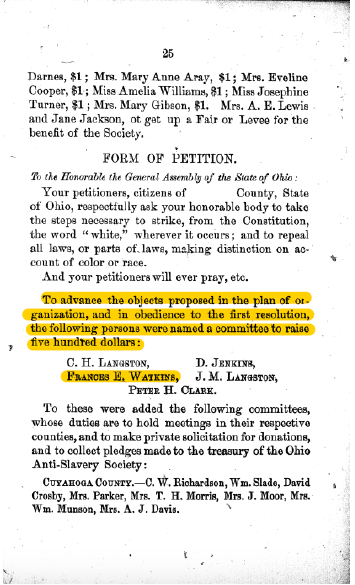
Convention of the Colored Men of Ohio (1858 : Cincinnati, OH), “Proceedings of a Convention of the Colored Men of Ohio, Held in the City of Cincinnati, on the 23d, 24th, 25th and 26th days of November, 1858.,”
Frances Ellen Watkins Harper played a significant role in the 1858 Convention despite being the sole woman delegate. Her involvement marked a milestone in women’s participation in the movement; only three years prior, Mary Ann Shadd Cary’s delegacy at the 1855 Philadelphia convention was heatedly debated, but Harper’s influence extended beyond her address, as she made substantial financial contributions and actively served in a committee that raised 500 dollars.
Newspapers were quick to laud Harper’s oratory skills. “Wilmington Republican” praised her “distinctness and enunciation, and clearness of argument” in discussing the “condition of the African race in our country.”[1] Her speeches often addressed slavery’s impact.
Harper’s appearance drew significant attention, especially from women. As one observer noted: “Our women turned out pretty largely to hear her, and I doubt not they sympathized with all she said. If the women once get right, and to moving, you may be sure it will not be without its influence upon the man.”[2] The writer was further amazed of Watkins’s presence and admits “Never before…could the M.E. Church be had to hold an anti-slavery lecture in of the character of Miss Watkins favored us with.”[3]
Despite her prominence, official records often minimized Harper’s contributions. Nevertheless, her early activism and powerful speeches paved the way for her continued involvement in the anti-slavery movement and women’s rights advocacy.
National Convention of Colored Men; held in the City of Syracuse, N.Y.; October 4, 5, 6, and 7, 1864; with the Bill of Wrongs and Rights; and the Address to the American People
The 1864 Syracuse Convention as, Eric Gardner, notes “would leave any student of African American culture starstruck.”[4] Among the Convention’s delegates were Frederick Douglass, Henry Highland Garnet, John Mercer Langston, and many more. The Syracuse Convention was held in the midst of the Civil War, as African Americans throughout the nation anticipation the abolition of slavery and Black activists pursued political equality and voting rights for Black men. The convention established the National Equal Rights League, and audiences were moved by speeches from Garnet and Douglass. Each of these delegates’ words were adequately recorded in the minutes of the convention, however, such is not the case for two women speakers—Frances Ellen Watkins Harper and Edmonia Highgate. The minutes, in fact, devote incredibly terse statements about their addresses:
Mrs. Frances Ellen Watkins Harper was then introduced, and spoke feelingly and eloquently of our hopes and prospects in this country.[5]
While the financial visit was pending, a song was called for, and sung finely by Mr. Robert Hamilton. The President then introduced Miss Edmonia Highgate, an accomplished young lady of Syracuse. Miss Highgate urged the Convention to trust in God and press on, and not abate one jot or tittle until the glorious day of jubilee shall come.[6]
Harper attended the convention shortly after she was widowed, marking her comeback in the lecturing circuit. Harper had not been as active during her marriage to Fenton Harper, as the couple were preoccupied in raising four children and taking care of their farm. From then on, Harper traveled extensively, lecturing throughout the country. While the contents of her speech at the 1864 convention remains a mystery, one can get a sense of what Harper spoke about by reading reports about her speeches around the same time. Explore Harper’s travels and speeches on the “Lecturing Circuit” page featuring an interactive map.
Convention of Colored People Held in Dover, Delaware, 1873
The last known convention where Harper spoke was at the Convention of Colored People in Dover, Delaware in 1873. The convention minutes record Harper as “being present was invited to address the Convention. She spoke in eloquent terms of the efforts of the colored people, and hoped they would not cease until equal rights were in fact within the reach of all.”[7] Following the adoption of the address, “the convention was entertained by Mrs. F.E.W Harper” as she read from her poetry book Sketches of Southern Life. While the proceedings record a substantial amount of information, we can find even more highlights of Harper’s speech through various newspaper covering the convention.
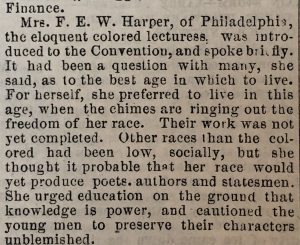
Delaware State Journal, January 9, 1873. Delaware Historical Society.
“She urged education on the ground that knowledge is power, and cautioned the young men to preserve their characters unblemished.”
The Delaware State situates Harper’s speech in relation to social and political climate during that time. The article identifies Harper as “the eloquent colored lecturess.”[8] Harper responded to this question by stating “she preferred to live in this age, when the chimes are ringing out the freedom of her race. Their work was not yet completed. Other races than the colored had been low, socially, but she thought it probable that her race would yet produce poets, authors and statesmen. She urged education on the ground that knowledge is power, and cautioned the young men to preserve their characters unblemished.”[9]
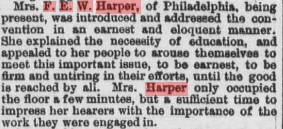
Wilmington Daily Commercial, 10 January 10, 1873. Chronicling America: Historic American Newspapers. Lib. of Congress.
The Wilmington Daily Commercial also covered the 1873 Convention speech, emphasizing how Harper “explained the necessity of education, and appealed to her people to arouse themselves to meet this important issue, to be earnest, to be firm and untiring in their efforts, until the good is reached by all.”[9] Harper’s speech at the 1873 speech uplifted Convention attendees through her encouraging words to present and future generations despite the ongoing fight for civil rights. While this may have been Harper’s last-known speech at a Colored Convention, Harper continued to give lectures and fight for civil rights and women’s rights across the United States until her death in 1911.
Credit
Written by Monet Timmons
References
[1] Wilmington Republican. “Frances E. Watkins,” The Liberator, December 9, 1856,19th Century U.S. Newspapers
[2] “Miss Watkins at New Lisbon,” Anti-Slavery Bugle, October 30, 1858. Chronicling America: Historic American Newspapers. Lib. of Congress.
[3] Ibid.
[4] Eric Gardner, “A Word Swiftly Spoken: Edmonia Highgate, Frances Ellen Watkins Harper, and the 1864 Syracuse Convention,” in The Colored Conventions Movement: Black Organizing in the Nineteenth Century, eds. P. Gabrielle Foreman, James Casey, and Sarah Patterson (Chapel Hill: University of North Carolina Press, 2020), 72.
[5] National Convention of Colored Men (1864 : Syracuse, NY), “Proceedings of the National Convention of Colored Men; held in the City of Syracuse, N.Y.; October 4, 5, 6, and 7, 1864; with the Bill of Wrongs and Rights; and the Address to the American People,” Colored Conventions Project Digital Records, accessed October 2, 2024, https://omeka.coloredconventions.org/items/show/282.
[6] The Convention of Colored People (1873 : Dover, DE), “Proceedings of the Convention of Colored People Held in Dover, Del., January 9, 1873.,” Colored Conventions Project Digital Records, accessed October 2, 2024, https://omeka.coloredconventions.org/items/show/297.
[7] Delaware State Journal, January 9, 1873. Delaware Historical Society.
[8] Wilmington Daily Commercial, 10 January 10, 1873. Chronicling America: Historic American Newspapers. Library of Congress.