
Harper AT 200
THE WATKINS FAMILY IN BALTIMORE
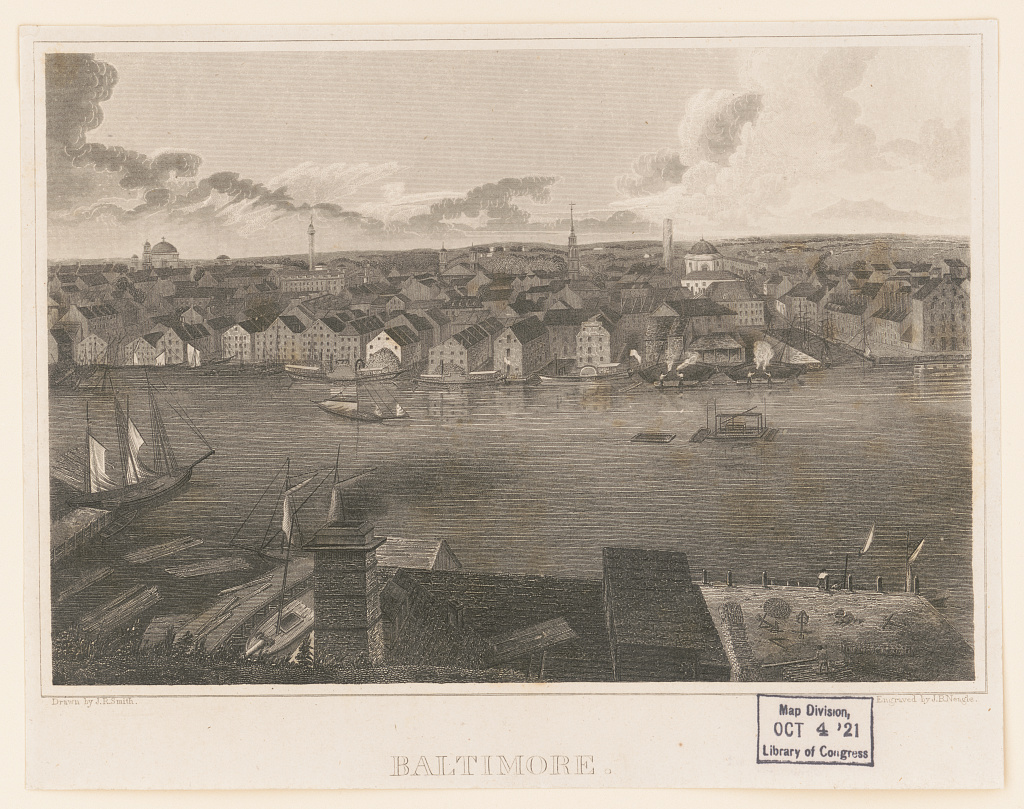
Baltimore, [No Date Recorded on Shelflist Card]. Source: Library of Congress.
Frances Ellen Watkins Harper developed her passion for learning, activism, and writing against the backdrop of Baltimore, Maryland, where she was born and had deep family roots. After Harper’s parents died in 1828, she was raised by her maternal uncle, Reverend William Watkins and his wife, Henrietta (née Russell. Her father was Sharp Street Trustee Richard Russell). The Watkinses were a prominent free Black family who used their status to help educate young Black people and support emancipated and self-emancipated persons, while fighting for abolition of the still-enslaved.
William Watkins Sr. was born in Baltimore in 1801, beginning his education in the Bethel Charity School, an institution founded by formerly enslaved writer and educator Daniel Coker at the Sharp Street Church. When Coker left for Liberia in 1820, Watkins took over his role as headmaster and minister at the church, and by the time he was 25, Watkins merged the Bethel Charity School with his own school, the Watkins Academy of Negro Youth. His school educated more than 50 free Black students per year—an incredible feat, given that Maryland was still a slave state, in spite of Baltimore having the largest population of free Black people of any American city at the time.[1]
In the 1820s, Watkins Sr. married Henrietta Russell. Henrietta’s father, Richard Russell, was a trustee of the Sharp Street Church like Watkins Sr.’s father. It is likely that Henrietta Watkins and William Watkins Sr. grew up together. Henrietta was born and lived her whole life in Baltimore. Little is known about Henrietta or her background, other than the fact that she was born to a free family, and her father was a blacksmith. Henrietta Watkins raised Harper as her own.
As a child, Harper was steeped in a culture of Black activism. Her aunt and uncle had eight children, the oldest of which was William Watkins Jr., born only one year after Frances. The two were raised like siblings and attended Watkins’ academy, where they developed a shared interest in continuing Watkins Sr.’s activist work. Harper was educated at the school until she was thirteen years old. She chose to work outside the home, which was common for children of her age in the nineteenth century. Harper found work as a seamstress for a white family who owned a bookstore, where she spent much time continuing to develop her love of reading.[2]
While Harper began to lend her own passion and skills to the abolitionist movement, Watkins Jr. also continued his activism in various ways, joining the American Reform Society and speaking at the National Conventions of Free Colored People in Philadelphia in 1833 and New York in 1834. He also wrote articles for Black newspapers including The Liberator and Freedom’s Journal, sometimes using the pseudonym “A Colored Baltimorean.”[3] He remained a staunch opponent of both slavery and colonization, disagreeing with his childhood mentor’s emigration to Liberia.[4] Watkins eventually left Baltimore for Toronto in 1852, and opened a grocery store while continuing to write for Black newspapers, changing his pseudonym to “The Colored Canadian.” Watkins died in 1858, but his influence on Harper is undoubtedly present in her continued work as an activist, educator, writer, and lecturer.
The Watkins Family
Click the buttons below to read more about the Watkins family.
REFERENCES
[1] Ortner, Johanna. “Lost no More: Recovering Frances Ellen Watkins Harper’s Forest Leaves,” Summer 2015, https://commonplace.online/article/lost-no-more-recovering-frances-ellen-watkins-harpers-forest-leaves/?print=print.
[2] Alexander, Kerri Lee. “Frances Ellen Watkins Harper.” National Women’s History Museum. 2020. www.womenshistory.org/education-resources/biographies/frances-ellen-watkins-harper.
[3]“William Watkins.” Archives of Maryland. 8 July, 2011. https://msa.maryland.gov/megafile/msa/speccol/sc5400/sc5496/002500/002535/html/002535bio.html.
[4]“William Watkins.” Archives of Maryland.
CREDITS
Written by Rachel Fernandes and Samantha de Vera.